Chemical storage problems are rarely caused by ignorance of the rules. They are caused by a store that grew around deliveries rather than around the products, by a shelf that was labelled when there were four chemicals and now holds twelve, and by a safety data sheet library that is filed somewhere other than where the products are used. Cleaning chemical storage requirements Australia wide come back to the same principle: build the store around the safety data sheets, because the sheet tells you what each product needs.
This guide is written for facility managers, cleaning supervisors and business owners responsible for chemical storage in commercial buildings, schools, aged care, hospitality and cleaning businesses. It covers how to work out which requirements apply, how to separate incompatible products, and what to keep where.
Cleaning Chemical Storage Requirements Australia: Build the Store Around the SDS
Start with the safety data sheets for the products the site actually holds, not with a generic storage diagram. Each sheet states the hazards, the storage conditions and the incompatibilities: which products must not be stored together, whether a product needs ventilation, whether it must be kept away from ignition sources, and whether it degrades in heat or light.
Then map the store against those requirements. The map answers the practical questions: where the concentrates live, where the working solutions are made up, where the personal protective equipment is kept, where the spill kit is, and where the sheets are held so that they are available to the person who needs them rather than to the person who filed them.
The result is a store that reflects the products on the shelf. Where the range changes - a new descaler, a different disinfectant, a solvent-based spotter - the map is updated and the staff are told, because the one thing that makes a compliant store unsafe is a shelf that no longer matches its label.
Which Chemical Storage Requirements Apply to Your Site?
Start with the products, because they set the obligation.
Australian work health and safety duties require hazardous chemicals to be managed according to their hazards, which means the storage arrangement follows from the safety data sheets rather than from a single template applied to every store.
The general framework sits in the Work Health and Safety Regulations 2011, and the regulators publish practical guidance for employers, including WorkSafe Victoria's hazardous substances material and the resources at SafeWork NSW. A cleaning store typically holds corrosive products such as acids and caustics, oxidising products such as chlorine-releasing bleaches and peroxides, and sometimes flammable solvents for spot cleaning, and each family carries its own storage requirements.
Where a site stores flammable liquids above the small quantities that domestic use covers, additional requirements apply to the storage itself, including separation from ignition sources and, in some cases, dedicated cabinets. Standards Australia lists the relevant reference as AS 1940, and where the site also stores larger quantities of other dangerous goods, state dangerous goods requirements may apply as well. Where the products are merely corrosives and detergents in normal commercial quantities, the obligation is still real, but it is met by separation, labelling, ventilation, spill control and access to the sheets.
Read the Label and the Current Australian SDS
Two documents drive everything else. The label stays on the container and identifies the product, the hazards and the first aid instructions. The safety data sheet holds the detail: composition, hazards, handling, storage conditions, incompatibilities, personal protective equipment and disposal.
Keep both current, and keep them where the products are used. A sheet library in an office that nobody opens during a shift is a filing obligation rather than a control. Freshway Supplies publishes safety data sheets by brand through its SDS library, organised so the sheet matching the product on the shelf can be found quickly.
Where a product has been reformulated, the sheet and the label change, and the store needs updating with them. Rotation matters for the same reason: chlorine-based products lose strength over time, and a container that has been sitting for a year may not perform as the label implies. Stock that is used in order of arrival is both a cost control and a safety control.
Separate Products by Incompatibility, Not Alphabetically
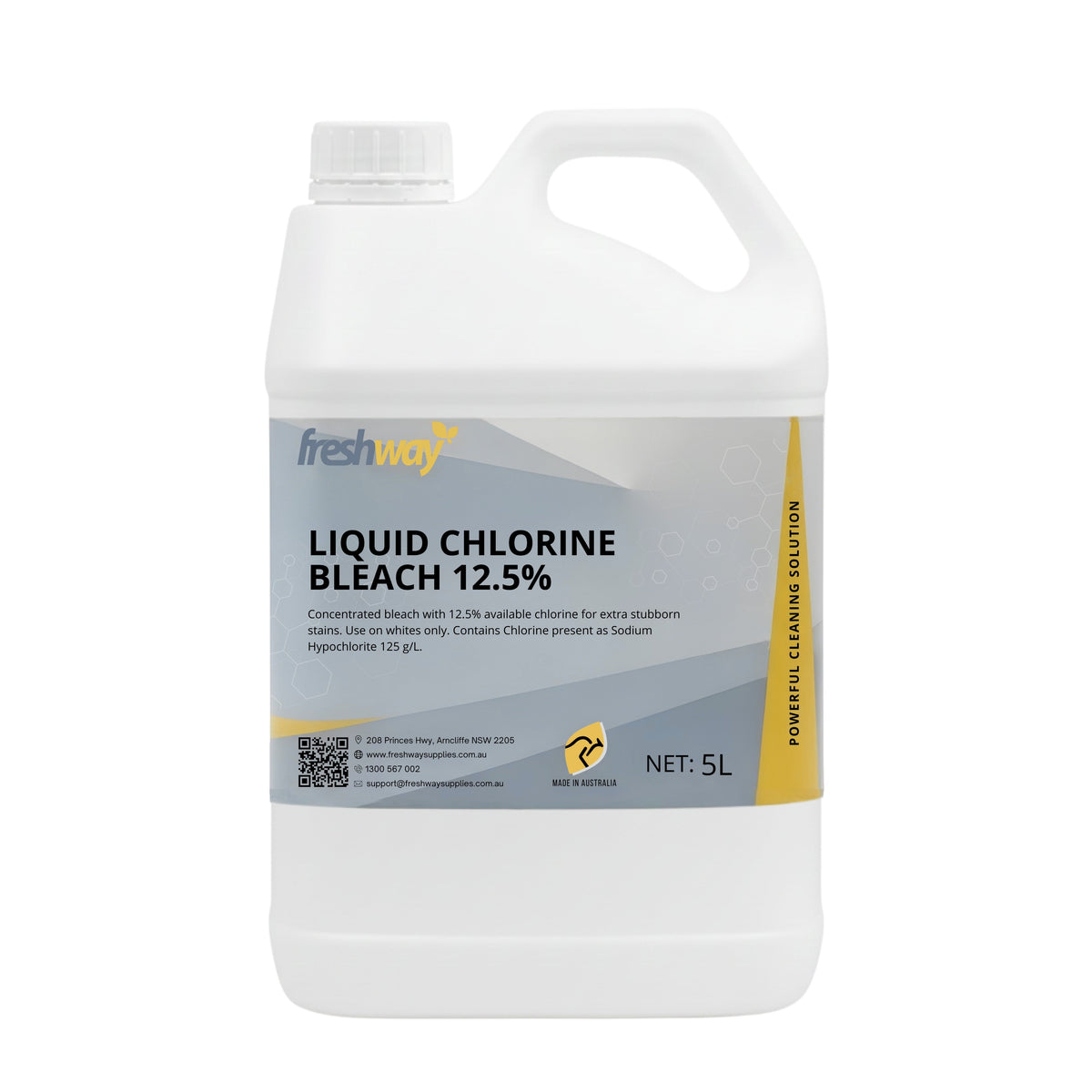
The most important storage decision is what is stored next to what. Acids and chlorine-releasing products must be separated so that a leak, a spill or a mistaken decant cannot bring them together, because the combination releases a hazardous gas. Oxidisers belong away from flammables and from organic materials. Solvents belong away from ignition sources and from anything that could react with them.
The practical arrangement in a cleaning store is by family rather than by brand or alphabet: acids together, caustics together, chlorine-releasing products together, solvents in their own cabinet, and neutral detergents on their own shelf. Secondary containment - trays under concentrates - contains a leak before it reaches the floor or mixes with something else.
Label the shelves with the family, not just with the product name, and make sure the working solutions are made up in labelled containers with the dose recorded. An unlabelled spray bottle is the single most common source of a mixing incident in a cleaning store, because it carries no product name, no hazard information and no dose.

Ventilation, Spill Control and Signage
The store needs enough ventilation to keep vapour concentrations low, which in practice means a door or a vent rather than a sealed cupboard, particularly where chlorine and solvent products are held. Where the store is small and the products strong, keeping the door open during stocking and never decanting in a closed space is a simple control that prevents most exposure incidents.
Spill control follows from the products. A spill kit matched to the chemistry on site - absorbent for liquids, a neutraliser where the product requires one, and the personal protective equipment the sheets specify - turns a spill into a five minute task rather than an evacuation. The kit belongs near the store, not in a central cupboard on another floor.
Signage completes the arrangement: the store is identified, the hazards are marked, and the sheet location is indicated. Eye wash facilities or a suitable alternative should be accessible where corrosive products are handled, and the first aid instructions on the sheets should be the version staff are trained to follow.
Dispensing, Decanting and the Chemical Register
Decanting is where a well-arranged store degrades. Where a site decants concentrates into secondary containers, those containers need to be labelled with the product name, the dose and the hazard information. Where dispensing systems are used, they should be calibrated and the working solutions made up for the shift rather than stored indefinitely.
A simple register - the product, the quantity held, where it is stored, and the date the sheet was last checked - makes the store auditable and makes ordering accurate. It also makes the risk assessment easier, because the register tells you what is actually on site rather than what the last specification assumed.
Disposal belongs in the same routine. Diluted cleaning solution and rinse water usually go to the sewer under the conditions the local water authority sets, while concentrates, solvents and contaminated absorbents follow a different route. The NSW EPA water guidance sets out what should not enter stormwater, and the local water authority sets trade waste conditions for the site. The practical guides to choosing, diluting and storing commercial chemicals cover how the store fits into the wider method.
Storage, Training and Staff Instruction
Training turns a store into a system. Staff need to know what is in the store, which products must never be combined, how the sheets are accessed, where the spill kit is, and what to do when a container is damaged or a product runs out. That is a short induction, repeated whenever the product range changes.
The instruction that matters most is the simplest: never decant into an unlabelled container, and never mix products. Those two rules prevent the majority of incidents in cleaning stores, and they are easy to check during a walk-through. Where staff are new or casual, the store should be arranged so that the correct behaviour is also the easiest, because the layout teaches the method.
Record the induction. Where a client or an auditor asks how the site manages chemicals, the answer is the store arrangement, the sheets, the register and the training records, and the record is usually what distinguishes a managed store from a tidy one.

Calculate the Cost of Poor Storage
Storage looks like an overhead until it fails. The costs of a poor arrangement are predictable: product wasted through over-dosing and spoilage, stock that cannot be found and is re-ordered, labour spent searching a disorganised store, and the far larger cost of an incident involving a mixed or misidentified product.
Three lines make the case in a budget review. Consumption against the specification, which shows how much product is being used beyond the approved dose. Time spent per shift locating products and making up solutions. And the cost of the incidents that have occurred or nearly occurred, including lost time, clean-up and the disruption to the site.
Against those, a store that is arranged by family, labelled by shelf, supplied with a spill kit and supported by accessible sheets is inexpensive. Where the site is audited by a client, an insurer or a regulator, it is also the difference between a straightforward conversation and a long one.
A Store Audit Scorecard
Walk the store quarterly and score it against the same list, so drift is visible before it becomes an incident.
- Separation: acids, chlorine products, caustics and solvents in their own labelled positions, with secondary containment under concentrates.
- Labelling: every container labelled, including working solutions, with the dose written on the bottle.
- Documentation: a current safety data sheet for every product on the shelf, accessible to staff during the shift.
- Register: products, quantities and storage positions recorded, with stock rotated so older product is used first.
- Ventilation and spill control: adequate airflow, a stocked spill kit near the store, and eye wash access where corrosives are handled.
- Training: induction records current, with the two core rules visible in the store.
Score it honestly rather than generously. The audit is only useful if it finds the shelf that has quietly become a mixed shelf, because that is the shelf an incident will come from.
Questions we get asked most
- How should cleaning chemicals be stored?
- According to their safety data sheets. In practice that means labelled containers, families separated so acids, chlorine-releasing products, caustics and solvents cannot meet, secondary containment under concentrates, adequate ventilation, a matched spill kit nearby and current sheets accessible where the products are used.
- Do I need to keep safety data sheets on site?
- Yes, and they need to be accessible to the people using the products rather than filed elsewhere. Keep a current sheet for every product on the shelf, replace them when a product is reformulated, and make sure the working solutions made up on site can be traced back to the sheet that covers them.
- Can I store bleach next to acid descalers?
- No. Chlorine-releasing products and acids must be separated so that a leak, a spill or a mistaken decant cannot bring them together, because the combination releases a hazardous gas. Give each family its own labelled position on the shelf rather than arranging the store by brand or alphabetically.
- Do I need a chemical register?
- A simple register of what is held, in what quantity, where it is stored and when the sheet was last checked makes the store auditable, makes ordering accurate and makes the risk assessment reflect what is actually on site rather than what the last specification assumed.
Conclusion
Build the store around the safety data sheets. The sheets tell you which products need separation, which need ventilation, which degrade with age and which must never meet, and the store arrangement follows from those facts rather than from shelf space.
Keep the sheets where the products are used, label every container including working solutions, contain concentrates in trays, keep a matched spill kit close by, and never mix or decant into unlabelled bottles. Audit the store quarterly against the same list, and the arrangement stays as safe as the day it was built.
Compare cleaning chemicals with safety data sheets available for every product, and ask the Freshway team about storage and dosing support for your site.