Burnishers and polishers are bought for the same reason and fail for the same reason: someone has seen a floor with a high gloss and assumed the machine produces it. A burnisher produces gloss by generating heat and friction on an existing finish at high speed; a polisher works a finish, a cleaner or a pad at lower speed with more control. Choose the wrong one and the finish either never develops or is damaged a little with every pass.
This guide is written for facility managers, cleaning contractors and procurement teams specifying floor care equipment for retail, healthcare, education, aged care and commercial buildings. It covers the finish decision, the pads and chemistry that go with it, and the practical constraints that decide which machine a site can actually run.
Floor Burnisher vs Floor Polisher: Start With the Failure Mode
Identify what is failing on the floor before comparing machines. Four complaints cover most sites. The first is gloss that fades within days, which usually means the finish lacks a maintenance program rather than the machine being wrong. The second is a finish that has dulled unevenly, which points to traffic patterns and pad choice. The third is black heel marks and scuffing, which is a pad and speed question. The fourth is a floor that looks dirty after burnishing, which means soil is being pressed into the finish instead of removed.
Each failure has a different fix. Dull traffic lanes need a defined maintenance cycle with the right pad. Marks need cleaning before polishing. A floor that never glosses may have a finish that is not designed to be burnished at all, or a finish that has been worn through, in which case polishing will not bring back what is no longer there.
Diagnosing first also tells you what the machine has to do. A retail floor that must look its best at opening needs speed and consistent coverage, which suits a high-speed burnisher on a sound floor finish. A site maintaining several different finishes, or working with a cleaner and a pad to restore appearance, needs the control a polisher provides. Most medium-sized sites need neither as their first purchase: they need the cleaning step underneath both.
Start With Floor Type, Finish and Soil
Floor type sets the ceiling for what any machine can achieve. Vinyl and linoleum with a polymer finish respond well to burnishing and are the classic application. Sealed concrete and epoxy behave differently: they can be polished, but heat and aggressive pads can damage some coatings. Terrazzo and stone are polished rather than burnished in the usual sense, and they have their own process and chemistry. Safety flooring, matting and unsealed surfaces are not burnishing candidates at all.
The finish itself is the deciding factor. A burnishable polymer finish responds to high speed with a gloss-producing pad. A finish that has been applied thinly, or one that has been cleaned with an alkaline product that stripped the surface, will not develop gloss regardless of the machine. Where the finish is unknown, a test area under a machine that can run at both speeds settles the question in minutes.
Soil is the third input. Burnishing presses whatever is on the floor into the finish, so the cleaning step matters more than the polishing step. Where dust, grit or detergent residue is left behind, high-speed passes drive it into the surface and produce the swirl marks that lead sites to assume the machine is at fault.
Which Machine Suits Which Finish?
Match the machine to the finish, then to the maintenance cycle the site will actually run.
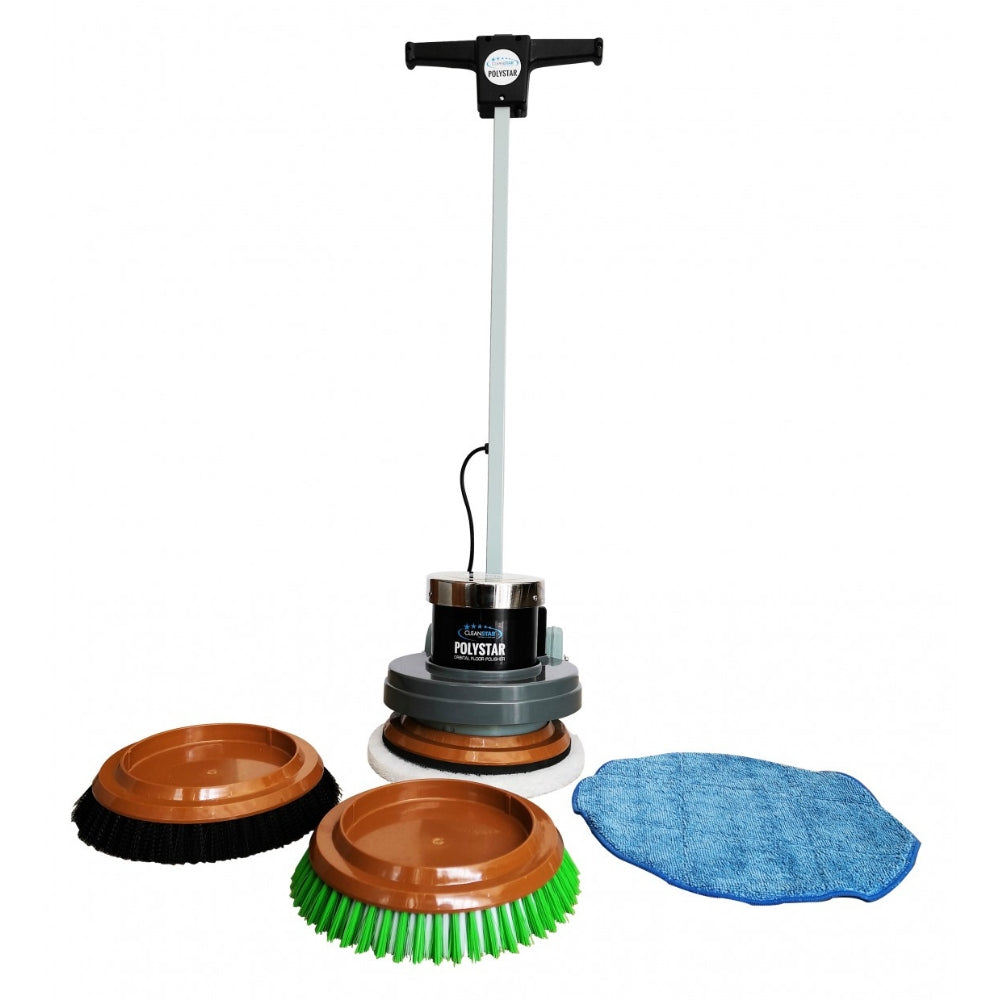
A high-speed burnisher suits a sound, burnishable finish that is cleaned first and maintained on a cycle, while a lower-speed polisher suits a broader range of finishes, tack cloth work and pad-driven cleaning where control matters more than gloss.
In practice, burnishers are used as a maintenance tool on retail, hospitality and health floors where appearance is part of the building's standard, and they are run frequently rather than occasionally, because gloss developed once and then neglected disappears quickly. Polishers are the more versatile machine: they clean, spray-buff, apply finish and restore floors where a single machine has to cover several tasks and finishes.
The practical recommendation for most sites is to buy the polisher first and add a burnisher when appearance standards justify a dedicated high-speed machine, rather than to buy a burnisher and expect it to clean, restore and polish. Where a site already has a scrubber for cleaning, a burnisher becomes the appearance tool that completes the system, and the two machines are complementary rather than competing.

Choose Pads, Brushes and Chemistry Together
Pads decide what a machine does to a floor, more than the machine does. A burnishing pad generates the friction that produces gloss. A buffing pad maintains appearance. A cleaning pad, used wet, replaces or supplements a brush. A stripping pad, used with stripper, removes finish - and a stripping pad run accidentally on a finished floor will do exactly that.
Chemistry has to match the pad and the finish. Neutral cleaners suit daily maintenance on finished floors because they leave no residue to interfere with gloss. Alkaline products lift grease but can attack some finishes with repeated use. Ammonia and solvent-based products strip the wax or polymer that the floor depends on. Restorers, spray buffs and finishes are used with the machine rather than instead of it, and their labels state the dilution and the pad they suit.
Colour and grade systems exist for a reason: they let a crew know what a pad will do before it touches the floor. Where a site stores pads loose in a cupboard, the wrong pad eventually gets used on the wrong floor, and the damage appears as a dull patch that has to be refinished. Freshway Supplies stocks pads and floor care chemistry alongside the machines, and this overview of floor scrubbers and polishers covers how the machines fit together.
Size Productivity Around the Real Route
A burnisher is only productive where the operator can move continuously over a sound floor. Restricted movement - racking, fixtures, tenancy boundaries, doorways, changes of level - turns open floor area into labour, and a machine that covers a wide swathe in a straight line may cover less in a cluttered space than a smaller machine that keeps moving.
Pad width, speed and weight all interact. A wider pad covers more ground per pass and needs more power and more operator strength to control; a machine that pulls or wanders at speed is fatiguing and produces uneven results. Weight helps develop gloss on some finishes and increases the risk of marking on others, which is why a machine that suits a vinyl floor in a shop is not automatically right for a hospital corridor.
Plan the route and the timing as part of the purchase. Burnishing is usually done outside trading hours on retail floors because of noise and slip risk, and the machine has to suit that window: how many square metres can be covered in the time available, and how many operators will be needed to do it. Where the window is short, the size decision is arithmetic rather than preference.
Battery, Charging and Access Constraints
Battery machines remove the trailing lead, which is the biggest practical constraint on open commercial floors, and add a battery management routine. Runtime depends on the surface, the pad and the load the machine is under, so a specification sheet figure rarely matches a shift. Where a machine must complete a floor in one session, capacity has to be sized against that session with margin, and the charging position and time have to be planned.
Access is the other half. Corded machines need an electrical supply where the work happens, with the lead managed out of traffic and away from wet floors. Battery machines still need somewhere to charge with adequate ventilation and a safe supply, and the store position affects how quickly the machine can be deployed. Where a floor spans several levels, the machine has to be moved between them, which brings lift access and weight back into the decision.
Storage is worth planning at the same time as charging. A machine that has to be stored in a corridor, or charged in a position that blocks a fire exit, will be run less often than one with a proper position, and floor appearance programs depend on frequency more than on specification.
Maintenance Inputs That Protect Uptime
Floor machines fail in predictable ways. Pads wear and need changing before they stop working evenly. Brushes lose bristle length and shape. Drive belts, motors and bearings wear on the machines that run long shifts. Batteries lose capacity with age and with the wrong charging habits. Cords and plugs suffer abrasion and damage.
The maintenance routine that keeps uptime high is short: check the pad or brush before every use and change it when it stops performing evenly, clean the machine after use rather than leaving dust and finish residue to harden, check cords, plugs and battery connections, and keep to the manufacturer's schedule for drive and motor service. On burnishers, the pad centring and the machine's balance matter, because an unbalanced machine produces swirl marks that look like a floor defect.
Spares availability completes the picture. Pads, brushes, belts and batteries should be obtainable locally and stocked in the quantities the site actually uses, because a machine out of service for a week costs more in appearance standard than the part cost to fix it.

What to Record in the Approved Method
Floor appearance programs are held together by documentation, because the difference between a well-maintained and a neglected finish is a cycle rather than a product.
- Floor and finish: substrate, finish product, number of coats, and whether the finish is burnishable.
- Machine and speed used on each area, with the pad or brush grade recorded.
- Chemistry: the cleaner, restorer or spray buff used, at which dilution, with which pad.
- Cycle: how often the area is cleaned, buffed, burnished, and when it is scheduled for restoration or stripping.
- Inspection: who checks the appearance standard, at what time of day, and against what reference area.
- Consumables: pad and brush consumption per area, and the reorder point that keeps the cycle running.
Recording the cycle is what allows a site to change equipment without losing the standard. Where the record shows a finish responding to a pad change rather than a machine change, the equipment decision can wait, which is usually the cheaper and better answer.
Questions we get asked most
- What is the difference between a floor burnisher and a floor polisher?
- A burnisher runs a pad at high speed to develop gloss on an existing finish, while a polisher runs at lower speed and is used to clean, buff, spray buff and restore across a wider range of finishes. Burnishing is an appearance step on a sound, burnishable finish; polishing is a more versatile maintenance task.
- Can I burnish any vinyl floor?
- No. The finish has to be burnishable and in sound condition, and the floor has to be cleaned first, because burnishing presses soil into the finish. LVT with a factory coating, worn or thin finishes and surfaces not designed for it will not respond, and a test area under the machine settles the question in minutes.
- How often should a floor be burnished?
- As often as the appearance standard requires, which on retail and hospitality floors can be several times a week and on lower-profile sites may be monthly. Frequency matters more than machine specification: gloss developed once and then neglected fades quickly, and the maintenance cycle is what keeps the appearance consistent.
- Do I need both machines?
- Most sites start with a polisher, because it cleans, buffs and restores across several finishes, and add a burnisher when appearance standards justify a dedicated high-speed machine. Where a scrubber already handles cleaning, a burnisher completes the system as the appearance tool rather than replacing anything.
Conclusion
Burnishers produce gloss on a sound, burnishable finish that is cleaned first and maintained often. Polishers clean, buff and restore across a wider range of finishes with more control. Both depend on the pads and chemistry chosen with them, and neither fixes a finish that has worn through or a floor that is not cleaned before it is polished.
Identify the failure mode, confirm the finish will respond, size the machine to the real route and the time window, and write the cycle down with the pads and products each area uses. That record is what keeps the floor looking the way the site expects between purchases rather than only on the day the machine arrives.
Manufacturer technical information: Nilfisk Australia and Karcher Australia. Plant and equipment duties: WorkSafe Victoria, the Work Health and Safety Regulations 2011 and SafeWork NSW.
Compare floor polishers, burnishers and the pads and chemistry that go with them in the Freshway floor care range.