Anti-Static and Sensitive Floor Vacuuming in Electronics and Labs
HEPA controls particles, not static, so let the site's ESD program decide the machine.
Shop now
A HEPA vacuum is not an anti-static vacuum. That can surprise cleaning managers who win their first electronics or laboratory contract in Sydney and assume the filter that traps fine dust also protects sensitive boards from electrostatic discharge. Filtration and static control are separate problems, written into separate rules, and the site's own program decides which machine is allowed through the door.
What makes a vacuum suitable for anti-static and sensitive floors?
A vacuum suits anti-static and sensitive floors only when it meets the site's electrostatic discharge program, not because it has a HEPA filter. Ask the site's ESD coordinator what equipment may enter protected areas, then choose sealed HEPA filtration for particle control, soft brushes for conductive flooring, and test-tagged electrics documented before work begins.
This guide reads the rules from a cleaner's side: what the ESD program, the lab induction, electrical testing and hazardous substances requirements each mean for the vacuum you bring.
Sensitive floors and particle control
Electronics assembly areas, test labs and clean-adjacent rooms care about two things on the floor: particles that become airborne and settle on product, and charge that can discharge into a device. A vacuum can make the first problem worse if its exhaust blows fine dust back into the room. It can also introduce the second if the operator, hose or tools are not managed the way the site requires.
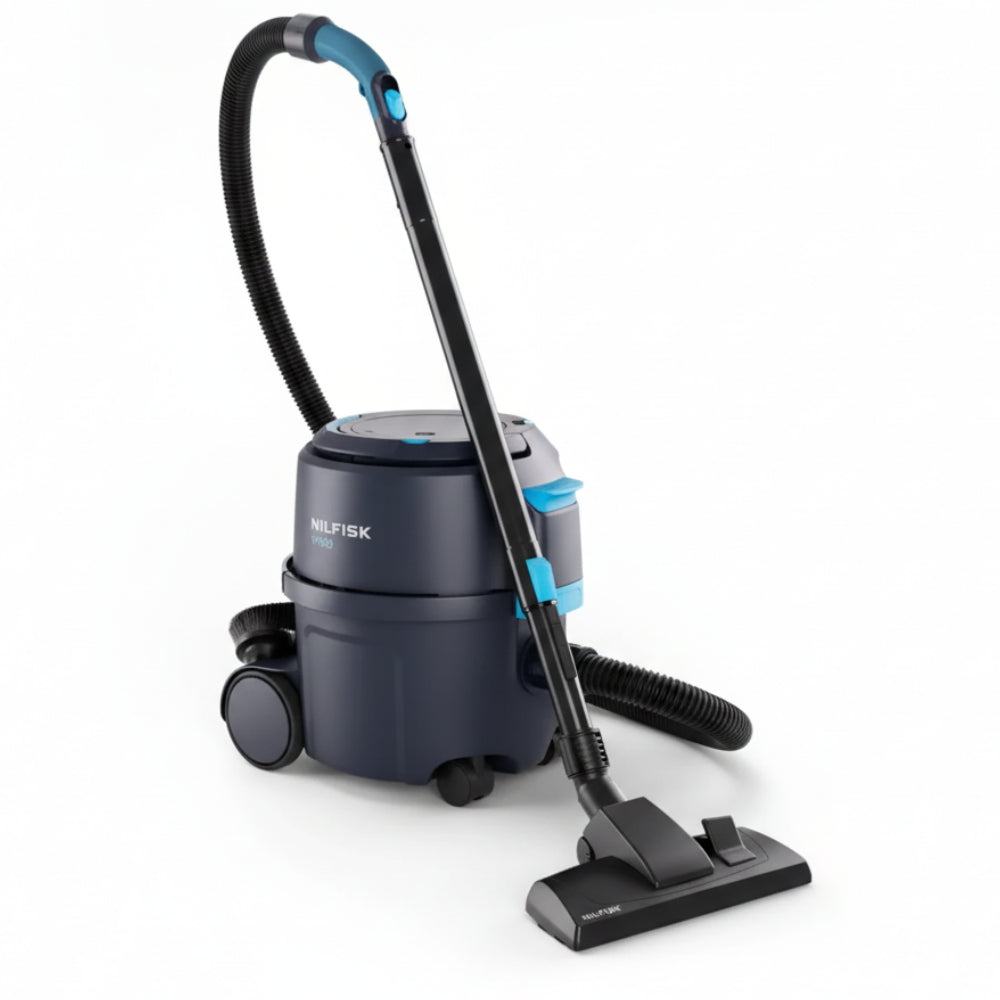
The filtration side is the easier one to read from a product page. Freshway lists the Nilfisk VP400 with an H13 HEPA filter that traps 99.95% of particles down to 0.3 microns, and the Numatic HZ370 with an H-Class compliant HEPA filter rated at 99.997%. Turn those figures around and the difference is clear: at the listed size, H13 lets about 5 particles in every 10,000 through, and the HZ370's rating lets about 3 in every 100,000 through. That is better particle control, not static control.
When ESD programs constrain tools
Protection of electronic devices from electrostatic phenomena is covered by the IEC 61340-5-1 standard, listed on the Standards Australia store for organisations that manufacture, assemble, test, inspect or otherwise handle electronic parts. Sites that work to it set up protected areas with their own rules for people, garments, footwear, flooring and equipment. A cleaner does not interpret that standard; the site's ESD coordinator does.
In practice, expect one of three answers. The vacuum is excluded from the protected area and floors there are cleaned another way. The vacuum is allowed only when the area is not handling exposed devices, such as after a shift. Or the site specifies equipment and tools that meet its program, and your machine must match. None of Freshway's listed HEPA vacuums claims an ESD rating, so do not describe them as anti-static to a client.
| Requirement | Who sets it | What it means for your vacuum |
|---|---|---|
| ESD protected area rules | The site, under its ESD program | Machine allowed, restricted or excluded; follow the coordinator's list |
| Laboratory access and induction | The facility's lab safety procedure | No entry until cleaners are inducted and authorised |
| Electrical testing records | WHS regulation, AS/NZS 3760 method | Current test record or tag on the machine |
| Hazardous dusts and chemicals | WHS law and the product SDS | H-Class only where the hazard requires it; never vacuum unknown spills |
| Particle control | Site cleanliness standard | Sealed HEPA filtration and low exhaust disturbance |
HEPA and sealed systems
A HEPA filter only performs if air cannot bypass it. Check that bags, filters and seals are fitted correctly every time, and that the machine is emptied before it is overloaded. Freshway lists the VP400 at 800 W with a 15 litre dust bag, 57 dB(A), 6 kg and a 10 metre cable, which suits quiet work in occupied lab and office areas. The HZ370 is a different class of machine: Freshway lists it as H-Class compliant with AS/NZS 60335-2-69, with a steel HEPA module, HepaFlo sealable bags and 48 L/sec airflow. The dust classes in that standard are summarised on the AS/NZS 60335.2.69 listing.

Coordinating with lab managers
Laboratories control who walks in. James Cook University's laboratory safety procedure says laboratories are to be secured so only authorised and inducted personnel can enter, including contractors and cleaning staff. The University of Queensland's laboratory safety guideline requires cleaning staff to complete a mandatory laboratory cleaners induction, with face-to-face inductions in buildings with multiple PC2 facilities.
Use that induction to settle the vacuum questions in writing: which rooms you may vacuum, at what times, which floors are conductive or ESD-rated, where you may plug in, and who to call if you find a spill.
Avoiding silicone and oily soils
On sensitive floors, what you leave behind matters as much as what you pick up. Keep floor tools clean and dedicated, so you are not dragging residue from a kitchen or workshop into a lab. Do not use spray polishes, silicone-based products or oily dust-control treatments unless the site has approved them. Check every chemical against its safety data sheet; WorkSafe Victoria's guidance on safety data sheets says employers must obtain an up-to-date SDS for each hazardous substance and make it available to workers.
Attachments and soft brushes
- Use soft brushes and floor tools that will not scratch conductive or sealed flooring.
- Keep a separate tool set for protected areas, labelled and stored clean.
- Replace worn tools before they shed bristles or plastic fragments.
- Do not vacuum unknown powders or liquids. Report them to the lab contact and follow the spill procedure.
Where hazardous dust is genuinely present, the machine must suit it. SafeWork NSW's page on airborne contaminants says no one may be exposed above the exposure standard, and that air monitoring is required in some circumstances. That decision belongs to the site, not to the cleaner choosing a vacuum.

Documentation expectations
Expect to show paperwork before the first shift. SafeWork NSW's page on electrical inspection and testing says a testing record must show who tested the equipment, when, the outcome and the next test date, and that the record may be a tag on the equipment. Add the machine model, filter class, the date filters were last changed, and the induction records for each cleaner. Keep a cleaning log per room if the site asks for one.
Spec questions to ask suppliers
- What filter class does the machine have, and is it HEPA or H-Class compliant?
- Are bags sealable, and how is the filter housing sealed against bypass?
- What are the listed noise level, weight and cable length?
- Does the product page claim any ESD or anti-static rating? If not, do not assume one.
- Which soft brushes and floor tools are included or available?
Compare options in the canister and barrel vacuums, hazardous dust vacuums and HEPA filtration backpack vacuums collections, or the Nilfisk vacuum cleaners range.
Frequently asked questions
Is a HEPA vacuum anti-static?
No. HEPA describes particle filtration. Static control depends on the site's ESD program and the equipment it approves.
Can we vacuum inside an ESD protected area?
Only if the site's ESD coordinator allows it, and only with the equipment and at the times they specify.
Do we need an H-Class vacuum in a laboratory?
Only where the site identifies hazardous dust that requires it. For general lab floors, sealed HEPA filtration is a sensible starting point.
What paperwork should a cleaner bring to a lab site?
Induction records, a current electrical test record or tag for the vacuum, and safety data sheets for any chemical used.
Delivery across Sydney
Agree the rules with the site first, then choose the machine. Order online for same-day delivery across Sydney, including Parramatta and the North Shore. Click and collect is also available from our Arncliffe warehouse. Call 1300 567 002 for help matching filter class and tools to your site.