How to Use a Window Squeegee Without Streaks
Streaks come from tired rubber, not bad technique. Swap the blade, not the method.
Shop now
For a streak-free result, wash the glass completely, create a dry starting edge, keep the rubber at a consistent angle, overlap each pass slightly and wipe the blade between passes. Finish only the perimeter with a clean, low-lint cloth. If a line repeats in the same place, inspect the rubber before changing your technique.
The method in 30 seconds
Wet and scrub the pane, create a dry starting edge, pull the squeegee with light and consistent pressure, overlap the next pass, wipe the rubber, then detail only the perimeter. A thin line that repeats in the same position usually points to grit or damage on the rubber edge.
Set up the glass and tools
You need a washer or applicator, a bucket with an appropriate glass-cleaning solution, a window squeegee in good condition, and separate clean cloths for the rubber and frame edges. Brush or wipe away loose grit and cobwebs before wetting the glass. Grit trapped under an applicator or blade can scratch some surfaces.
Follow the cleaning product label and the window manufacturer's care instructions. More detergent is not automatically better: excessive residue can make the rubber drag or leave a film. Work out of direct sun where practical so the solution does not dry before it is removed.
Use straight pulls first
- Wet and scrub the whole pane. Keep the surface lubricated, paying attention to corners and marks.
- Create a narrow dry edge. Use a cloth or the squeegee to clear a starting strip along the top or side so the rubber begins on dry glass.
- Set the blade. Hold the channel so the rubber trails behind the handle rather than being pushed ahead of it. Use light, even pressure.
- Pull in one continuous stroke. Stop at the opposite edge without changing pressure abruptly.
- Wipe the rubber. Remove water and picked-up dirt with a dedicated clean cloth.
- Overlap the next pass. Cover a small part of the previous dry path so no wet line remains between strokes.
- Detail the perimeter. Use a clean, dry corner of a low-lint cloth only where water remains at the frame.
Vertical or horizontal straight pulls are easier to diagnose than fanning. Once each pass is clean and consistent, an experienced operator can learn fanning for speed and to keep water moving across larger panes.
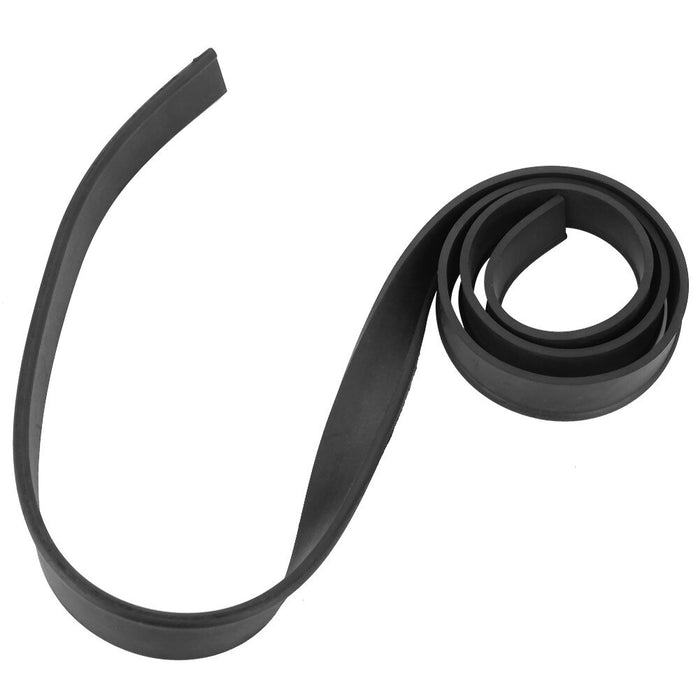
A straight, sharp rubber edge is critical: a nick commonly produces a thin line in the same position on every pass.
Why is the squeegee still leaving streaks?
| What you see | Likely cause | What to change |
|---|---|---|
| A fine line repeats in exactly the same place | Nick, grit or damaged blade edge | Clean and inspect the rubber; flip or replace it if the edge is damaged |
| Wide smears or chatter marks | Glass drying, too little lubrication, excessive pressure or poor blade angle | Re-wet the pane, reduce pressure and keep the trailing angle consistent |
| Water line between passes | Insufficient overlap or lifting at the edge | Overlap slightly and finish the stroke without twisting the channel |
| Drips appear later at the frame | Water trapped along the top or sides | Detail the perimeter and sill with a clean cloth |
| Cloudy film after drying | Dirty solution, residue or contamination on cloths | Change the solution and cloths; use the correct dilution |
Check the rubber and channel
Wash grit from the rubber and feel along the edge for a cut or rounded section. If the profile has two usable edges, it may be possible to reverse it; replace it when both edges are worn. The strip should sit straight in the channel without bunching, and the channel itself should not be bent.
Size also affects control. A wide channel clears open glass quickly, while a narrower squeegee is easier on small panes and divided windows. Choose a width that can complete a clean stroke without striking the frame.
Keep clean and dirty textiles separate
Use one cloth to wipe the wet rubber and another clean, dry cloth for detailing glass edges. A cloth already carrying detergent, frame dirt or oily residue can put contamination back on the pane. Rotate to a dry section rather than continuing with a saturated corner.
Change the bucket solution when it becomes visibly dirty or after working on heavily contaminated windows. Clean the washer sleeve and cloths according to their care instructions, and store the rubber without a sharp bend or prolonged sun exposure.
Plan safe access before reaching higher glass
For commercial work above ground level, access planning is a separate safety decision. Safe Work Australia describes working at height as high risk and says risks should be eliminated so far as reasonably practicable, including performing work from the ground where possible. Do not lean out or improvise access to extend a handheld squeegee's reach. Use the site's approved system, suitable equipment and competent workers.
For ground-level work, Freshway's window squeegee range includes complete tools and replacement components. Match replacement rubber to the channel profile and dimensions rather than assuming that every refill fits every squeegee.
Frequently asked questions
Should the squeegee rubber be wet before the first pass?
The glass must be lubricated, but the starting edge should be dry enough to prevent water from escaping behind the blade. Seat the rubber on that dry edge, then pull through the wet area.
Can squeegee rubber be flipped over?
Many professional replacement strips have two usable edges and can be reversed if the other edge is clean and undamaged. Confirm the profile, refit it squarely and replace it when both edges are nicked or rounded.
Why do streaks appear only after the window dries?
A broad haze usually indicates residue from too much product, dirty solution or a contaminated detailing cloth. Mix the cleaner at its labelled dilution, change dirty water and keep the blade-wiping cloth separate from the final detailing cloth.
References
- Safe Work Australia — Working at heights (accessed 7 September 2026).
Part of the cleaning methods guide — the index to the other surfaces, kitchen and washroom methods.