Squeegee size looks like a trivial decision until a crew is working a building with mixed glazing. A channel that is too wide for the pane cannot be controlled at the edges; one that is too narrow turns a shopfront into a hundred overlapping passes, and each overlap is a place where a line can dry. This window squeegee size guide is about matching the channel to the pane, the access and the working space, because that match decides both the speed and the finish.
It is written for cleaning contractors, facility managers and procurement teams specifying window cleaning tooling for commercial buildings, and it covers channel size, rubber, handles, reserves and the checks that reveal a problem before the client sees it.
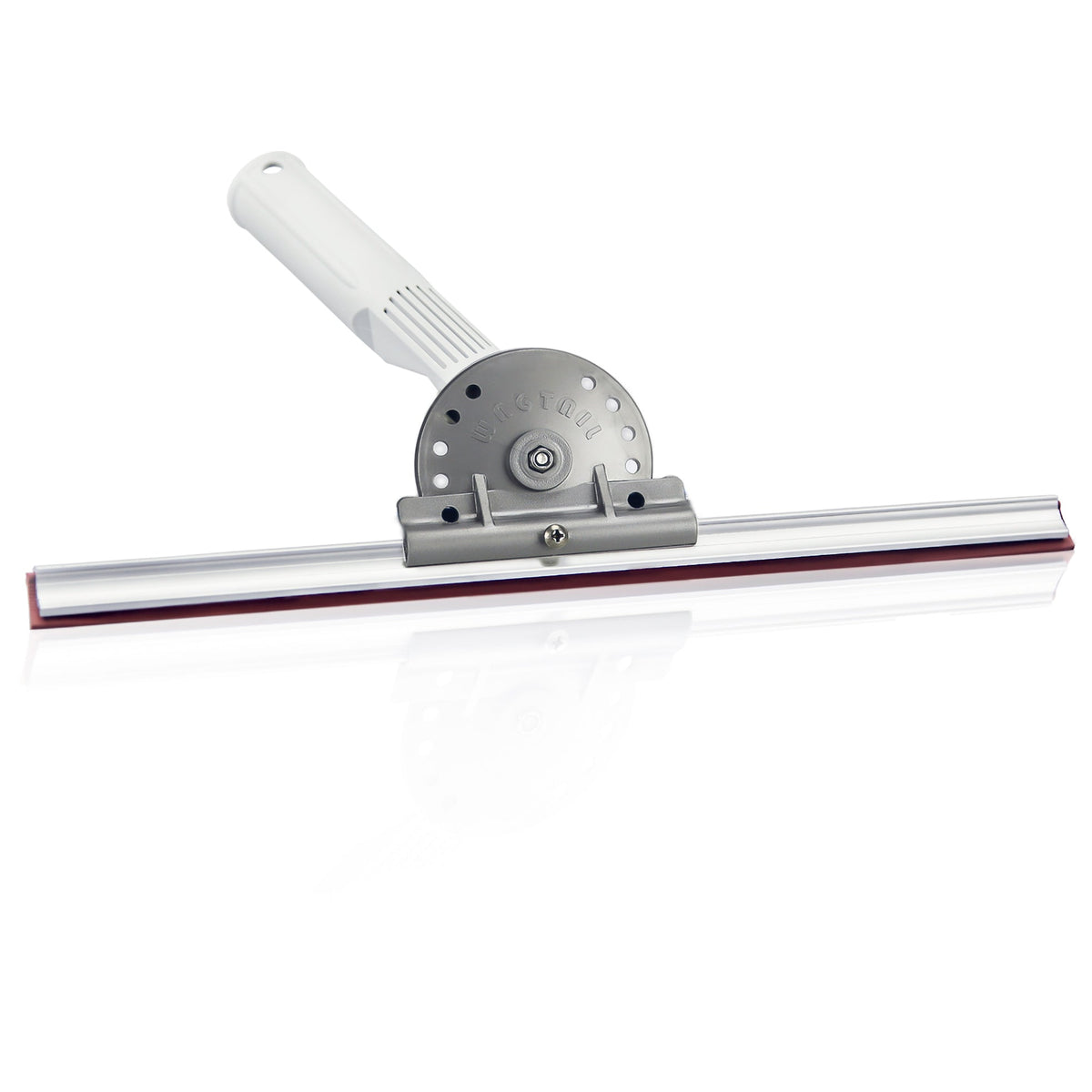
Window Squeegee Size Guide: Match the Channel to the Pane
Channel size is measured by the length of the blade, and the working range for professional glass runs from around 150 millimetres for small panes and tight frames to 450 millimetres and beyond for large shopfront glass. The useful rule is that a squeegee should be able to clear most of a pane in one controlled pass, without the ends travelling over frames, seals or adjacent surfaces.
Access changes the rule. On a pole, a wider channel is harder to control and more likely to lift an edge; on a ladder or a platform, a wider channel saves a pass. Where the operator is working one-handed or at reach, a smaller channel produces a better finish even though it takes longer.
The third input is the frame. Deep rebates, mullions, beading and seals all reduce the width that can be swept in one pass, and a channel that is slightly narrower than the clear width usually produces a cleaner result than one that fits only if the operator is careful. Reserving the widest channel for wide, flat, unobstructed glass is the practical compromise on a mixed building.
Clarify the Result and the Trade-off
Decide what the finish has to be before choosing the tooling. Interior glass in an office may only need to be clean and streak-free in normal light; a shopfront or a glass facade is judged from the street in raking light, where every edge line and every frame run shows. The standard decides how much time the crew can spend on each pane, and therefore how large a channel is sensible.
The trade-offs are real and worth stating. Speeding up with wider channels and fewer passes can leave edge lines and drips at the frames, which is what a client notices on a sunny morning. Working smaller channels with more overlap produces a better finish and takes longer, which changes the quote. And on high glass, control matters more than speed, because a line left at the top of a pane cannot be corrected without redoing the pane.
Where a site has a mixed glazing scheme, the answer is usually a set of two or three channels rather than one compromise size, plus a washer and a handle that suit the working position. The set costs little compared with the labour it saves, and it removes the temptation to make one tool do everything.
Match Tools to Pane Size and Access
Build the set around the panes the site actually has. Large uninterrupted glass - shopfronts, facades, atriums - suits a wide channel. Standard window and door glass suits a mid-size channel around 250 to 350 millimetres. Small panes, divided lights, mullioned windows and interior partitions suit a narrow channel or a combination tool that carries a squeegee and a microfibre pad in one unit.
Washer and applicator size follow the same logic. A wider washer applies solution faster on large glass; a small washer reduces the chance of soaking frames and sills on interior work. Scrims and microfibre cloths do the finishing and the detailing, and their size matters far less than their condition: a cloth that has been used past its life leaves lint and film on every pane it touches.
Then match the handle to the reach. Short handles suit interior glass at arm's length, swivel and pivot handles suit angled and overhead work where the operator needs the blade to stay flat, and poles suit height where the operator must work from the ground. Because a pole removes fine control at the blade, the channels used on poles are usually narrower than those used at arm's length. Freshway Supplies stocks professional window cleaning tooling including squeegees, channels and handles, and this overview of what a professional window cleaning kit contains covers how the pieces fit together.
Which Channel Size Suits Which Pane?
Match the channel to the clear width of the glass and the access around it.
A channel that clears most of the pane in one pass, stops short of the frame and can be controlled on the way down gives the best combination of speed and finish, and on mixed glazing that means carrying more than one size rather than compromising on the middle.
In practice the choice runs to three working sizes. A narrow channel - around 150 to 200 millimetres - suits divided lights, fanlights, small panes, interiors and any glass where the operator is working on a pole or in a confined space. A mid-size channel - around 250 to 350 millimetres - is the general-purpose tool for windows, doors and partitions, and it is the size most crews use most of the time. A wide channel - 450 millimetres and above - suits large glass where the operator can work a full-width pass and control the blade at both ends.
Two details decide whether the size actually works. The first is the frame: where the channel is the same width as the glass, the rubber touches the frame and picks up dirt and sealant that then streaks the pane. The second is the operator's position: standing directly in front of the pane allows a wider channel than reaching across a desk, a display or a stair void. Where the working space is tight, sizing down is faster than fighting the space with a wide blade.
Water Quality, Detergent and Residue
Squeegee technique removes water; the water and the detergent decide what is left behind. Clean water and a correctly dosed detergent let the blade clear the pane in one pass, while hard water leaves mineral spotting as it dries and excessive detergent leaves a film that attracts dust and re-streaks in rain.
On exterior glass, and particularly on pure-water work, the rinse is what carries the soil away, and the squeegee or brush is the tool that moves it. Where a site uses a pure-water system, detergent may not be needed on the glass at all, and mixing the two approaches produces a film neither method would have left. Decide the method per building and keep it consistent across the crew.
Residue also comes from the tools. Rubber that is perished or nicked leaves lines; a channel with a damaged end fitting drags water; a cloth used on frames and then on glass moves sealant and grit onto the pane. Cleaning the rubber after use, storing channels so the ends are protected and laundering cloths on a schedule are the unglamorous controls that keep a finish consistent.

Frames, Seals and Adjacent Surfaces
Glass is surrounded by surfaces that the cleaning method can damage. Aluminium and powder-coated frames tolerate most glass cleaners but not acids or abrasives. Timber frames and sills are sensitive to soaking. Sealant, gaskets and beading can be softened by solvents and lifted by a blade dragged across them. Painted render, stone sills and signage vinyl all have their own limits.
The practical controls are about the pass rather than the product. Wipe the frame and sill as part of the same task so detergent does not sit in the channel and run down the glass later. Lift the blade rather than dragging it over beading. Where a product would be unsuitable for a frame, apply it to the glass and remove it without letting it run onto adjacent surfaces. And keep the working solution off interior window treatments, document trays and equipment.
Adjacent surfaces also decide the sequence. Cleaning frames first and glass second leaves the glass clean; the reverse leaves a line of dirty water at the bottom of every pane as the frames are wiped. Where a site has a recurring complaint about dirty window bottoms, the sequence is usually the cause.
Working at Height and Public-Area Controls
Window cleaning is work at height even when it looks modest, and the controls scale with the access method rather than with the height. Water-fed poles and extension poles keep the operator on the ground and remove the fall risk, which is why they are preferred for reachable glass. Where ladders, platforms or elevated work platforms are used, the equipment, the setup and the operator's competence are all part of the risk control.
The relevant technical reference for height safety in Australia is the fall protection series published by Standards Australia, listed as AS/NZS 1891.1, and regulator guidance sets out the duty for the task. Public areas add a second set of controls: cordoning below the work, managing hose and water runoff, watching for pedestrians and protecting vehicles and stock from drips and detergent.
Weather belongs in the same planning. Wind affects pole control and the safety of elevated work; direct sun on glass dries the product before the blade reaches it; rain makes exterior work unproductive and building drips make interior work pointless. A window cleaning programme that ignores weather spends its labour on repeat work.
Replacement Rubber, Channels and Brushes
Rubber is the consumable that decides whether a good technique produces a good finish. It hardens with age and with UV exposure, takes nicks from frame edges and becomes uneven at the ends. The signs are specific: a line that follows the blade across every pane, water left at one end of the pass, or squealing as the rubber drags rather than glides. Replacement rubber is inexpensive, and changing it before it fails is the cheapest quality control in window cleaning.
Channels hold their alignment unless they are dropped or used as scrapers, and the parts that fail are the end fittings and the handle connection. Stocking replacement rubber in the sizes the site uses, plus at least one spare channel and handle, means a damaged tool is a short swap rather than a lost day.
Brushes and washers wear in a different way: bristles flatten and microfibre loads with detergent and soil, which reduces the solution it holds and the soil it lifts. Laundering microfibre on a schedule and replacing washers when they stop holding solution is what keeps the first pass effective, which is what makes the squeegee pass easy.

Quality Checks in Changing Light
Glass has to be inspected in the light the client sees it in. A pane checked from inside in the evening can look flawless and show every edge line the next morning when sunlight rakes across it, which is why the check belongs at the time of day the complaint would occur.
Inspect at an angle rather than straight on, from the side the client uses, and look specifically for edge lines, water at the bottom of the pane, frame runs and mineral spotting. Where a site has recurring complaints, record the pane, the time and the weather so the cause can be identified rather than guessed at.
Record the method as well: the channel size used on each glazing type, the product and dose, the water source and the sequence. On multi-building contracts that record is what turns one operator's technique into a standard, and it is the evidence that shows the tooling is matched to the glass rather than chosen by habit.
Questions we get asked most
- What size squeegee should I use for shopfront glass?
- A wide channel, typically 450 millimetres or more, so most panes can be cleared in one controlled pass. The channel should stop short of the frames so the rubber does not pick up sealant and dirt, and the operator needs a stable working position to control both ends of the blade.
- Is a bigger squeegee always faster?
- No. A channel that is too wide for the pane leaves edge lines, and on poles or in tight working spaces a wide blade is harder to control than a smaller one. On mixed glazing, carrying two or three channel sizes produces a better finish and often takes less time than fighting one compromise tool.
- How often should I change squeegee rubber?
- Replace it as soon as it leaves lines, squeals or fails to clear water evenly at one end of the pass. Rubber hardens with age and UV exposure and takes nicks from frame edges, and on commercial rounds a spare channel with fresh rubber is the cheapest way to avoid a callback.
- Can I use a squeegee on a pole?
- Yes, and the channel is usually narrower than the one used at arm's length because control decreases with distance. Extension and pivot handles help keep the blade flat, and for higher glass a water-fed pole with a brush usually produces a better finish, because the rinse does the work rather than the blade.
Conclusion
Squeegee size is decided by the clear width of the glass and the space the operator has to control the blade. A channel that clears most of the pane in one pass and stops short of the frame gives the best finish; mixed glazing is best served by two or three sizes rather than one compromise.
Match the tooling to the access, keep the rubber and cloths in condition, control the water and the detergent, and inspect the glass in the light the client sees it in. The tooling cost is trivial next to the labour, which is why specifying the set properly is the cheapest improvement available in window cleaning.
Manufacturer technical information: Agar cleaning chemicals and Unger professional window cleaning tools. Height safety: AS/NZS 1891.1 via Standards Australia, the Work Health and Safety Regulations 2011 and SafeWork NSW.
Compare professional squeegees, channels, rubber, handles and poles in the Freshway window cleaning range.