How to Choose a Pressure Washer for Commercial Cleaning
Buy on duty cycle, not PSI. This one is built to run all day, every day.
Shop now
Choose a commercial pressure washer by starting with the work: what must be removed, from which surface, how much area is cleaned per shift, and what power and water are available on site. Pressure alone does not answer those questions. Flow rate, duty cycle, heat, mobility, accessories and service access can matter just as much.
Last updated:
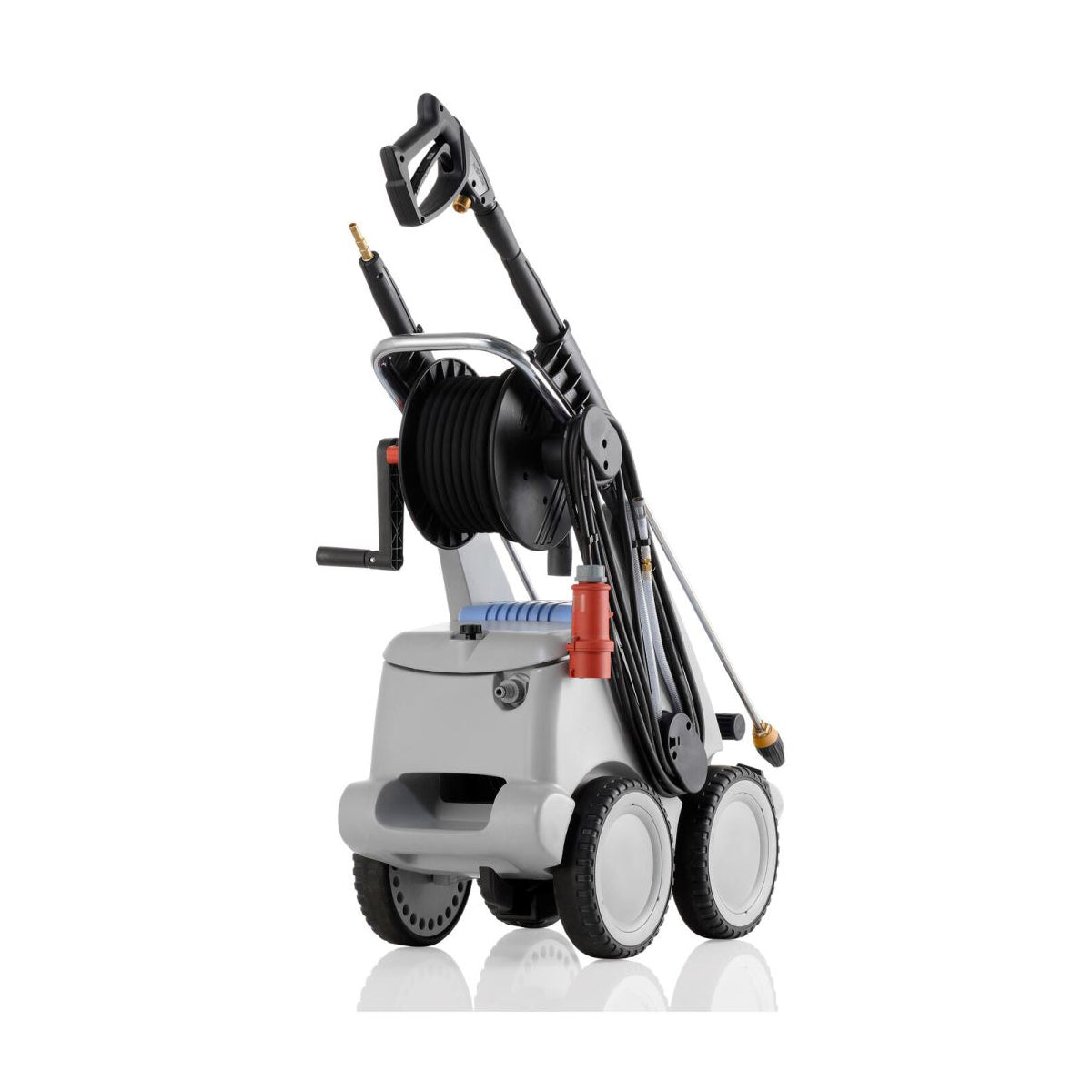
Your five-point buying brief
- Define the soil, surface and daily workload.
- Read pressure and flow together.
- Match the power source to the worksite.
- Confirm duty rating, inlet supply and accessory compatibility.
- Trial the complete system on a representative job.
Turn the cleaning job into a specification
Write down your most demanding regular task before comparing machines. A contractor washing broad concrete areas needs enough water flow to carry loosened soil away and to run a suitable surface cleaner. A workshop removing oily residue may gain more from hot water than from another jump in pressure. A facility cleaning indoors may need an electric machine because exhaust fumes and noise make an engine-powered unit unsuitable.
Use these questions as a purchasing brief:
- Soil: loose dust, mud, algae, traffic film, grease, oil or a bonded coating?
- Surface: sound concrete, masonry, equipment, painted panels, vehicles or a more easily damaged finish?
- Output: a few small jobs or hours of cleaning across a shift?
- Site: indoors or outdoors, near the public, noise-sensitive, and connected to 10 A, 15 A or three-phase power?
- Water: does the supply reliably meet the machine's inlet requirement?
- Reach: can the machine stay in one place with a longer hose, or must it travel over rough ground?
What matters more: PSI or flow rate?
PSI describes pressure; litres per minute (LPM) describes water flow. Pressure helps break the bond between soil and the surface. Flow helps move the loosened material away and affects how quickly you can rinse a large area. Two machines with similar pressure can therefore feel very different in production if their flow rates differ.
Neither specification is universally more important. Australian equipment guidance likewise tells buyers to consider both PSI and LPM. Do not select a number from a universal “PSI for every surface” chart and treat it as a guarantee. Nozzle angle, working distance, dwell time, surface condition and operator technique all change the force delivered to the surface. Begin with a wider fan and lower effective pressure, test an inconspicuous area, and increase only when the substrate tolerates it. See the Crommelins pressure-washer selection guidance for an example of PSI and flow being assessed together.
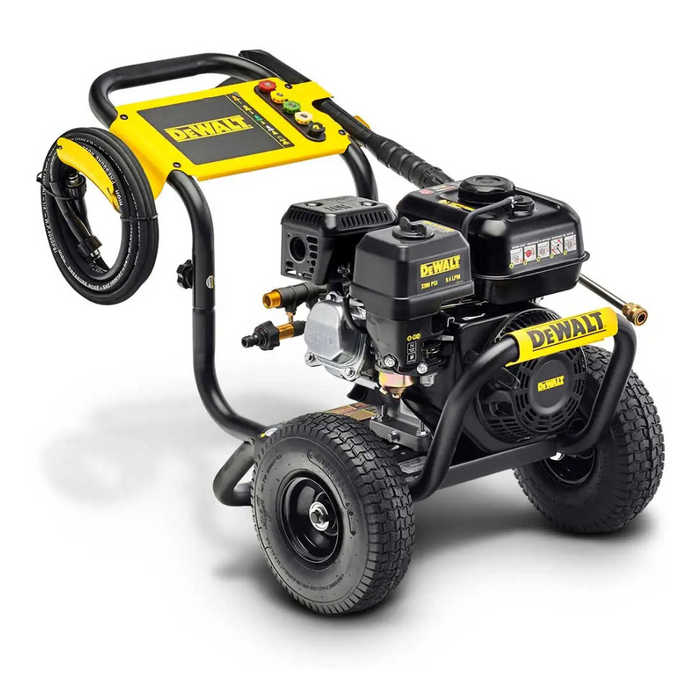
A bundled surface cleaner can be useful for broad, sound concrete, but its rated pressure and flow compatibility still need to match the washer.
Choose the power source around the site
| Option | Usually suits | Check before buying |
|---|---|---|
| Electric | Fixed wash bays, indoor or noise-sensitive sites, regular access to power | Available amperage and voltage, lead restrictions, water ingress controls, cable management |
| Petrol | Outdoor mobile work, construction, property maintenance and remote jobs | Ventilation, fuel handling, engine servicing, noise and transport |
| Diesel | Heavy mobile or industrial fleets where diesel support is already available | Machine size, purchase cost, maintenance capability and actual utilisation |
| Battery | Short, mobile jobs where portability matters more than continuous high output | Runtime under load, spare batteries, charging time and whether performance fits the task |
Never use an internal-combustion engine in an enclosed or poorly ventilated space. Site risk controls and the manufacturer's operating instructions take priority over convenience.
When is hot water worth the extra complexity?
Cold-water machines are a practical fit for general wash-down, mud and loose outdoor grime. Hot water can improve removal of fats, oils and greasy films, which may reduce chemical demand or repeated passes. Heat adds cost, weight and maintenance, so it should solve a recurring soil problem rather than simply sound more industrial.
If sanitising is part of the requirement, do not assume that owning a hot-water pressure washer automatically validates a hygiene process. The surface, temperature at the point of contact, dwell time, detergent or disinfectant, rinse procedure and industry rules all need to be considered in the site's documented method.
Duty cycle and construction determine whether it is truly commercial
Ask how long the machine may run in one session and across a day, then compare that requirement with the manufacturer's rated use. Look beyond the peak pressure printed on the box. Pump design, motor or engine speed, thermal protection, hose construction, fittings, frame, wheels, filters and access to replacement parts influence downtime and ownership cost.
A machine that completes one job quickly but cannot tolerate the weekly workload is a poor commercial choice. Equally, an industrial unit can be wasteful when a compact commercial machine meets the actual hours, access and transport limits.
Match the accessory to the task
Nozzles change the spray pattern and effective cleaning force. A wider fan is generally easier to control; a narrow or rotating jet concentrates force and raises the risk of surface damage. Surface cleaners can improve consistency on flat hard areas and contain some spray, but their diameter and nozzle set-up must suit the washer's flow and pressure. Hose length can improve reach, while an unsuitable hose, fitting or undersized water supply can restrict the system.
Confirm compatibility as a complete system: washer, inlet supply, hose, gun, lance, nozzle, chemical injector and any surface cleaner. A high-pressure component must be rated for the system in which it is used.
Use a short on-site trial before committing
- Test the actual soil and surface, not a cleaner demonstration panel.
- Record set-up time, cleaning time and the number of repeat passes.
- Check whether runoff, overspray, noise, exhaust, hoses or power leads create operational problems.
- Inspect the dry surface for etching, raised grain, coating damage or uneven bands.
- Ask who will service the unit and how quickly wear parts are available.
For workplace use, include the machine in the site's risk assessment and operating procedure. Safe Work Australia's high-pressure water-jetting guidance covers systems above a defined output threshold as well as lower-output equipment where injury is foreseeable. Applicable controls depend on the equipment and the work, so consult the relevant state or territory regulator where needed.
Once your task brief is complete, compare it with Freshway's commercial pressure washer range and confirm the power supply, water requirement, duty rating and accessory compatibility before ordering.
What a commercial pressure washer actually costs
In this range, a commercial-grade machine starts at about $5,100 and runs past $50,000, and the step that moves the price most is hot water rather than pressure.
The bands below are the listed prices on machines in this catalogue, so you can see where the money goes before you start comparing specifications. The pattern is consistent: a cold-water industrial unit and a hot-water unit of similar pressure do not sit in the same price band, because the burner, the fuel system and the heavier frame carry the cost.
| Class | What that buys | Listed price band here |
|---|---|---|
| Cold water, industrial single or three phase | Continuous running on a fixed site; the workhorse for wash bays and floors | about $5,100 to $6,600 [e.g. Nilfisk MC 6P, Karcher HD 9-23 G] |
| Hot water, single phase | Grease and oil removal where a three-phase supply is not available | about $5,800 to $9,700 [e.g. Karcher HDS 5/10 C, Kranzle CA11-130] |
| Hot water, three phase industrial | All-day operation with heat; the class most food and transport sites end up at | about $9,600 to $15,200 [e.g. Karcher HDS 7-12-4 M, Kranzle Therm-RP1200] |
| High-output hot water and skid units | Very high flow, diesel or heavy-duty electric, multiple operators | $14,600 to $23,200 [e.g. Nilfisk Magnum MC 4M, Karcher HDS 1000 DE] |
| Specialist and large industrial | Application-specific builds where the machine is part of a fixed plant | up to about $60,000 |
Purchase price is only part of it, and the part that is easiest to forecast. Running cost is dominated by what the site already pays for power or fuel, then by consumables: nozzles and tips wear and are the usual cause of a machine that seems to have lost performance, seals and valves are periodic items rather than annual ones, and a hot-water unit adds fuel and burner servicing on top. For a machine used daily, budget for the consumable line rather than treating it as an occasional cost.
Two cautions before using these bands as a budget. The prices are what is listed here on the day this was written and move with supply, and the correct comparison is cost per hour of work the machine can actually do, not cost per unit of pressure. A $6,000 cold-water machine that cannot shift the grease on your site is more expensive than a $10,000 hot-water machine that can.
Frequently asked questions
Can a commercial pressure washer draw water from a tank?
Some models can, but tank-fed operation is not universal. Check whether the pump is self-priming, the permitted lift and hose arrangement, and the minimum inlet flow in the manufacturer's manual. Fit the specified filter and never let the pump run short of water.
Is a 10 A electric pressure washer enough for commercial work?
It can be when its pressure, flow and rated duty match the job. A 15 A or three-phase supply may support a different performance class, but the plug rating alone does not prove that a machine is more productive or durable.
How large should a surface cleaner be?
Use the washer and attachment manufacturers' compatibility data. A wider head needs enough flow and the correct nozzle sizing to spin and clean evenly; choosing by diameter alone can produce slow or striped results.
How much does a commercial pressure washer cost?
In this range, commercial-grade machines start at about $5,100 for a cold-water industrial unit, sit between $5,800 and $15,000 for most hot-water machines, and run past $50,000 for specialist and large industrial builds. Hot water, not pressure, is the step that moves the price most.
What pressure washers do professionals use?
Professionals choose by flow rate and duty cycle rather than by brand, and in food, transport and plant maintenance they usually end up on hot water because cold water moves oil rather than lifting it. Among the ranges stocked here, Karcher HD and HDS, Nilfisk MC and MH, Kranzle and Kerrick are the machines most often specified for commercial sites.
References
- Safe Work Australia — Guide for managing risks from high-pressure water jetting (accessed 7 September 2026).
- Crommelins — pressure-washer selection guidance (accessed 7 September 2026).
This article is one section of the pressure washer guide, which covers selection, use, faults and surface-by-surface technique in that order.