Scale is the most predictable cleaning problem in a commercial building and the one most often treated with the wrong acid. Limescale on a shower screen, cement residue on a new floor, rust staining on a tile and effluent scale in a urinal are all mineral deposits, but they sit on different surfaces and need different concentrations, dwell times and rinse methods. A commercial descaler guide should start with the mineral and the substrate, not with the strongest product in the cupboard.
This guide is for facility managers, cleaning contractors and procurement teams specifying descalers for washrooms, kitchens, plant rooms, tiled floors and external surfaces. It covers how to choose the acid, how to read the label and safety data sheet, how to rinse safely, and what to record so the method is repeatable.
Commercial Descaler Guide: Match Scale, Surface and Rinse
The first decision is the mineral. Limescale and hard-water film are calcium and magnesium deposits and respond to acid. Cement and grout residue are alkaline and respond to acid. Rust staining responds to a reducing or acidic product, depending on the surface. Effluent scale in urinals is a mix of mineral and organic material and usually needs an acidic product with dwell and agitation.
The second decision is the surface. Acid attacks cementitious materials, so grout, render, unsealed concrete and some stone are at risk. It also attacks some metals, particularly aluminium and zinc, and it can dull plated fittings. The same acid that restores a urinal can etch a marble benchtop, so the substrate has to rule out options before the product is chosen.
The third decision is the rinse. A descaler that is left on the surface continues to work after the deposit is gone, and the result can be etched stone, dulled metal or a floor that stays slippery. The rinse method, the water volume and the runoff route are part of the specification rather than the clean-up.
Set the Operating Constraint Before Building a Shortlist
Start with what the site will not allow. A heritage stone floor, a coated tapware set, a sealed concrete slab, a colour-sensitive grout or a surface with a recent repair all limit the acid and the dwell. Those constraints convert directly into a product family and a maximum concentration.
The second constraint is the application. A vertical surface needs a product that stays in contact rather than running off, which usually means a gel or a foam. A horizontal floor can take a liquid. A drain or a urinal needs a product that can be flushed without damaging the trap or the pipework.
The third constraint is the site. Occupied washrooms need ventilation and exclusion; food areas need food-safe chemistry and a rinse; plant rooms need drainage that can take the runoff. Where the runoff cannot be managed, the method has to change before the product does.
Which Acid Suits Which Scale?
Match the acid to the mineral and the surface.
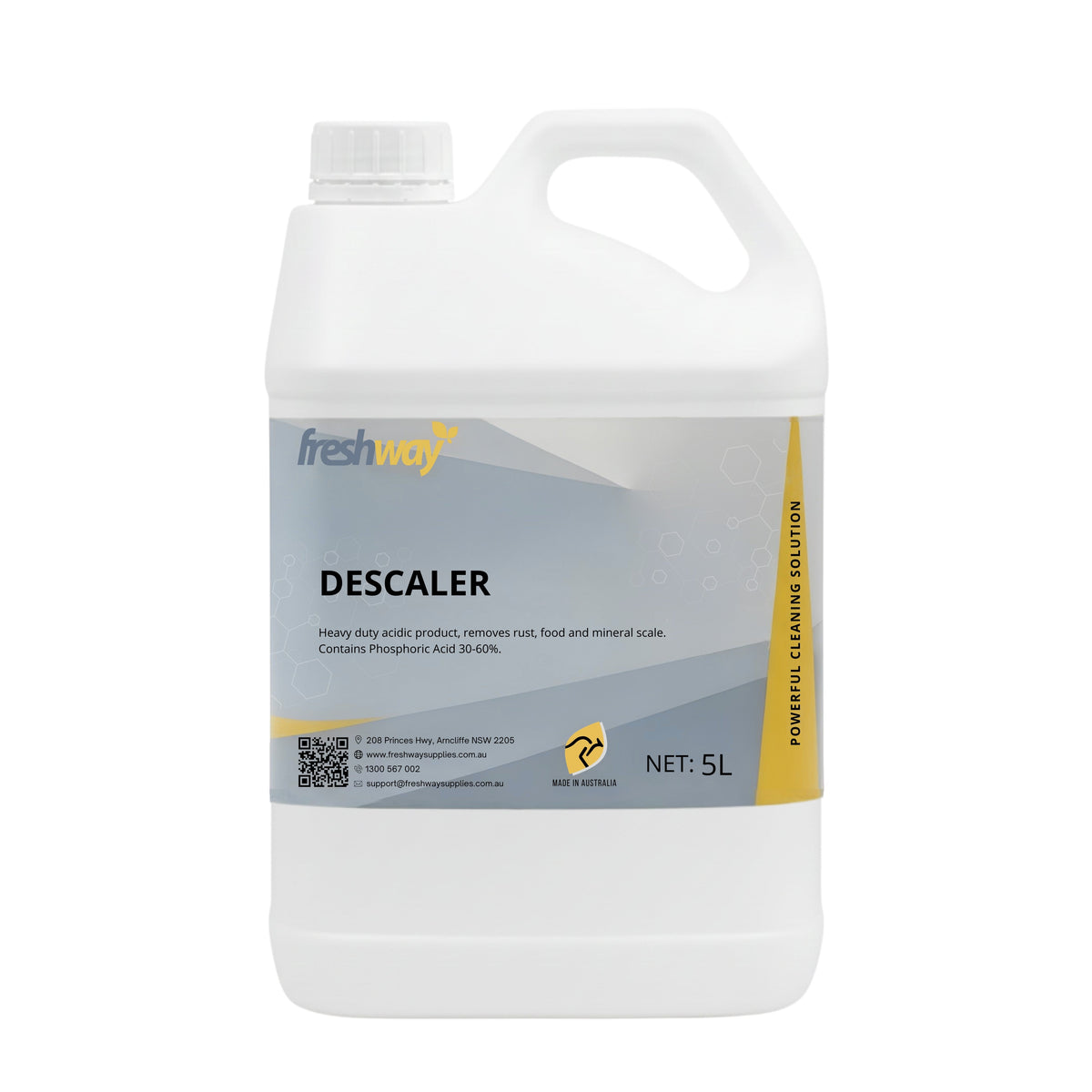
Citric and other mild acids suit light limescale and delicate surfaces, phosphoric and sulfamic acids suit heavier scale and grout residue, and stronger acids are reserved for industrial scale where the substrate and the procedure allow it.
In practice, commercial sites need three or four products rather than one. A mild acid descaler for daily or weekly washroom maintenance on chrome, tile and glass. A stronger acid for cement and grout residue on new floors, applied before sealing. A urinal descaler formulated for effluent scale and drainage. And a rust remover for staining on tile and concrete, chosen for the substrate.
The concentration matters as much as the acid. A mild acid at a longer dwell can be safer and more effective than a strong acid applied briefly, particularly on vertical surfaces where the product runs off before it works. Where the scale is thick, two applications at the correct dilution are usually better than one strong mix.

Read the Label and the Current Australian SDS
The label states the surfaces, the dilution and the contact time. The safety data sheet states the hazards, the personal protective equipment, the incompatibilities and the first aid. Both belong with the product, and both need to be current, because formulations change and an old laminated card is worse than no card.
Two rules are specific to acids. Never mix an acid with a chlorine-releasing product, because the combination releases a hazardous gas. And never decant an acid into an unlabelled bottle, because the next operator needs the product name, the concentration and the hazard information that the original container carries.
Freshway Supplies publishes safety data sheets by brand through its SDS library, so the sheet that matches the bottle stays with the method. Australian chemical safety duties sit in the Work Health and Safety Regulations 2011, with practical guidance from WorkSafe Victoria and SafeWork NSW.
Dilution, Dwell Time and Mechanical Action
Descalers work by dissolving mineral deposits, which is a chemical process that needs time. Dilute to the label, apply to the surface, and leave it for the stated contact time. Scrubbing a scale layer that has not been softened polishes it rather than removing it, and it uses more product for a worse result.
Dwell should be managed in sections. On a long shower screen or a tiled wall, apply to a manageable area, let it work, agitate where the surface allows, then rinse before moving on. Applying to the whole wall and starting at one end means the first section has dried before the last is reached.
Mechanical action should be the least that works: a soft brush or pad on tile and chrome, a non-abrasive pad on glass, and no metal scraper on plated fittings. On grout, a narrow brush reaches the joint without opening the surface. Where the deposit is thick, a second application at the same dilution is safer than a stronger mix or a harder brush.
Surface Compatibility: What Acid Must Not Touch
Acid is incompatible with more surfaces than most operators expect. Marble, travertine, limestone and other calcium-based stone etch on contact. Cementitious grout and render are attacked by repeated use. Aluminium, zinc and some plated finishes discolour. Some glazed tiles lose their finish, and some sealants soften.
The practical control is a test patch. Apply the product to an inconspicuous area, allow the dwell, rinse and inspect after drying. Colour change, dulling, etching or a rough feel are all reasons to stop and choose a different product. On stone, the building's stone contractor or the manufacturer's guidance should be consulted before any acid is used.
Where the surface is unknown, use the mildest acid that works, at the lowest concentration, with the shortest effective dwell, and rinse thoroughly. That approach is slower than a strong product but far cheaper than refinishing a floor or replacing fittings.
Rinse Method and Runoff
Rinsing is the step that stops the acid. Residual acid continues to attack the surface, attracts soil and can leave a sticky film, so the method needs clean water, enough volume and a defined direction. On a vertical surface, rinse from the top down; on a floor, rinse towards the drainage point rather than across the cleaned area.
Runoff has to go somewhere. Descaler runoff contains acid and dissolved minerals, and it should not reach gardens, stormwater or a sensitive surface. The NSW EPA water guidance sets out what should not be discharged, and where a site discharges to sewer or trade waste the local water authority sets the conditions.
Neutralising is sometimes required by the procedure or the product label, particularly on large floor areas. Where it is, use the neutraliser the supplier specifies and confirm the surface is neutral before it is returned to use. Where the label does not require it, a thorough clean-water rinse is still the minimum, and the surface should be dry before it is returned to use so any remaining reaction is visible.
Rinsing also has a sequence. Work from the top of the surface downwards so the acid and the dissolved minerals leave the area rather than being carried across it, and rinse the edges and joints where product collects. On a shower screen, rinse the frame as well as the glass, because acid left in the channel continues to attack the metal and the sealant.
Storage, Dispensing and Staff Training

Acids belong in their own labelled position, separated from chlorine-releasing products and from alkaline chemicals, in a ventilated store with the safety data sheets accessible. Decanting should be limited to labelled working bottles, and the dose should be recorded so the next operator repeats it.
Training should cover four points: which acid for which mineral and surface; the dilution and dwell; what the product must never touch; and what to do after a splash. The distinction between a maintenance descaler and a heavy-duty remover is the one operators most often miss, and it is the one that causes surface damage.
Dispensing systems help on sites with high turnover. A wall-mounted dispenser or pre-measured bottle reduces overdosing, and a colour-coded label keeps the acid separate from the neutral cleaner on the trolley. Where hand mixing is unavoidable, a calibrated jug and a written dose are the minimum.
What to Record in the Approved Method
- Mineral and surface: what the deposit is, the substrate and the finish, recorded per area.
- Product and dilution: the acid, the dose and the dwell used for each task.
- Test patch: the area tested, the result after drying and the date.
- Rinse: the water volume, the direction and the runoff route.
- Result: whether the scale was removed, reduced or referred for restoration.
That record is what makes descaling repeatable across shifts and buildings. It is also the evidence a client or an auditor will ask for when a surface has been damaged or a result has not held.
Questions we get asked most
- What is the best descaler for commercial washrooms?
- It depends on the surface. Chrome, ceramic tile and glass tolerate a mild acid descaler; urinals need a product formulated for effluent scale and drainage; and acid-sensitive stone needs a different method entirely. Match the product to the mineral and the substrate, not to the strongest bottle.
- Can I use vinegar instead of a commercial descaler?
- Vinegar is a mild acid and can work on light limescale, but it is slow, it smells, and it is difficult to control on a commercial scale. Proprietary descalers are formulated with surfactants and a controlled pH so they work faster and rinse more predictably.
- How long should a descaler stay on the surface?
- As long as the label states for the product and the deposit. Too short and the scale is not dissolved; too long and the acid can attack grout, metal or stone. Work in sections so each area gets the full dwell without drying.
- Do I need to neutralise after descaling?
- Where the label or the site procedure requires it, yes. Otherwise a thorough clean-water rinse is the minimum. On large floor areas or sensitive surfaces, check the surface after drying and neutralise if the procedure calls for it.
Conclusion
Descalers are chosen by mineral and substrate, then by dilution, dwell and rinse. The strongest acid is rarely the best answer, and on stone, grout and metal it is usually the most expensive one.
Test the surface, follow the label, rinse thoroughly and record the method. That is what removes the scale without removing the finish, and it is what makes the next clean as predictable as the first.
Manufacturer information: Agar cleaning chemicals. Chemical handling: WorkSafe Victoria, the Work Health and Safety Regulations 2011 and SafeWork NSW. Water discharge: NSW EPA.
Compare acid descalers, urinal cleaners and tile and grout chemistry in the Freshway range.