Carpet Extractor vs Steam Cleaner: Which Does Your Job Need?
Extraction wins on soil removal. This is the machine most commercial jobs actually need.
Shop now
Choose a carpet extractor when the main job is flushing soil from carpet or upholstery and recovering the dirty solution. A vapour steam cleaner is better suited to heat-assisted detail cleaning on compatible hard surfaces and fixtures. “Steam cleaning” is also commonly used in Australia to describe hot-water carpet extraction, so confirm the actual process before comparing machines.
Start by clearing up the terminology
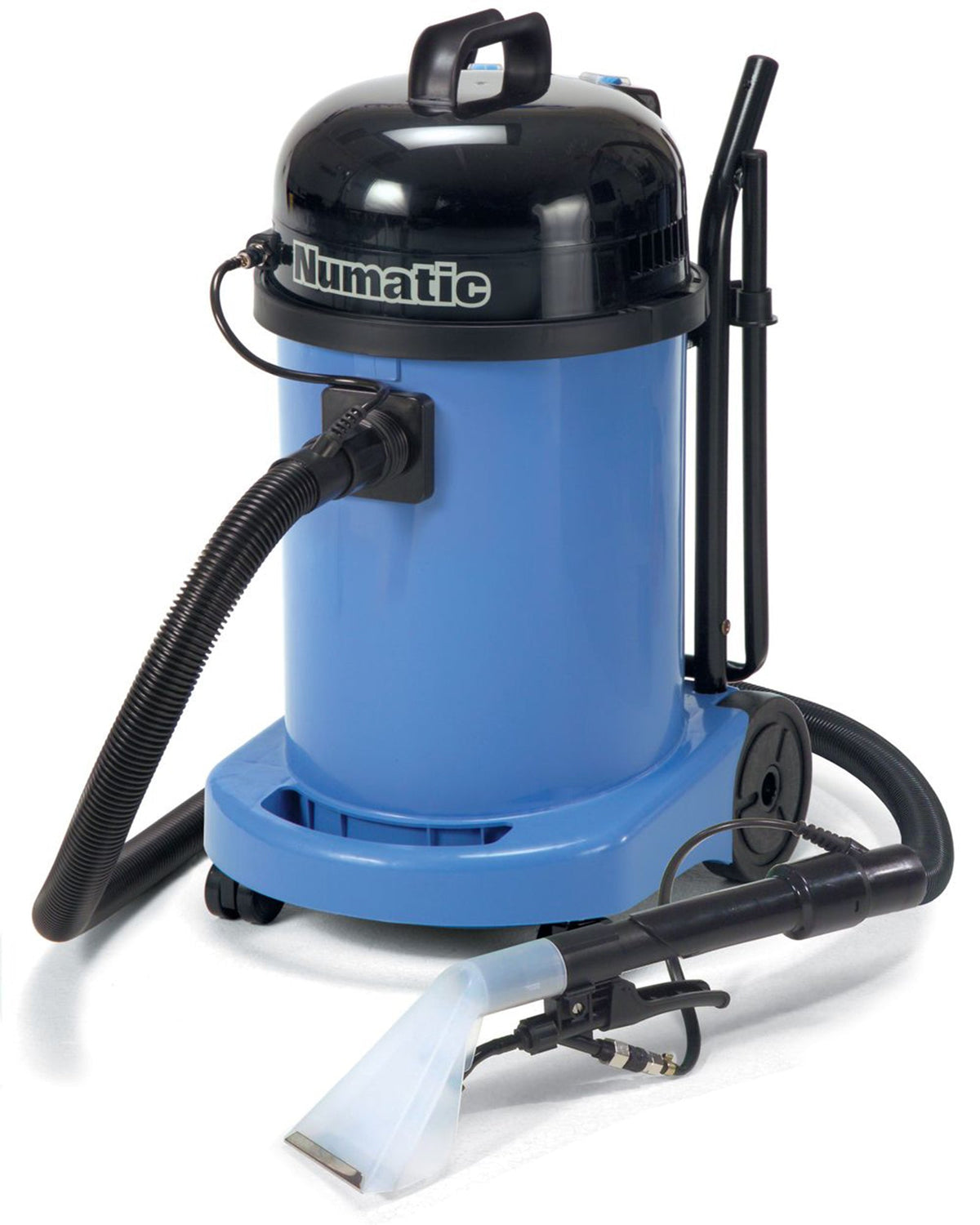
A spray extractor applies a measured cleaning solution to textile fibres and vacuums the resulting moisture and loosened soil into a recovery tank. A vapour steam cleaner produces hot, relatively low-moisture vapour for compatible hard surfaces, joints and fixtures. It does not normally rinse carpet fibres and recover the dirty solution in the same way.
The name “steam cleaner” causes confusion in Australia because hot-water injection and extraction is often called steam cleaning even when no vapour-steam machine is involved. Ask what the equipment delivers, what it recovers and which tool contacts the surface. Those three answers are more useful than the product category alone.
Which machine fits each cleaning task?
| Task | Starting choice | Reason | Check before use |
|---|---|---|---|
| Corrective cleaning of carpet traffic lanes | Carpet extractor | Applies solution through the pile and recovers suspended soil | Carpet maker’s cleaning method, fibre, backing and warranty |
| Upholstery or vehicle fabric | Compact extractor with a suitable hand tool | Controls spray close to the fabric and provides visible recovery | Colourfastness, fabric code, seams and drying conditions |
| Grout lines, sealed hard surfaces and detail points | Vapour steam cleaner where approved | Heat and small accessories can work around detailed geometry | Heat sensitivity, seals, coatings and electrical components |
| Routine dry particulate removal | Dry vacuum | Removes loose soil before moisture is introduced | Floor tool, filtration and carpet type |
| Unknown textile or backing | Identify and test before either wet process | Heat, moisture or chemistry may distort, shrink, bleed or delaminate material | Manufacturer guidance and an inconspicuous test |
Extraction is part of a carpet-maintenance system
Do not treat extraction as a substitute for routine vacuuming, spot response and planned interim cleaning. Dry soil should normally be removed first. Spots need identification because the wrong chemistry or aggressive rubbing can set a stain or damage the pile. High-traffic areas may need attention before the whole room looks uniformly dirty.
The Carpet Institute of Australia describes hot-water injection and extraction as both an interim and corrective method and notes that lower-moisture methods may be used between extraction cycles. The appropriate frequency depends on traffic, soil, maintenance history and the carpet manufacturer’s requirements. A calendar copied from another building is only a starting point.
Drying time depends on the complete process
Machine labels such as “low moisture” or “powerful suction” cannot establish a reopening time. Drying changes with the amount of solution delivered, vacuum recovery, the number of wet passes, fibre and backing, room temperature, humidity and airflow. Overlapping wet passes at corners and around furniture can create isolated slow-drying areas even when the main lane feels dry.
Pre-vacuum thoroughly, use the labelled dose, avoid unnecessary solution, and make additional recovery-only passes where the machine instructions allow. Set up ventilation and control access until the carpet is suitably dry. Before a time-critical job, trial the proposed method on the actual carpet under representative conditions and record the result rather than promising a universal number of hours.
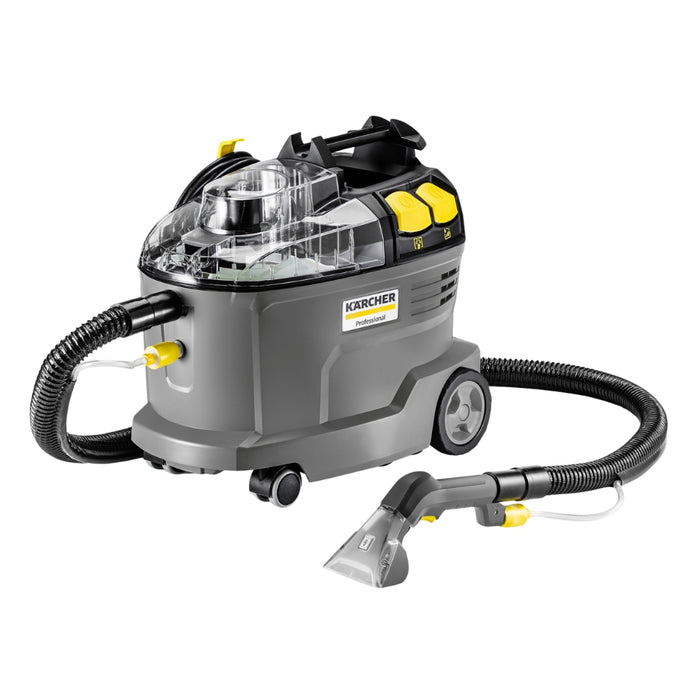
A compact extractor with an upholstery tool suits targeted textile work. Confirm whether a floor wand is included before planning room-scale carpet cleaning.
Compare capacity and tools, not just motor power
For an extractor, compare clean- and recovery-tank capacity, spray pressure, recovery performance, hose length, tool width, weight when full, drain method and access to replacement seals, nozzles and hoses. A large tank reduces refill stops but increases transport weight. A small machine can be faster in stairs, vehicles and furnished rooms even when it is slower across an open floor.
For vapour equipment, check approved surfaces, warm-up and refill process, continuous-fill capability where offered, accessory range, cable and hose reach, and how the machine manages condensate. Temperature at the boiler does not prove the temperature delivered to every surface, and heat alone does not prove a cleaning or disinfection outcome.
Run a controlled site trial before buying
- Identify the textile or hard surface, its condition and the manufacturer’s restrictions.
- Define the result: dry-soil removal, stain treatment, fibre flushing, detail cleaning or another specific task.
- Select the correct tool and approved chemistry, then test an inconspicuous area.
- Measure setup, active cleaning, refilling, recovery, pack-down and realistic drying time.
- Inspect the surface after it is fully dry, including texture, colour, residue and any returning spots.
- Calculate how many rooms or square metres fit inside the available cleaning window.
Browse Freshway’s carpet extractor range and verify included tools, tank sizes, temperature limits and compatible solutions against the exact product manual.
Common selection mistakes
- Buying a vapour cleaner for a job that requires dirty-water recovery from carpet.
- Assuming every machine sold as a carpet cleaner includes a full-width floor wand.
- Comparing only tank size while ignoring carrying weight, stairs and drain access.
- Using extra detergent to compensate for poor pre-vacuuming or slow technique.
- Approving a process immediately after cleaning instead of inspecting after drying.
If one site needs both textile extraction and hard-surface detail cleaning, compare two purpose-matched machines with any combined system being considered. Include accessories, setup, operator training, maintenance and the time lost when one shared machine is unavailable. A longer feature list is useful only when the required functions perform well on the site’s actual surfaces.
Frequently asked questions
Is a carpet extractor the same as a wet-and-dry vacuum?
No. An extractor has a controlled solution-delivery system as well as recovery. A wet-and-dry vacuum may recover liquid but does not necessarily apply cleaning solution through a carpet tool.
Should carpet be dry-vacuumed first?
Usually, yes. Removing dry particulate before adding moisture prevents avoidable soil from becoming suspended in the cleaning solution. Follow the carpet and equipment instructions for the specific job.
Can vapour steam be used on every sealed floor?
No. Seals, adhesives, coatings and joints can respond differently to heat and moisture. Confirm the surface maker’s instructions and test the proposed tool, temperature and dwell time.
References
- Carpet Institute of Australia — Commercial carpet cleaning fact sheet.
- Carpet Institute of Australia — Carpet maintenance guidance.
Filed under the carpet and upholstery guide, alongside the carpet cleaning method comparisons.