Terracotta and Quarry Tile: Scrubber Pads and Chemistry That Fit
Match deck width, pad and chemistry to kitchen quarry and foyer terracotta.
Shop now
The breakfast line has closed, but the quarry tile in the kitchen still looks wet and greasy under the pass. A cleaner has already been over it with a hot mop and a strong degreaser, and the grout is darker than it was last month. The tiles are not "dirty again"; the soil has gone into the pores and the grout, and the pad or the chemistry just used is likely to be wearing the wrong part of the floor. That pattern shows up in hospitality kitchens across Sydney more often than a single missed mop.
How should you choose a floor scrubber, pad and chemistry for terracotta and quarry tile?
Choose a floor scrubber, pad and chemistry for terracotta and quarry tile by matching soil and surface, not the most aggressive pad or strongest degreaser. Use a compact deck in a tight kitchen, a milder daily detergent on sealed foyer tile, and reserve high-alkaline cleaner for grout and porous bodies that have taken up fat.
This article is for hospitality facilities running kitchens and public foyers on terracotta or quarry tile. Freshway's guide to planning floor scrubber pads, brushes and consumables covers pad stocking in general; this piece is about those two tile types and the chemistry that fits them.
How does soil behave on porous tile?
Quarry and terracotta are not sealed vinyl. Fat, gravy and fine grit sit in the pores and in the grout, then get walked back onto the body of the tile. A mop often shines the high spots and leaves the grout darker. A scrubber with the right mechanical action and a low-foam cleaner can lift that soil into a recovery tank instead of spreading it. Agar Once Off is listed as a high-alkaline, low-foaming tile and grout cleaner, with a pH of 13.0–14.0, and as suitable for terracotta as well as ceramic tile, concrete, clay pavers, bluestone and sandstone. It is also listed as suitable for auto-scrubbers, and as being able to be used more concentrated for restoration or diluted up to 1:120 for routine daily maintenance. That 1:120 rate is 10,000 ml ÷ 120 ≈ 83 ml of concentrate per 10 litres of water. Use the restoration strength only when the floor actually needs it, and only as the label allows.
How aggressive should the pad be on a glaze or a porous body?
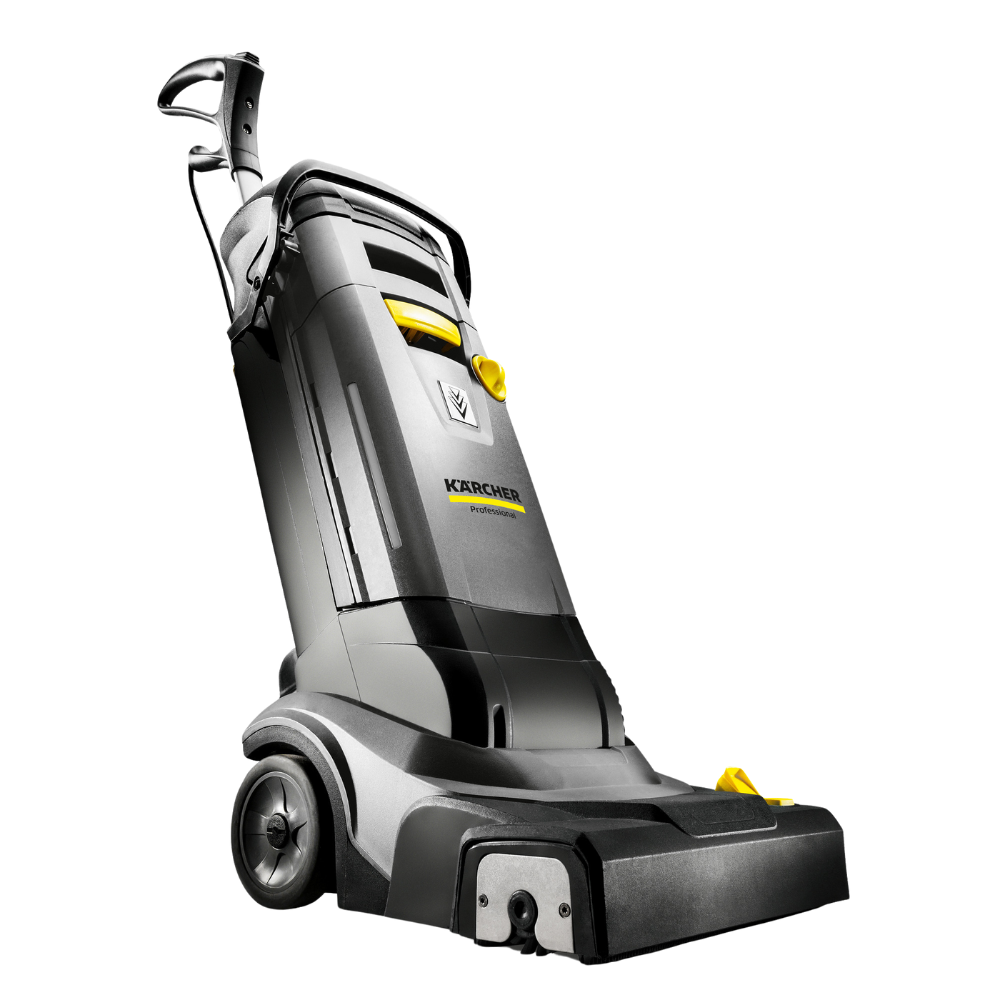
A black stripping pad is the wrong default on a glazed or decorative terracotta foyer. Freshway lists the Glomesh TK400 regular-speed floor pad in a 400 mm size, including a black variant described as a stripping pad for regular-speed rotary machines, typically 150 to 300 rpm, with aggressive fibres intended to cut through old acrylic sealers and heavy dirt. That is a restoration tool for finish removal, not a daily pad on a glaze you still want to keep. If the kitchen tile is unglazed quarry, a cylindrical brush that reaches into grout is often kinder than a coarse pad that scratches the body of the tile. The Karcher BR 30/4 is listed with a 150 rpm cylindrical roller whose bristles are described as reaching into recessed grout lines and the pores of safety tiles, on a 300 mm cleaning path.
If you do need a rotary pad, start milder than black, watch the tile after a short test pass, and retire a pad that is loaded with grit; trapped grit becomes sandpaper. Pads and holders are worth stocking beside the machine, including options in the scrubbing pads range, but the colour on the box still has to match the job.
When do you use a degreaser, and when a milder daily cleaner?
Kitchen quarry that has taken up fat is a degreaser job. Foyer terracotta that is sealed and only sees shoe soil is not. Agar Once Off is listed as a heavy-duty degreaser at pH 13–14. Agar Novadet is listed as a low-alkaline detergent concentrate at pH 9 ± 0.5, for daily maintenance on sealed hard floors including terrazzo, marble and slate, and as autoscrubber compatible, with a dilution of ¼ cup per 10 litres for light soil and ¾ cup per 10 litres for heavy soil. Agar Fresh Mop is listed as a mildly alkaline, free-rinsing daily cleaner that can be diluted 1:120 for general cleaning or 1:50 for heavy soil, and as safe for acrylic sealers and polished floors. For a 10 litre tank, Fresh Mop at 1:120 is 10,000 ÷ 120 ≈ 83 ml; at 1:50 it is 10,000 ÷ 50 = 200 ml.
| Situation | Chemistry to start with (as listed) | Mechanical action | Why |
|---|---|---|---|
| Greasy commercial kitchen quarry or terracotta | Once Off, pH 13.0–14.0; daily maintenance up to 1:120, or a stronger mix only as the label allows for restoration | Cylindrical brush or a non-stripping pad; short test pass first | Fat sits in pores and grout; a high-alkaline, low-foam cleaner is listed for terracotta and for auto-scrubbers |
| Sealed foyer or dining terracotta with shoe soil | Novadet, pH 9 ± 0.5, ¼–¾ cup per 10 L; or Fresh Mop 1:120 (about 83 ml per 10 L) | Mild pad or brush; do not start with a black strip pad | A strong degreaser can dull a sealer you still want to keep |
| Dark, loaded grout lines after service | Once Off with dwell as the label allows, then extract | Brush that reaches into the joint, not a glaze-cutting pad | The soil is in the joint; grinding the tile face will not clear it |
Kitchen degreasers and daily floor cleaners sit in the Agar kitchen cleaners and Agar floor cleaners collections. Check the product page and the SDS before you change a dilution.

How should grout lines be given dwell, and how do you maintain a sealer?
Grout needs contact time. Lay the cleaner, give it the dwell the label allows, then scrub and extract; do not flood a kitchen and walk away so the floor becomes a slip path. SafeWork NSW lists liquids, water, grease, oil and cleaning methods among common sources of slips on its page on slips, trips and falls. Sign the area, and extract until the tile is dry enough to walk on. WorkSafe Victoria's page on slips, trips and falls covers the same hazard family for workplaces that must keep public areas open during service.
Sealer cycles depend on whether the floor was sealed at all. Agar First Base is listed as a water-based, low-odour base-coat sealer with a pH of 7.5–9.5, coverage of 30–40 m² per litre depending on porosity, 1 to 2 coats by mop, brush or roller, and light foot traffic in 2 to 3 hours. The listed surfaces are bare concrete, terrazzo, vinyl, timber and porous stone. If your terracotta or quarry is to be sealed, confirm the product is suitable for that exact tile and follow the label; do not assume a vinyl sealer belongs on kitchen quarry that will see hot fat the next morning. Recoat when water no longer beads and soil starts to enter the pores again, not on a fixed calendar alone. Related sealer and finish products are in the floor strip, buff and sealers collection.
Kitchen versus foyer terracotta, and the deck width that fits
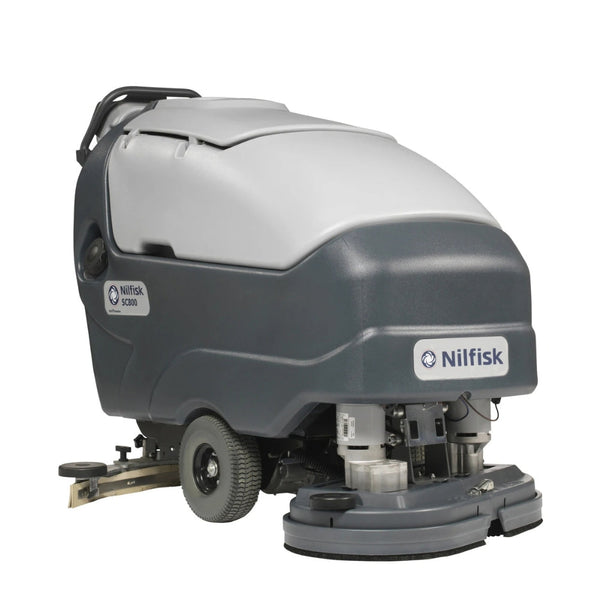
A kitchen needs a machine that can turn beside a prep bench and still reach grout. The BR 30/4 is listed with a 300 mm cleaning path, 4 litre fresh and 4 litre recovery tanks, a 12 metre cable, and a weight of 11 kg empty, with a foldable handle. That width and weight suit a tight cook line. A larger walk-behind may cover a foyer faster, but it will not thread a galley kitchen. The Nilfisk SC351 is listed with a 37 cm cleaning path, 11.5 litre solution and recovery tanks, a weight of 80 kg including the battery, and a noise level of 65 dB(A). Use that class of machine where the floor is open enough to accept it, not as a default in a cramped kitchen.

WorkSafe Victoria's injury hotspots for cleaning page lists scrubbing machines among the aids that reduce repetitive manual work, and tells employers to obtain SDS access for cleaning chemicals. SafeWork NSW's hazardous chemicals page is the NSW counterpart: cleaners must be handled and stored under those rules. A pH 13–14 product is not a daily foyer mop-and-bucket mix without the right PPE and a read of the SDS, as WorkSafe Victoria sets out on its safety data sheets page.
Supplying scrubbers and tile chemistry across Sydney, Melbourne and Brisbane
Hospitality groups often run the same tile problem in more than one city: a tight kitchen on quarry, and a foyer that must stay presentable during service. Specify the deck width and the chemistry for each room, then order the machine and the consumables together so the pad and the detergent actually match the scrubber on site. Check current figures on the product page before you write a standard kit for every venue.
Common damage patterns to watch
- A black or coarse pad used daily on a glaze, leaving a dulled or scratched face.
- A strong alkaline cleaner used on a sealed foyer floor, dulling the sealer the venue still wants.
- No dwell on grout, so the tile looks briefly wet-clean and the joints stay dark.
- A walk-behind deck that is too wide for the cook line, so corners are still mopped and remain slippery.
- A wet floor left without signs during service, which is a slip risk as well as a finish problem.
Frequently asked questions
Can I use the same pad and detergent in the kitchen and the foyer?
Not as a default. Kitchen quarry often needs a degreaser and a grout-reaching brush, while a sealed foyer is better on a milder daily cleaner and a less aggressive pad.
Does a high-alkaline tile cleaner replace daily scrubbing?
No. Agar Once Off can be diluted up to 1:120 for routine work, but restoration strength is for soil that daily cleaning has not lifted. Follow the label and do not leave the floor wet for traffic.
What deck width should I specify for a tight kitchen?
Match the aisle, not a showroom floor. A compact unit such as the BR 30/4, listed at 300 mm wide and 11 kg empty, is built to turn in a tight space; a wider, heavier walk-behind belongs on a more open floor.
Should terracotta always be sealed after a deep clean?
Only if the tile and the sealer are compatible, and the room's use allows it. Confirm the product listing and the label for that surface; a kitchen that sees hot fat is not the same job as a foyer.
Next steps with Freshway
Walk the kitchen and the foyer separately, write down the deck width that will actually turn in each space, and pair a high-alkaline tile cleaner only with the floors that need it. Freshway can help you match a compact scrubber, a pad or brush, and a listed tile or floor cleaner to the venues you run; contact the team on 1300 567 002 with the floor type and the aisle width.
Supplied Across NSW, VIC & QLD
Freshway supplies floor scrubbers and tile-care chemistry to businesses in Sydney NSW, Melbourne VIC and Brisbane QLD. Same-day delivery is available in Sydney; Melbourne and Brisbane receive fast delivery. See the floor scrubbers collection to specify a machine for the next venue.