Strata Common-Area Pressure Washing Without Breaching By-Laws
By-laws, notice, noise and runoff plans for quieter electric common-area washes.
Shop now
A contractor fires up a petrol pressure washer in a basement car park at 6.30 am. The jet lifts dirt off the concrete, then sends a grey sheet of water under the first row of cars and toward the grated drain at the driveway entry. By the time the building manager arrives, three residents have photographed the splash marks and asked who approved the work. That is a buying and booking problem, not just a cleaning one, and it is a familiar scene on Sydney strata sites.
How do you complete strata pressure washing of a common area in Australia without breaching by-laws?
Complete strata pressure washing of a common area in Australia after you have read that scheme's by-laws, set a work window that meets the local council's noise rules, and planned how wash water will stay out of stormwater. Give residents notice, protect cars and gardens, and prefer a quieter electric machine where the site allows.
This brief is for strata managers buying the work and the equipment, not a seasonal how-to. Freshway's seasonal pressure washing guide covers timing and method; this article concentrates on by-laws, notice, noise, runoff and the machine specification.
Which by-laws and notice should a manager check?
Do not assume a standard by-law. The NSW Government's page on strata by-laws states that by-laws are rules all residents in a scheme must follow, and that they commonly cover noise and parking. Model by-laws exist, but owners corporations often adopt them and then add scheme-specific rules. Ask the owners corporation, the strata manager or the agent for a current copy before you issue a work order.
NSW Government guidance on strata repairs and maintenance is clear that the owners corporation maintains and repairs common property, while lot owners repair what sits inside their own property. Driveways, visitor parking and courtyards usually sit on the owners corporation side, but you still need to confirm the boundary and any by-law that limits how the work is done.
Notice periods are not one number for every scheme. Some by-laws set how and when residents must be told about works; some do not. If the job is a minor repair, the NSW repairs page notes that the strata committee, strata manager or building manager can often manage it without a meeting. That is not a licence to start unannounced. Put the dates, start time, areas, machine type and runoff plan in writing with the work order.
What noise window should you book?
The NSW Government's noise in strata page tells managers to check the scheme's by-laws for what noise is acceptable, and to check the local council's rules for what is acceptable and at what times. It lists power tools among common complaints. The NSW EPA's neighbourhood noise page also says to check time restrictions for operating domestic equipment. Do not copy another suburb's hours onto this site: Inner West and St George schemes sit under different councils, and the by-laws may be tighter than the council rule.
Workplace noise is a separate duty. SafeWork NSW's noise code of practice sets the exposure standard at 85 dB(A) averaged over eight hours, and explains that every 3 dB increase doubles the sound energy, so the same standard is reached in half the time. If a petrol machine will run for hours in a hard-walled car park, specify a quieter electric unit, or budget hearing protection and a shorter pass.
How do you stop runoff reaching cars, gardens and drains?
The NSW EPA's guidance the drain is just for rain says runoff from washing must not enter stormwater drains, and that washing cars, equipment or work floors should be confined to a designated wash bay. A typical strata driveway is not a wash bay. Plan the fall of the slab, every grated inlet, and where dirty water will be collected or directed to sewer under the scheme's trade-waste arrangements, before the lance comes out.
Cars, garden beds and painted surfaces need a physical plan. Cone off a work bay, ask residents to move vehicles where you can, and use covers or a temporary bund on the downhill side. Wet runoff is also a slip risk: SafeWork NSW lists liquids, water and cleaning methods among common sources of slips on its page on slips, trips and falls. Sign the wet area and keep pedestrian routes usable. Freshway's article on stormwater, wash bays and the NSW EPA drain rule goes further on capture and disposal; this section is about not spraying a problem onto parked cars and garden soil.
When is a soft wash the better specification?
High pressure is not always the right purchase for common property. Painted render, aged grout, oxidised roof sheets and some cladding can be marked or driven full of water by a tight jet. Where the soil is biological film rather than compacted grit, a lower-pressure soft wash with controlled dwell is often the safer specification. Freshway's guide to soft-wash mix discipline on Australian roofs and cladding covers dosing and contact time; do not invent a mix for an untested surface.
If you specify high pressure, write the stand-off distance, the nozzle type and the surfaces that are out of bounds into the work order.
Booking quieter pressure washing in Sydney
When you book the work, specify the machine class, the start window and the runoff plan in the same email as the date. A quieter electric unit on a standard 10 amp socket is easier to defend to residents than a petrol machine in a courtyard, and it avoids a fuel can in a basement. Ask the contractor to name the model, and check that it can be fed from a socket the scheme may use.
For plug-in machines moved between sites, SafeWork NSW explains when residual current devices must be provided and that they must be tested regularly. Put RCD use and a dry lead path in the site rules, especially where a lead would cross a pedestrian route or a wet slab.
Which electric machines fit a quieter strata brief?
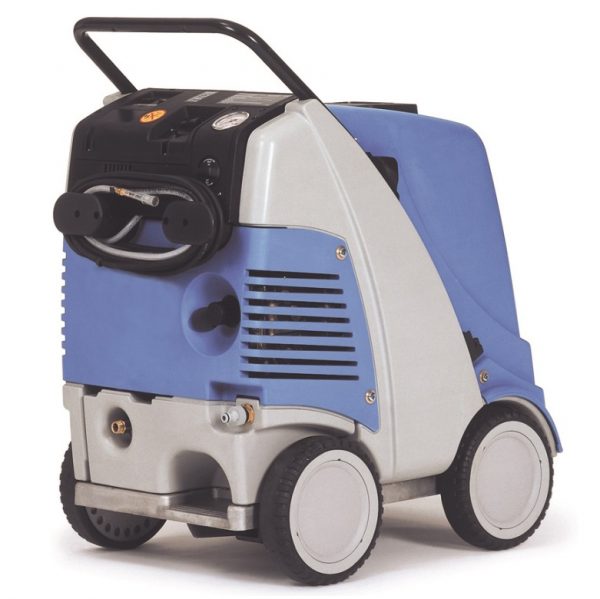
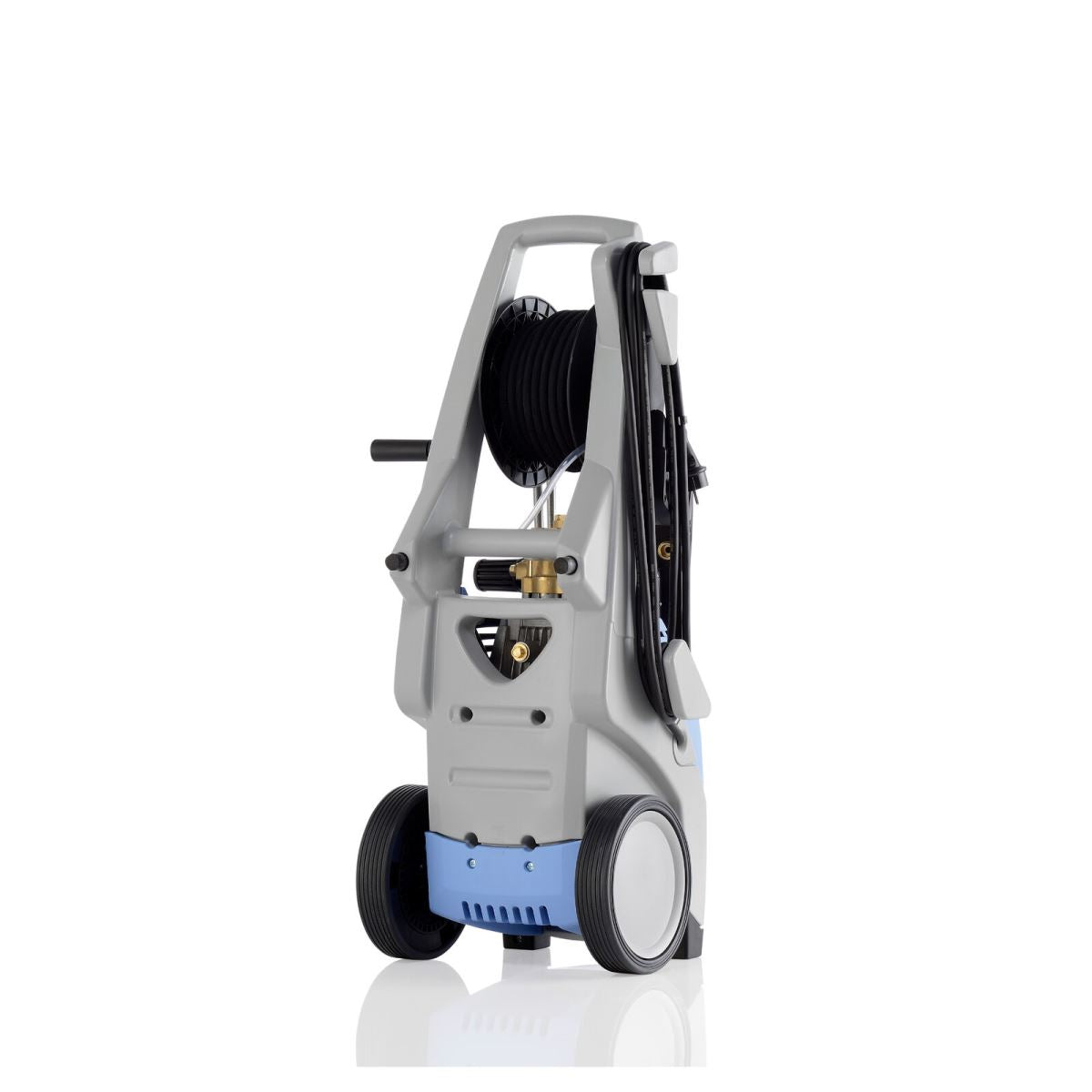
Petrol machines have a place on open industrial slabs. On a residential common area, an electric cold-water unit is usually the more defensible buy: no exhaust in a car park, and a motor that stops when the trigger is released. Figures below are from the Freshway product pages.
| Factor | Kranzle K2160TST | Karcher HD 4/8 Classic | Makita DHW080 |
|---|---|---|---|
| Power source | Electric, standard 10 A, 240 V | Electric, single-phase 240 V, 10 A | Battery, 18 V × 2 (36 V) brushless |
| Pressure and flow (as listed) | 1740 PSI / 120 bar, 11 L/min | 80 bar, 400 L/h (400 ÷ 60 ≈ 6.7 L/min) | Max 8.0 MPa (1160 PSI); max flow 380 L/h |
| Hose / water | 15 m steel-braided hose on a reel | Onboard hose and lance storage | 5 m hose; 50 L storage box that can be used as a water tank; self-priming |
| Weight | 40 kg | 14.37 kg without accessories | 5.3 kg skin; 7.7 kg with batteries |
| Other listed features | 1400 rpm 4-pole motor, described as turning slowly and quietly; Total-Stop | Automatic pressure relief when the trigger is released; retractable pull handle | Cordless; high and low modes; no mains lead across the courtyard |
The K2160TST is listed with a 15 metre hose reel, so it can sit once, away from cars, on a tight driveway. Freshway describes its 1400 rpm, 4-pole motor as turning slowly and quietly; the listing does not give a dB(A) figure, so do not treat it as a measured rating. The HD 4/8 Classic, at 14.37 kg, is easier to take up a service lift. The DHW080 is listed at 5.3 kg without batteries and can draw from its 50 litre box, at a maximum listed 1160 PSI, below the Kranzle's 1740 PSI.


Browse electric pressure washers and the wider commercial pressure washers range when you match a model to the socket, the hose reach and the surface. Check the product page for the figures that apply to the unit you order.
How should residents be told?
Write to all lots, not only the people whose cars sit in the work bay. Say which common areas will be washed, the start and finish window, where to move vehicles, and who to call if access is a problem. If a by-law requires a minimum notice period, meet it; if it does not, still give enough time for people to shift cars.
On the day, put a short reminder at the lobby and the car-park entry, and do not start until the cones, covers and wet-area signs are in place. If a resident will not move a car, shrink the work bay rather than spraying around a bumper.
Checklist before starting
- Read the scheme's current by-laws and note any noise, notice, parking or works rules.
- Check the local council's noise times for the scheme's address.
- Confirm the area is common property the owners corporation maintains.
- Issue written notice: dates, hours, areas, vehicle moves and a contact name.
- Walk the fall of the slab and locate every stormwater inlet runoff could reach.
- Set out cones, vehicle covers or a downhill bund, and a wet-area sign.
- Name the machine in the work order: electric or battery where possible, with hose reach and plug type.
- Confirm an RCD is in use on any plug-in unit, and that leads will not cross a wet walkway.
- Agree where dirty water will be collected or discharged, and that it will not enter a stormwater drain.
- Check that cars in the bay have been moved or protected, then start only inside the booked window.
Frequently asked questions
Can we start at 6 am if most residents have already left for work?
Only if that start time sits inside the scheme's by-laws and the local council's noise rules. Early does not automatically mean allowed. Check both, then put the agreed window in the work order.
It is only water, so can runoff just go down the driveway grate?
No. The NSW EPA states that runoff from washing must not enter stormwater drains and that washing should be confined to a designated wash bay. A driveway grate is usually a stormwater inlet, not a wash bay.
Do we have to specify an electric machine?
Not in every case, but an electric or battery unit is easier to defend on a residential common area than a petrol machine. Name the model, the plug or battery, and the hose reach in the booking so the crew does not arrive with a noisier unit.
Is a verbal heads-up to the building manager enough notice?
No. Check whether the by-laws set a notice method or period, and write to all lots even when they do not. A verbal word to one person does not warn the residents whose cars and courtyards are in the work area.
Next steps with Freshway
Read the scheme by-laws, agree a council-compliant work window, and write the runoff plan and machine class into the booking. Freshway can help you match a quieter electric or battery pressure washer to the socket and the surface; contact the team with the site type and access.
Delivery Across Sydney
Order online for same-day delivery across Sydney, including the Inner West and St George. Click & collect is available from our Arncliffe warehouse. See the electric pressure washers collection to specify a unit for the next wash.