Commercial Glass Cleaner Streaks: Causes and Fixes for Facades and Lobbies
Rank the streak cause, then fix dilution, rubber and drying time.
Shop now
One litre of Eureka Sparklex window cleaning concentrate is listed as making 100 litres of working solution, a 1:100 dilution. A 10 litre bucket therefore needs 10,000 ml ÷ 100 = 100 ml of concentrate. Dose the same bucket at 1:10 and you have put 1,000 ml in — ten times the label rate — and that leftover film is a common cause of streaks on lobby glass. Crews who pick up chemistry in Arncliffe run into this when a bucket is mixed by eye.
How do you fix commercial glass cleaner streaks on facades and lobbies?
Fix commercial glass cleaner streaks on facades and lobbies by ranking the cause first: leftover detergent from overdosing, mineral spots from drying droplets, a dirty or worn rubber, or a salt film on coastal glass. Correct the dilution, change the cloth or rubber, and reclean the pane in shade rather than adding more product.
This article is for cleaners working interior lobby glass and accessible facade panes. Freshway's commercial glass cleaner buying guide covers how to choose a product; this piece is about why streaks appear and how to clear them.
Which streak causes should you rank first?
Work through the causes in this order, because the fix is different for each:
- Overdosed detergent — a cloudy, soapy smear that follows the squeegee path and often looks worse after a second wet pass with the same bucket.
- Mineral spots — hard-edged dots or rings where droplets have dried, especially on sunlit facade glass and near sprinklers.
- Tool marks — repeating lines from a nicked rubber, a dirty microfibre, or a channel that is not sitting flat.
- Salt or atmospheric film — a dull haze on coastal or roadside facades that ordinary glass cleaner only moves around.
If you skip the ranking and just add more chemical, you often make the first cause worse.
How do hard water and overdosing leave a film?
Sydney Water explains how it measures hardness on its page about what's in your water: hardness is the milligrams per litre of calcium carbonate (CaCO3), water below 60 mg/L is classed as soft, water above 60 mg/L is classed as hard, and Sydney Water reports a CaCO3 level of about 57 mg/L. That is just under the hard threshold, and the same page notes that dissolved salts can cause scale. When a droplet dries on glass, those minerals stay behind as spots. Sites outside that supply, or panes wetted by groundwater, irrigation or bore water, can be harder still.
Overdosing is a separate film. Sparklex is listed at a 1:100 yield: 1 litre of concentrate makes 100 litres of solution. For a 750 ml trigger bottle, 750 ÷ 100 = 7.5 ml of concentrate. For a 5 litre bucket, 5,000 ÷ 100 = 50 ml. If a cleaner free-pours "a capful" that is closer to 50 ml into a 750 ml bottle, the mix is about 50 ÷ 7.5 ≈ 6.7 times the listed rate. Ready-to-use products have the opposite problem: they are not meant to be watered down or topped up with another cleaner. Agar Fast Glass is listed with an alkaline pH of 10.7–11.7, and Agar Flash Dry with a milder pH of 8.5 ± 0.5; neither Freshway page gives a dilution rate, so do not invent one. Use each product as the label directs, and remake a stained bucket rather than adding a squirt "to strengthen it".
| Mix | Label yield (as listed) | Working amount |
|---|---|---|
| Sparklex in a 10 L bucket | 1:100; 1 L makes 100 L | 10,000 ml ÷ 100 = 100 ml concentrate |
| Sparklex in a 750 ml bottle | 1:100 | 750 ÷ 100 = 7.5 ml concentrate |
| Same 10 L bucket mixed at 1:10 | Ten times the listed rate | 1,000 ml concentrate in 10 L |
| Agar Flash Dry or Fast Glass | No dilution listed; use as labelled | Do not invent a ratio |
Read the safety data sheet for the product you are using, as WorkSafe Victoria advises, and keep it available to the crew. SafeWork NSW's page on hazardous chemicals notes that cleaners are among the workplace chemicals that must be handled and stored under those rules.
What cloth and squeegee technique actually clears the pane?
Chemistry only wets and loosens the soil. The rubber and the cloth have to take it off in one controlled pass. The Eureka Quad Pro is listed as a swivel handle with a 90° pivot and a rigid extruded aluminium channel, held by a dual spring clamp, and it accepts two-sided or four-sided commercial rubbers. That channel only works if the rubber is straight, the clamp is tight, and you start with a clean, lightly lubricated blade. A nicked edge leaves the same line on every stroke.

Technique that holds up on lobby partitions and storefront panes:
- Wash the glass, then squeegee from a dry top edge, overlapping each stroke so you do not leave a wet strip.
- Wipe the rubber after every stroke; one dirty wipe re-lays the soil you just removed.
- Use a clean, dedicated glass cloth for the edges and the last drips, and retire it when it starts to smear.
- Do not use the same cloth that has already been through a general-purpose detergent.
Replacement channels, rubbers and handles are in the window squeegee collection.
How do you deal with exterior salt films?
Coastal and harbour-facing facades pick up a salt film that is not the same soil as fingerprints on a lobby door. A detergent mix that works indoors may only skate over that film and dry as a haze. Rinse with plenty of clean water first, then apply the specified glass cleaner and squeegee before the pane flashes dry. If spots remain after a clean rinse and a correct mix, you are likely looking at mineral scale rather than detergent residue; a routine glass cleaner is not a scale remover, and you should not invent a harsh acid mix for architectural glass. Test any specialist product on a low corner and follow its label and SDS.
On anything above a solid floor, work from the ground or from a proper access setup. SafeWork NSW's page on working at heights requires a PCBU to protect workers from the risk of falling from one level to another, no matter the height, and to work from the ground or a solid construction where that is practicable.
When should you specify chemistry, and when a pure-water system?
Daily lobby glass, lift doors, mirrors and accessible storefront panes are a chemistry-and-squeegee job: a listed glass cleaner, a clean rubber and a controlled dilution. Some facade contracts already run a pure-water pole system; that is a different method, and you should not pour a detergent mix into a system designed to leave almost no residue. If the site does not have such a system, specify a commercial glass cleaner from the Agar glass and window cleaners range and a squeegee that the crew can keep sharp, rather than a domestic spray bottle topped up from a mop bucket.
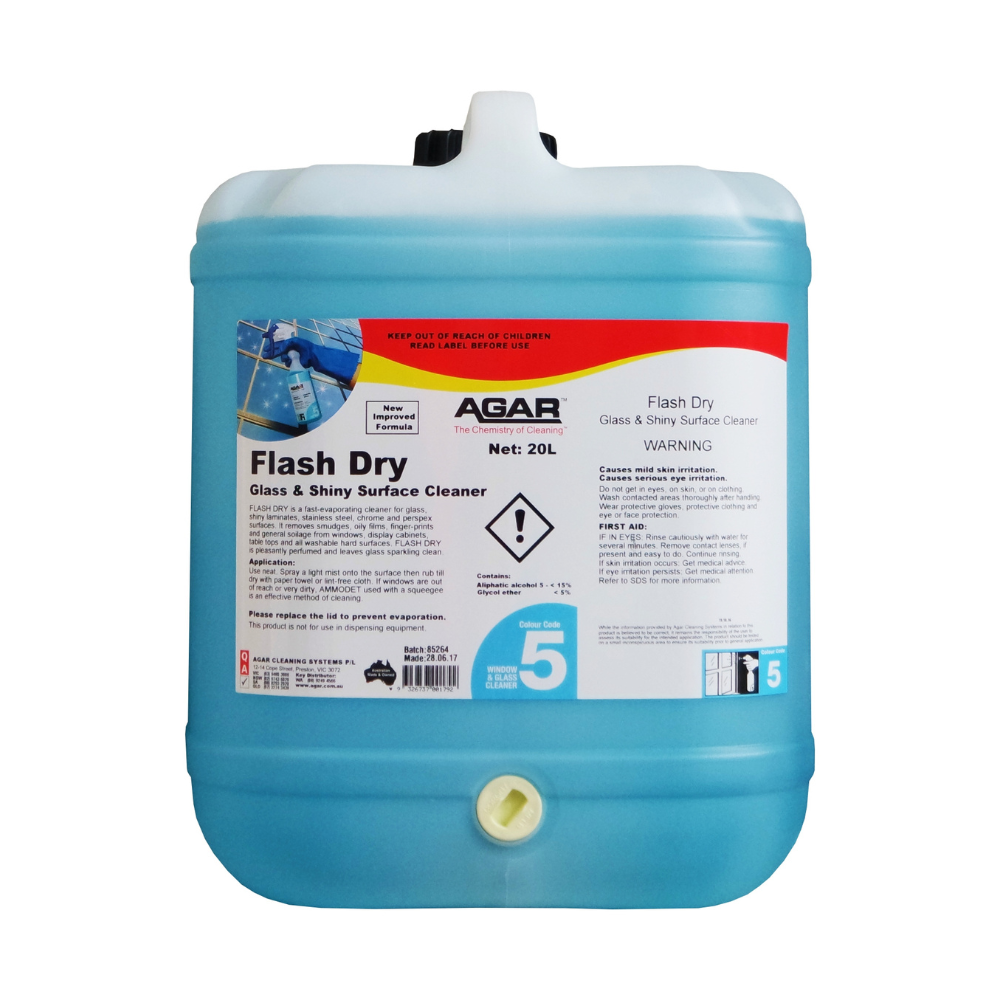
Agar Flash Dry is listed as an alcohol-based, rapid-drying glass and shiny-surface cleaner with a pH of 8.5 ± 0.5 and anti-static properties, in 5 litre and 20 litre sizes, and as not classified as dangerous goods. Agar Fast Glass is listed as a spray-and-wipe cleaner with a pH of 10.7–11.7, also not classified as dangerous goods, for interior and exterior glass, mirrors and high-gloss cabinets. Use Flash Dry where a fast flash-off on indoor glass matters; use Fast Glass where the listed alkaline range is needed for greasier films, still at the label method, not at a stronger homemade ratio.

What weather window should you wait for?
Hot, full-sun glass flashes a mix dry before you can squeegee it, which is how even a correct dilution leaves tracks. Work the sunny elevation early, or wait for shade. Wind dries edges just as fast and blows grit onto a wet rubber. After rain, salt and dust often sit in droplets that dry into spots, so a rinse and a proper pass still matter. Interior lobbies are more about air-conditioning draughts and door traffic than sun, but the same rule holds: do not flood a pane you cannot finish before it dries.
Wet floors around the work are a slip risk. SafeWork NSW lists liquids, water and cleaning methods among common sources of slips on its page on slips, trips and falls. Sign the lobby floor, and wring or replace drop cloths before they become a runway.
Buying commercial glass cleaner in Arncliffe
For crews restocking mid-round, a correctly labelled concentrate and a spare rubber matter more than a new brand name. WorkSafe Victoria's injury hotspots for cleaning page also points to long-handled window squeegees as a way to reduce awkward postures, and tells employers to treat chemicals as potentially hazardous unless the SDS or label says otherwise. Put the dilution on the bottle in millilitres, not as "a splash", and carry a spare rubber so a nicked blade is not used on a full lobby wall.
Other glass chemistry sits in the wider cleaning chemicals range. Check the product page for the current pack size and any label directions before you decant.
Training drills and a short checklist
- Write the dilution on the bucket or trigger: for Sparklex, 100 ml per 10 L, or 7.5 ml per 750 ml bottle.
- Make a fresh mix; do not spike yesterday's bucket.
- Inspect the rubber and channel before the first pane; replace a nicked blade.
- Wash, squeegee from a dry edge, wipe the rubber every stroke, and detail the edges with a clean glass cloth.
- On exterior glass, rinse salt or irrigation film first, and work in shade where you can.
- If streaks remain, change the variable that failed (mix, rubber, cloth or drying time) instead of adding more chemical.
- Sign wet floors, and store leftover product as the SDS directs.
Frequently asked questions
A stronger mix will cut through streaks faster, won't it?
Usually the opposite. Overdosing leaves a detergent film that looks like a streak once it dries. Use the label rate, and remake the mix if the bucket is contaminated.
If the squeegee is new, does the chemistry still matter?
Yes. A new rubber will still leave tracks if the mix is too strong, the glass flashes dry, or the cloth detailing the edges is dirty.
Will more glass cleaner remove hard water spots?
Not reliably. Mineral spots are deposits left when droplets dry, not ordinary fingerprints. Rinse, use the correct dilution, and treat remaining scale only with a product labelled for that job.
Can I clean facade glass in full sun?
You can, but the mix often dries before you finish the pane, which leaves tracks. Work the sunny elevation in shade or earlier in the day, and rinse salt film first on coastal glass.
Next steps with Freshway
Set the dilution in millilitres, put a spare rubber in the kit, and reclean a streaked pane by changing one variable at a time. Freshway can help you match a glass cleaner and a squeegee to lobby and facade work; contact the team with the surfaces you clean.
Pickup & Delivery
Need it today? Pick up from our warehouse at 208 Princes Highway, Arncliffe NSW 2205 — handy for crews in Mascot and Alexandria. Prefer delivery? We offer same-day delivery within Sydney and ship Australia-wide. See the Agar glass and window cleaners collection to restock the next kit.