Noise and Occupied Spaces: Daytime Scrubbing Without Complaints
Most daytime complaints come from where and when you scrub, not the machine.
Shop now
The complaint rarely mentions decibels. It arrives as an email from a tenant on level three saying the cleaner's machine was "droning outside the boardroom all through the 10 o'clock pitch". The scrubber was doing its job. It was simply doing it at the wrong time, in the wrong place, in the wrong mode.
Daytime scrubbing is now normal in offices, hospitals, schools and shopping centres. Floors get cleaned while people are in the building, and the cleaning budget no longer has to pay for a night shift. This guide looks at what the noise rules actually say, how to read the dB(A) figure on a Freshway listing, and the site habits that keep a quiet machine quiet.
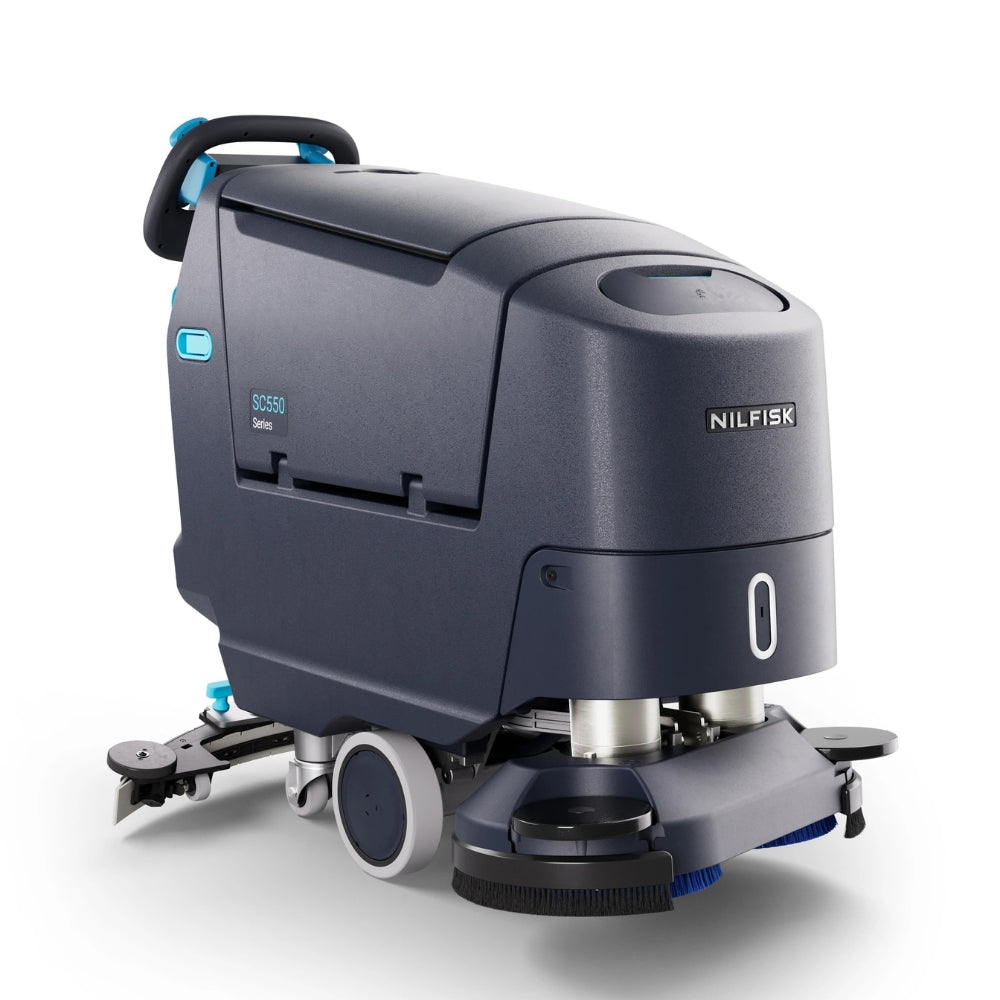
Quiet commercial floor scrubber: the short answer
A quiet commercial floor scrubber for occupied buildings is usually a battery walk-behind listed in the low-to-mid 60s dB(A), ideally with a quiet mode. Pick the machine on its listed figure, then control the rest with timing, zoning and signage. Most daytime complaints come from where and when you scrub, not the machine.
The figures help, but they are not the whole story. A 61 dB(A) machine running beside a meeting room at 10 am can still annoy people, while a louder machine in an empty loading dock at 7 am will not. Treat the spec as your starting point and the site plan as the thing that prevents complaints.
What the noise rules cover, and what they don't
Start with the regulation, because it is often misread. SafeWork NSW explains that the workplace exposure standard is 85 dB(A) averaged over an eight-hour period, and that noise above this level is considered hazardous. Its rule of thumb: if you have to raise your voice to be heard, the level is likely to be 85 dB(A) or more.
Every scrubber in the table below is listed well below that figure. So for a facility manager, the 85 dB(A) standard is about protecting the operator's hearing over a shift, not about whether a tenant finds the machine distracting. Annoyance is a building-management question, and it is handled through purchasing, timing and communication.
The regulator's guidance still points in a useful direction. SafeWork NSW's page on controlling hazardous noise in the workplace suggests a "buy quiet" policy, obtaining noise emission data before purchase, and scheduling noisy activities outside normal hours or on shifts with fewer workers present. WorkSafe Victoria's noise hub gives the same advice in plainer words: buy the quietest tools and machinery available. Those are hearing-safety tools, but they work just as well for keeping tenants happy.
Where scrubber noise comes from
Hearing a scrubber in a corridor, most people notice one sound. In practice there are several, and each has a different fix.
- Vacuum motor. This lifts dirty water through the squeegee and is the steady, high-pitched part of the sound. Freshway's Nilfisk SC500 listing puts the emphasis here, describing an insulated vacuum motor rated at 66 dB(A) or less for daytime cleaning.
- Brush and pad contact. This changes with the floor. Textured safety vinyl and grout lines sound different from smooth sealed concrete.
- Squeegee chatter. Worn or dry blades can squeal on some floors, which is often louder than the motor.
- Transport and handling. Raising and lowering the deck, bumping door frames and dragging a cord all add short, sharp sounds that people notice more than a steady hum.
Reading the dB(A) figure on a spec sheet
Freshway lists a noise level on most scrubber pages. The table below collects the figures for a range of models, from smallest to largest listed figure.
| Model (Freshway listing) | Format and power | Cleaning width | Listed noise level |
|---|---|---|---|
| Nilfisk SC800 71 / 71C | Walk-behind, traction drive, 24 V battery | 710 mm | 61 dB(A) |
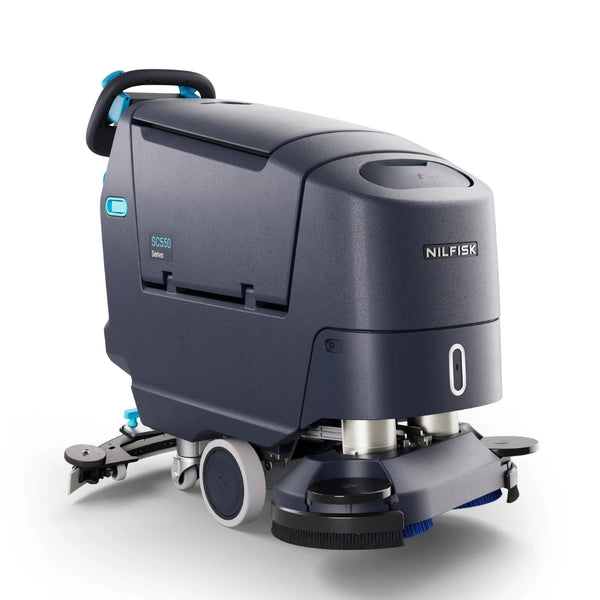
| Nilfisk SC550 CYL 51 / D 61 | Walk-behind, lithium-ion | 508 mm / 610 mm | 65 dB(A) normal; 59–61 dB(A) Silent Mode |
| Nilfisk SC351 | Compact walk-behind, lithium battery | 37 cm | 65 dB(A) |
| Nilfisk SC401 | Walk-behind, maintenance-free battery | 43 cm | 65 dB(A) |
| Nilfisk SC250 | Compact walk-behind, lithium-ion | 34 cm | 66 dB(A) |
| Nilfisk SC500 | Walk-behind, 24 V battery | 510 mm | ≤ 66 dB(A) |
| Nilfisk SC2000 53B | Micro ride-on, battery | 53 cm | 68 dB(A) |
| Hako Wizzard W24N | Compact, 230 V corded, 400 W | 215 mm | 68 dBA |
| Nilfisk SC100 | Upright, 230 V corded | 31 cm | 72 dB(A) |
Two points help when reading it. First, decibels are logarithmic. SafeWork NSW notes that every increase of 3 dB is a doubling of noise intensity. The 11 dB gap between the SC100 at 72 dB(A) and the SC800 at 61 dB(A) works out to roughly 12 times the sound intensity, because 10 to the power of 1.1 is about 12.6. Switching the SC550 from normal mode at 65 dB(A) to Silent Mode at 59–61 dB(A) leaves between about a quarter and 40% of the intensity.
Second, the listings do not state the measurement distance or test method. Figures within one brand's range are more comparable than figures from different brands. Ask for the test basis if two machines are close and the choice depends on it.

Soft-start habits that stop the first complaint
The first 30 seconds in a new area set the tone. Operators who start gently rarely get the email.
- Lower the deck and start the vacuum in a corridor or service area, not outside an occupied office.
- Use the quietest mode the soil allows. On the SC550 that means Silent Mode for routine maintenance passes, with normal mode kept for heavier soil.
- Walk at a steady pace. Constant stopping and restarting is more noticeable than a continuous run.
- Lift the deck and switch off the vacuum before crossing lift lobbies or reception counters.
- Check squeegee blades at the start of each shift. A squeal from a worn blade undoes the benefit of a quiet motor.
Zoning the site for daytime work
Zoning is where most of the complaint reduction happens. Divide the floor plan into three zones and give each a time window.
- Red zones: meeting rooms, consulting rooms, wards, exam halls and open-plan desks. Scrub before arrival, during known quiet periods, or with the quietest machine and mode only.
- Amber zones: corridors, kitchenettes, amenities and lift lobbies. Daytime scrubbing is fine with wet-floor signs and a short pass.
- Green zones: loading docks, plant rooms, car park lobbies and back-of-house. Any time, any mode.
Slips matter as much as noise in occupied areas. SafeWork NSW's slips, trips and falls guidance lists slippery floor surfaces resulting from cleaning products or methods as a hazard, and notes that vinyl is slippery when wet, particularly if polished. A scrubber dryer that picks up cleanly is a big advantage here, but signs stay out until the floor is dry.
Why battery machines help in occupied buildings
A battery takes the cord out of the picture. That matters less for noise than for movement: no cord dragging over door thresholds, no hunting for outlets, and no trip line across a busy corridor. Freshway's SC250 listing makes the same point, describing cordless operation that removes the trip hazard of a trailing power cable during trading hours.
Battery machines bring their own routine. SafeWork NSW's lithium-ion battery guidance says to use chargers designed for the battery type and voltage and not to leave batteries charging unattended or for long periods. Plan a charging spot in a cleaner's room, not under the reception desk.
Corded machines still have a place for small areas, but their leads are worked hard on wet floors. SafeWork NSW's page on electrical inspection and testing covers equipment used where it is exposed to moisture, and refers to AS/NZS 3760 for inspection, testing and tagging methods and frequency. Freshway's guide on battery vs corded floor scrubbers goes further into the trade-offs.
Worked scenarios
Open-plan office, CBD tower. The issue is kitchenettes and lift lobbies during the day, with desks nearby. A compact machine suits this job. The Nilfisk SC351 is listed at 65 dB(A) with a 37 cm path and a rotating deck that scrubs and dries in forward and reverse, so it can work under tables without long passes past desks. Book kitchenettes for 2 to 3 pm, after the lunch rush.
Hospital or aged care corridor. Corridors stay occupied around the clock, so there is no empty window. Choose by mode as well as by figure. The SC550's Silent Mode is listed at 59–61 dB(A), and its listing also mentions personalised PIN access, which helps a supervisor control who runs the machine.
Shopping centre mall during trading. Large areas, constant foot traffic and background music. Here the SC800 stands out: it is listed at 61 dB(A) with a 710 mm scrubbing width and traction drive up to 5.8 km/h, so passes are fewer and quicker. Freshway's guide to scrubbers for public hours in retail centres covers the traffic side.

Common mistakes to avoid
- Treating 85 dB(A) as the target. That figure is the hearing-safety limit for workers. Occupant comfort is a far lower bar.
- Comparing figures across brands as if they were measured the same way. Without the test basis, a 1 to 2 dB difference may not mean much.
- Running full mode everywhere. If a machine has a quiet mode, the method sheet should say where to use it.
- Ignoring squeegee and pad condition. Worn parts can add more noise than the gap between two machines.
- Scrubbing peak foot traffic. Noise complaints and slip risk both rise when people are queuing or moving between meetings.
- Not telling anyone. A short note to tenants or ward staff about cleaning windows heads off most complaints.
Checklist for site supervisors
- Listed dB(A) recorded for every machine on site, with the quiet mode noted where available.
- Floor plan marked in red, amber and green zones with time windows.
- Method sheet states the machine mode for each zone.
- Squeegee blades and pads checked at the start of each shift.
- Wet-floor signs on the machine, out until the floor is dry.
- Battery charging point set up in a back-of-house room. Corded machine leads inspected and tested per site schedule.
- Cleaning windows shared with tenants or ward managers. Complaints logged by time and place, then fed back into the zoning plan.
Quick-fire FAQ
Is a 65 dB(A) scrubber a hearing risk for the operator?
Not on its own. SafeWork NSW sets the exposure standard at 85 dB(A) over eight hours, so check total site noise if unsure.
How much quieter is 62 dB(A) than 65 dB(A)?
About half the sound intensity. SafeWork NSW notes that every 3 dB increase doubles noise intensity.
Can we scrub offices during business hours?
Yes, with a quiet battery machine, zoned time windows and wet-floor signs until the floor is dry.
Battery or corded for daytime work?
Battery, in most occupied buildings. It removes the trailing cord from busy corridors.
Next steps with Freshway
Shortlist machines by listed dB(A) and quiet mode in the floor scrubbers collection, then compare against vacuums and other equipment in commercial cleaning machines. For low-foam products that suit daytime scrubbing, browse cleaning chemicals, and if your vacuums also need to go quieter, read our guide to a quiet commercial vacuum cleaner. Check each product page for current pricing and full specifications.