Retail and Shopping Centres: Scrubbers for Public Hours
Clean to dry, keep it quiet and keep cords off the floor while shoppers walk past.
Shop now
Two retail floors, same Saturday. At 9.15 am a staff member in a 450 m² high-street boutique has 45 minutes to scrub polished concrete before the doors open, and nobody else on shift. At the same moment, a contract cleaner in a suburban shopping centre is starting the first of several laps of a 3,000 m² tiled concourse and food court that will stay open, and full of shoppers, until late.
Both people need a retail floor scrubber. They do not need the same one. This guide works through the two scenarios from the operator's side, then turns them into the checks that decide which machine goes on the order.
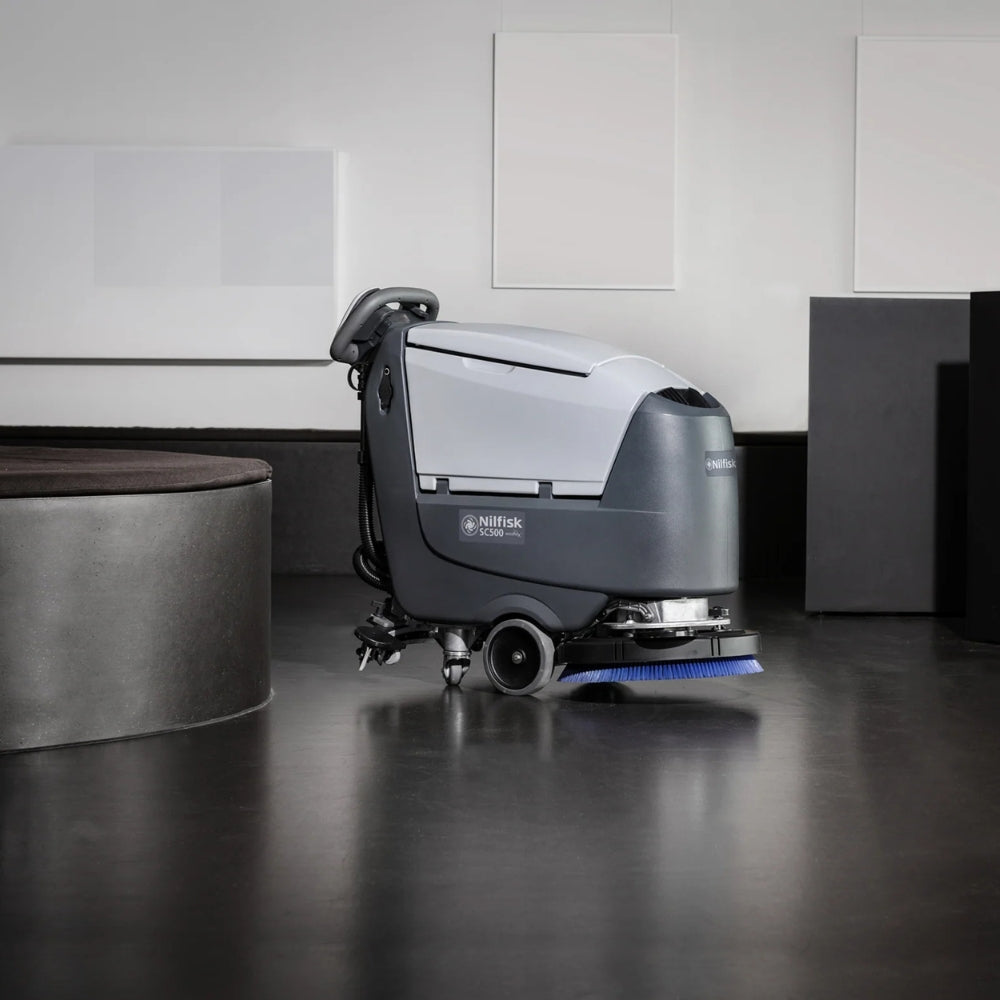
Retail floor scrubber: the short answer
A retail floor scrubber has to leave the floor dry behind it, run quietly beside customers, and fit the narrowest aisle on its route. Small shops usually suit a compact battery machine of around 34 cm. Shopping centres that clean during trading usually need a 50 cm class walk-behind with large tanks and long runtime.
The scenario table below shows why, and the sections after it cover safety, noise, spills and the spec sheet.
Two floors, one Saturday: the scenarios side by side
These are worked examples, not client case studies. Machine figures come from each Freshway listing. Times are theoretical at a steady 3 km/h walking pace, before turns and overlap.
| Factor | Scenario A: boutique | Scenario B: shopping centre |
|---|---|---|
| Floor | 450 m² polished concrete, racks and fitting rooms | 3,000 m² tiled concourse and food court |
| When it is cleaned | Before opening, plus spills during trade | Through trading hours, around shoppers |
| Operator | One staff member, not a full-time cleaner | Contract cleaner on a set route |
| Machine fit | Nilfisk SC250: 34 cm path, lithium battery, 6-litre tanks, 25 kg with battery | Nilfisk SC500: 510 mm path, 40-litre tanks, up to 4 hours runtime |
| Theoretical time | 0.34 m × 3,000 m/h = 1,020 m²/h, so about 26 minutes | 0.51 m × 3,000 m/h = 1,530 m²/h, so about 2 hours |
| Listed noise | 66 dB(A) | ≤ 66 dB(A) |
| Main risk | Running out of time before opening | Wet floor and cords among the public |
Scenario A is a time problem. The SC250's 34 cm path covers 450 m² well inside the 45-minute window, and at 25 kg it is light enough for a non-specialist to steer between racks. Scenario B is a public-safety and endurance problem. The SC500's 2-hour theoretical lap sits inside its listed runtime of up to 4 hours, and its 40-litre tanks cut the number of trips back to the cleaner's room.

Public safety: wet floors, signs and the dry-behind rule
In retail, the floor is shared with the public the whole time it is being cleaned. WorkSafe Victoria lists uneven or slippery floor surfaces and tripping over stock among the most common causes of slips, trips and falls in retail, and tells businesses to clean up spills immediately. SafeWork NSW's slips, trips and falls guidance names slippery floors from cleaning products or methods as a risk, and asks whether wet floor signs are available and used correctly.
The same guidance lists housekeeping and cleaning, signage and limiting access to high-risk areas among the controls. On a shopping-centre floor that means two habits: keep people off any area that is still wet, and do the heavy scrubbing when foot traffic is at its lowest. A scrubber dryer that picks up in one pass is what makes clean-to-dry realistic in a mall. Signs still go out, because the squeegee can miss a strip on a turn.
Cords are the other public hazard. WorkSafe Victoria's guidance includes removing loose objects such as electrical cords from walk areas. That is why both scenario machines are battery models. Freshway's battery vs corded guide covers the trade-off in more depth.
Quiet and visibility during trading
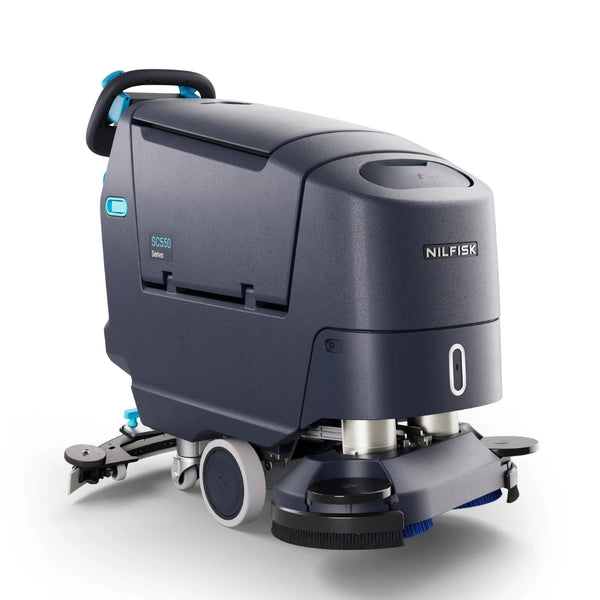
From behind the handle, noise is what customers notice first. SafeWork NSW's hazardous noise guidance explains that every 3 dB increase doubles noise intensity. On Freshway's listings, the Nilfisk Liberty SC60 autonomous scrubber is listed at 57 dB(A) and the SC500 at ≤ 66 dB(A). That 9 dB gap is three doublings, or about eight times the sound intensity. The SC550 is listed at 65 dB(A) normally and 59 to 61 dB(A) in Silent Mode.
Visibility is about the operator, not the machine. Keep the route clear of blind corners where possible, slow down at shop entrances and escalator landings, and let shoppers pass rather than steering around them. The Liberty SC60 is listed for retail and shopping centres during business hours, with obstacle detection and navigation that adapts to changing foot traffic and temporary displays. It still needs a supervisor who knows the route and the stop button.
Spill response between scheduled scrubs
Spills do not wait for the next lap. A dropped drink in an aisle needs a quick, contained response:
- Put a wet-floor sign on each side of the spill.
- Pick up broken glass or packaging by hand or with a pan first.
- Scrub and dry the patch with a compact machine, or blot it if it is small.
- Check the floor is dry before removing the signs.
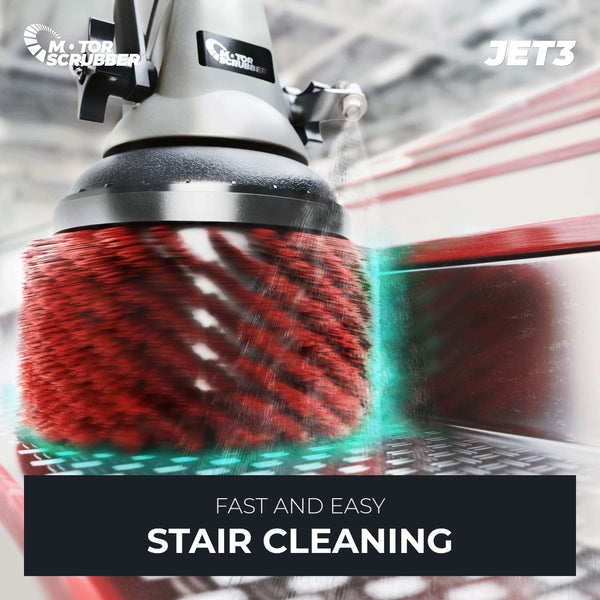
For the spill kit machine, Freshway lists the Kärcher BR 40/10 C for rapid spill response in retail and supermarket aisles. It is a corded 400 mm roller machine that picks up water forwards and backwards. For edges, corners and entrance thresholds, a hand-held tool such as the MotorScrubber JET3 (18 cm scrub head) from the MotorScrubber range can agitate the floor. It has no recovery tank listed, so plan a wet pick-up behind it.
Compact vs mid-size: where each earns its place
Compact machines (around 30 to 40 cm) suit boutiques, pharmacies, cafés and back-of-house corridors. They are light, fit between racks, and a staff member can learn them in one shift. Their limit is tank size: the SC250 carries 6 litres each way.
Mid-size machines (around 50 cm) suit concourses, supermarkets and large-format stores. The SC500 is listed at 75 kg net, with automatic water and detergent flow that adjusts to machine speed. That helps when the operator keeps slowing down for shoppers. Its limit is access: check lifts, service corridors and the door to the cleaner's room before ordering.
Most shopping centres run both: a mid-size machine on the concourse and a compact one for amenities and tenancies. The full line-up is in Freshway's floor scrubbers collection.

Spec-sheet fields to check on a floor scrubber
- Listed noise in dB(A), and whether there is a quiet or silent mode.
- Power and runtime: battery type and listed hours against your longest lap.
- Path width and overall width against the narrowest aisle and checkout gap.
- Solution and recovery litres, which set how often the operator leaves the floor.
- Weight, if a non-specialist has to steer it or it travels between tenancies.
- Electrical testing for corded machines. SafeWork NSW's electrical risks fact sheet gives commercial cleaning equipment as an example for inspection and testing at least once every six months.
Checklist for the operator on shift
- Battery charged on the charger designed for it, as SafeWork NSW's lithium-ion battery guidance recommends, and tanks empty before the shift starts.
- Wet-floor signs on the machine, not back in the cleaner's room.
- Low-foaming floor chemical at the label dilution.
- Route planned to avoid entrances and food-court queues at peak times.
- Recovery water emptied only at the approved sewer point. The NSW EPA's "the drain is just for rain" guidance says runoff from washing work floors must not enter stormwater drains.
- Squeegee blades checked for nicks that leave wet streaks.
Common mistakes to avoid
- Running a corded machine across a busy concourse.
- Buying a mid-size machine that cannot get through the service corridor.
- Removing wet-floor signs before the floor is fully dry.
- Scrubbing over glass instead of picking it up first.
- Choosing on listed productivity alone and ignoring noise and runtime.
Frequently asked questions
Isn't a mop quicker for a small spill?
For a few drops, yes. For a full drink or a wider patch, a scrubber dryer leaves the floor dry in one pass, while a mop leaves a wet film that needs signs until it dries.
Can we really scrub while shoppers are in the centre?
Yes, if the machine picks up in one pass, runs on battery, and the operator uses signs and a planned route. Schedule the heavy work for the quietest hours.
Wouldn't a bigger machine finish the concourse faster?
On open floor, yes. In aisles, food courts and service corridors, a wider machine can lose that time on turns and access, so check the narrowest gap first.
Does a robot scrubber remove the need for a cleaner?
No. Someone still has to set the route, empty and fill the tanks, charge the batteries and deal with spills and obstacles.
Next steps with Freshway
Write down your floor area, cleaning window, narrowest aisle and whether the centre stays open while you clean, then compare the machines above. Check each product page for current pricing. Freshway's Service & Repairs workshop in Arncliffe services floor scrubbers, with pick-up and delivery for commercial clients across Sydney. For the rest of a retail or office cleaning kit, see the shop-by-industry page and the office cleaning equipment checklist.