Battery vs Corded Floor Scrubbers for Commercial Sites
Let the site's power points and foot traffic decide between battery and cord.
Shop now
Freshway lists two versions of the Hako Wizzard W34P side by side. Both have a 315 mm cleaning width, a 4 litre solution tank and a theoretical rate of up to 350 m² per hour. One runs from a 230 V power point through a 600 W mains motor. The other, the W34P/DC, runs on a lithium-ion battery.
On paper they clean the same floor at the same speed. So for this pair the choice has nothing to do with cleaning performance. It comes down to the building: where the power points are, who walks through the work area, and where a charger can safely live. That is how a buyer should frame battery vs corded for most commercial sites, and it is the angle this guide takes.
Battery vs corded floor scrubber: the short answer
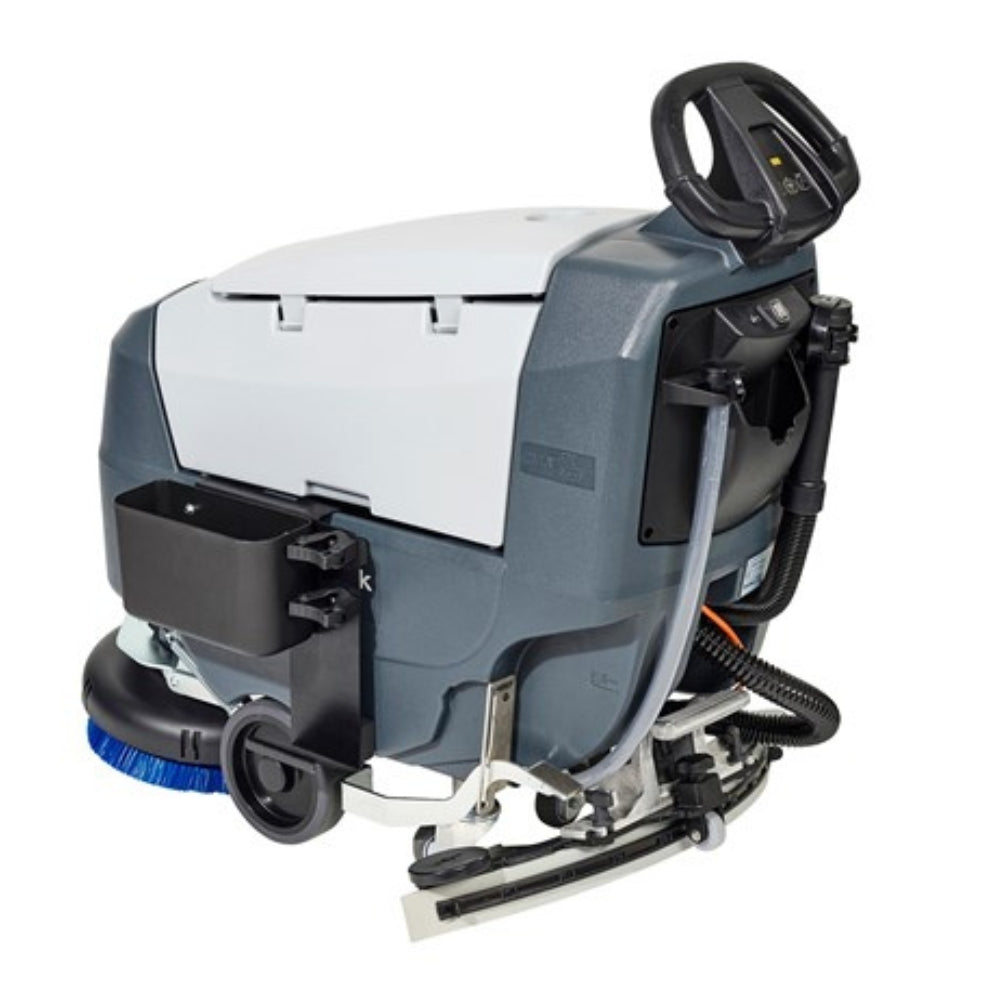
Choose battery where people, doors and long aisles make a trailing lead risky, or where power points are far apart. Choose corded where rooms are compact, outlets are close, the area is closed while cleaning and there is nowhere to charge. Either way, check the outlet rating, RCD protection and charging location first.
For sizing a battery machine to a route, Freshway's battery floor scrubber guide goes deeper. This article stays with the power question.
Runtime planning: what actually stops the machine
A corded machine is often sold as having unlimited runtime. The mains supply will not run out, but the tanks still do. Kärcher Australia's BR 40/10 C page lists mains operation, 10 litre fresh and dirty water tanks and water consumption of 1 litre per minute. That is roughly 10 minutes of scrubbing per fill (10 ÷ 1). At the page's practical rate of 300 m² per hour, one fill covers about 50 m² (300 × 10 ÷ 60).
So the corded machine stops for water every few rooms. A battery machine stops for whichever runs out first: charge, solution or recovery space. On a large floor the tank is often the real limit for both.
Ask three questions of any shortlist. How long between refills? How far is the fill and dump point? And for a battery machine, does the stated runtime belong to the exact battery package being quoted?
Charge infrastructure: where the battery machine sleeps
A battery scrubber moves the power problem from the floor to the store room. It still needs an outlet, just one fixed point instead of many. Freshway's listing for the Nilfisk SC401 describes a maintenance-free battery with an onboard charger, and the Hako Scrubmaster B12 listing describes a 24 V system with an integrated on-board charger.
Battery type changes what that room needs. SafeWork SA warns that lead acid batteries release hydrogen and oxygen while charging, which can cause an explosion. It advises charging in a well-ventilated area, using the right charging regime for flooded, gel or AGM batteries, and topping up flooded cells with distilled or de-ionised water. Check the battery type on the product page before you choose the charging spot.
The routine itself (when to charge, opportunity charging, records) is covered in Freshway's floor scrubber battery charging guide.

Trip hazards of cords in occupied buildings
This is the strongest argument for battery power in any building that stays open while it is cleaned. SafeWork NSW's guide to preventing slips, trips and falls names "not enough power points within range" as a cause of trailing cables and cords. Its suggested controls include installing more outlets where work happens, routing cables overhead and encouraging cordless tools.
WorkSafe Victoria's injury hotspots for cleaning makes the same point for cleaners: install more power points to eliminate long power leads.
Do the reach maths before buying. Freshway lists a 12 metre cable on the Kärcher BR 30/4 compact scrubber. From an outlet in the middle of a 30 metre corridor, that reaches 12 metres each way, or 24 metres in total. The last 3 metres at each end need another outlet or an extension lead, and every swap is a moment when the cord crosses a walkway.
Power availability: can the outlet carry it?
A standard 10 A power point at 240 V supplies up to 2,400 W (10 × 240). Kärcher Australia lists the BR 40/10 C at a maximum rated input of 2,300 W. That is about 9.6 A at 240 V (2,300 ÷ 240), and about 10.5 A at the bottom of its 220 to 240 V range. There is very little headroom, so do not share that outlet or a double adaptor with a vacuum or a kettle.
Smaller corded machines are easier. The Wizzard W34P's 600 W works out to about 2.5 A at 240 V (600 ÷ 240).
Then the protection. SafeWork NSW's RCD page lists equipment moved while in operation, including floor polishers and extension cords, among common examples that need RCD protection. Its inspection and testing guidance says plug-in equipment used where moisture is likely must be inspected and tested by a competent person, with AS/NZS 3760 setting the methods. A wet scrubber, its lead and any extension lead all fit that description, and so does a battery charger kept in a damp cleaner's room.

Cost of batteries, and the costs a cord hides
Battery machines carry costs that corded ones do not: the battery pack, its eventual replacement, the charger and the space it occupies. Corded machines have their own, they are just less visible. Check each product page for current pricing, then add the items below to the comparison.
| Factor | Battery scrubber | Corded scrubber |
|---|---|---|
| What ends a session | Charge, solution or recovery tank, whichever runs out first | Solution or recovery tank |
| Trip risk while cleaning | No trailing lead | Lead across the work area, plus outlet swaps |
| Power during cleaning | None | An outlet within cable reach, rated for the machine |
| Fixed infrastructure | One charging point; ventilation if lead acid | Enough outlets along the route |
| Electrical checks | Charger and its lead | Machine lead, extension leads, RCD |
| Ongoing cost items | Battery replacement, charger, water top-ups for flooded cells | Leads, RCDs, test and tag, labour time moving the cord |
| Usual fit | Occupied buildings, long aisles, daytime cleaning | Small closed rooms, kitchens, amenities, short jobs |
The labour line is easy to miss. Every unplug, walk and replug is paid time.
When corded wins
Corded machines make sense where the room is small, the outlet is close and nobody else is in the space. Commercial kitchens, toilet blocks and plant rooms cleaned after hours fit well. The Kärcher BR 40/10 C, for example, lists brush contact pressure of 20 to 30 kg and roller brushes at 1100 RPM, which suits small tiled areas.
Corded also wins where there is nowhere suitable to charge: no ventilated store room, or a site you visit once a week with a machine in the van.
And it avoids a battery that sits flat between infrequent jobs.
Spec-sheet fields to check on a floor scrubber
For battery machines, compare energy rather than amp-hours alone. Volts multiplied by amp-hours gives watt-hours. Freshway lists the Nilfisk BR855 with four 6 V 400 Ah batteries, which in series make 24 V (4 × 6), or about 9.6 kWh (24 × 400). The Kärcher BR 75/75 W Classic Bp Pack lists 24 V and 170 Ah, about 4.1 kWh. Ask which discharge rate each Ah figure is quoted at, because figures at different rates do not compare.
| Field | Battery | Corded | Why a buyer cares |
|---|---|---|---|
| Power | Voltage and Ah, or kWh | Rated input in watts | Runtime on one side, outlet load on the other |
| Battery type | Lithium, AGM, gel or flooded | Not applicable | Sets the charging room and the maintenance |
| Charger | Onboard or separate | Not applicable | Onboard needs only an outlet at the parking spot |
| Cable length | Not applicable | Metres from the outlet | How many outlets the route needs |
| Tank sizes | Litres | Litres | Refill stops for both types |
| Productivity | Theoretical and practical m²/h | Theoretical and practical m²/h | Kärcher lists 400 and 300 for the BR 40/10 C |
Checklist for site supervisors
- Walk the route and mark every power point, door and lift.
- Note the hours the area is occupied while cleaning happens.
- For corded options, confirm cable reach and outlet rating against the machine's rated input.
- Confirm RCD protection and current test tags on the machine, leads and any charger.
- For battery options, choose the charging spot and check ventilation against the battery type.
- Time a refill cycle on a trial clean, for either power type.
- Record who is trained to use, charge and clean the machine.
Frequently asked questions
Is a battery floor scrubber safer than a corded one?
It removes the trailing lead, which SafeWork NSW identifies as a trip hazard where power points are out of range. It adds charging risks instead, and SafeWork SA says lead acid batteries should be charged in a well-ventilated area.
Can a corded floor scrubber run from a standard power point?
Often, but check the rated input. A 10 A outlet at 240 V supplies up to 2,400 W. Kärcher lists the BR 40/10 C at a maximum of 2,300 W, about 9.6 A, which leaves very little headroom.
Does a corded scrubber need an RCD and test and tag?
SafeWork NSW lists floor polishers and extension cords moved while operating as examples that need RCD protection. Plug-in equipment exposed to moisture must be inspected and tested by a competent person under AS/NZS 3760.
Does a corded scrubber clean for longer without stopping?
Not always. The tank still sets the pace. Kärcher lists the BR 40/10 C with 10 litre tanks and water use of 1 litre per minute, so it needs a refill about every 10 minutes.
Next steps with Freshway
Bring the route notes and outlet map to the conversation, then compare two or three machines from the floor scrubbers collection. If the site also needs vacuums or sweepers, the wider commercial cleaning machines range sits alongside it, and Freshway can confirm battery type, charger and cable details for each model before you order.