Commercial Scenarios: Industrial Yards and Equipment
On yard soils, flow carries the dirt, heat loosens oil and the pump sets the lifespan.
Shop now
Here is the uncomfortable truth about industrial yards: the machine with the biggest pressure figure is rarely the one that gets the yard clean first. On caked mud, hydraulic oil and diesel soot, flow does the carrying, heat does the loosening, and the pump's duty rating decides whether the machine is still running in year three.
That reverses the usual buying habit, which starts with PSI and works backwards. This guide starts with the soil, works through the numbers an engineer would check, and ends with the lockouts and runoff rules that apply on Australian sites.
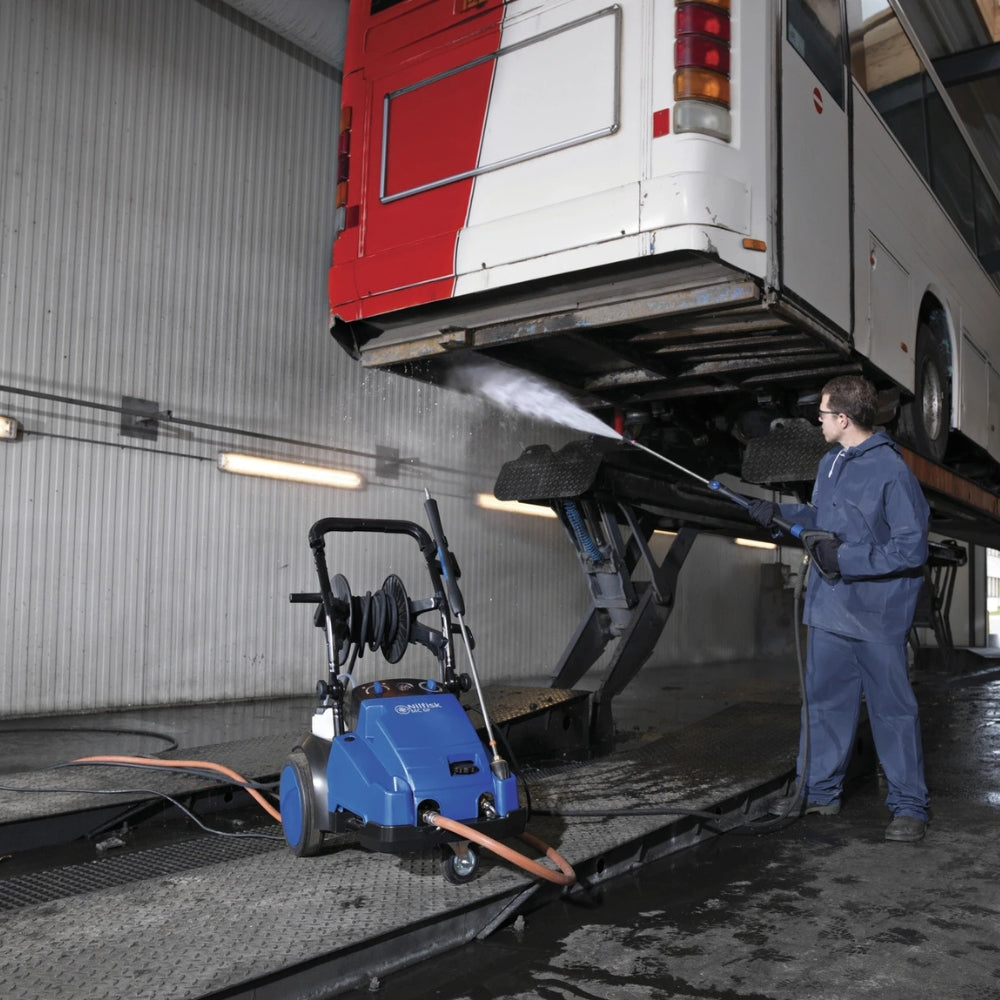
Industrial pressure washer yard: the short answer
Choose an industrial pressure washer for a yard by soil type, duty hours and site power, then check pressure. Heavy mud needs flow: roughly 17 to 21 L/min on the machines compared below. Oil and grease need hot water. Long shifts need a slow-running pump. Runoff must go to a wash bay, not stormwater.
Everything below expands on those four decisions in the order they usually come up on site.
Heavy soils: start with what is on the ground
Yard soils fall into three broad groups, and each points to a different part of the spec sheet.
- Loose and caked mud, clay and slurry. Mostly mechanical. The jet breaks it up and the water volume carries it away. Look at flow first.
- Oil, hydraulic fluid, grease and diesel soot. Cold water tends to move oil around. Freshway's hot water listings, such as the Kränzle Therm-RP1200, describe heated water as the tool for melting grease and hydraulic fluid. Look at temperature and burner details.
- Mixed soil on plant and equipment. Excavators, forklifts and trailers usually carry both. Plan for hot water with enough flow to rinse the loosened mud.
If the yard is mostly group 1, a high-flow cold machine may be all you need. If group 2 shows up daily, budget for heat from the start rather than trying to fix it with more chemical. Freshway's overview of industrial and manufacturing cleaning supplies covers the wider kit for these sites.
Pump duty: matching the machine to the shift
An engineer looks at the pump before the pressure. Yard work means long trigger-on periods, frequent start and stop, and dirty water supplies, which punish light-duty pumps.
Freshway's listings give the clues to look for:
- Nilfisk MC 6P 250/1100 FA: listed as designed for more than five hours of continuous use per day, with an NA6 wobble disc pump running at 1450 RPM with four ceramic pistons, and flow-activated control to reduce wear during frequent stop-start trigger use.
- Kränzle Therm-RP1200: listed with a 4-pole motor at 1400 RPM, described as built to run continuously for 8-hour commercial shifts.
- Kärcher HDS 10/20-4 M: listed with a 4-pole, low-speed motor that Freshway describes as allowing continuous running without overheating.
Low pump speed, ceramic pistons and a stated duty period are the fields to compare. A machine without a duty statement on its listing is worth a phone call before it goes onto a full-time roster.
The numbers: pressure times flow, and what they predict
Pressure and flow multiply into one figure: bar × L/min. WorkSafe Victoria uses that figure in its high-pressure water jetting safety alert, which explains that AS 4233.1 defines Class A systems as 800 to 5,600 bar litres per minute and Class B as more than 5,600. The same number is a quick way to compare machines on cleaning output.
Flow also tells you how much wastewater you will create. Multiply L/min by 60 for litres per hour.
| Machine (Freshway listing) | Listed pressure | Listed flow | bar × L/min | Water per hour | Heat and power |
|---|---|---|---|---|---|
| Nilfisk MC 6P 250/1100 FA | 250 bar | 18.3 L/min (max) | 4,575 | about 1,100 L | Cold; accepts inlet water up to 80°C; 415 V 3-phase, 8.5 kW |
| Kränzle Therm-RP1200 | 190 bar | 20 L/min | 3,800 | 1,200 L | Up to 140°C, diesel burner; 415 V, 20 A |
| Nilfisk PP6012MAG-35HG skid | 240 bar | 21 L/min | 5,040 | 1,260 L | Up to 120°C wet steam; Honda GX630 petrol engine, diesel burner |
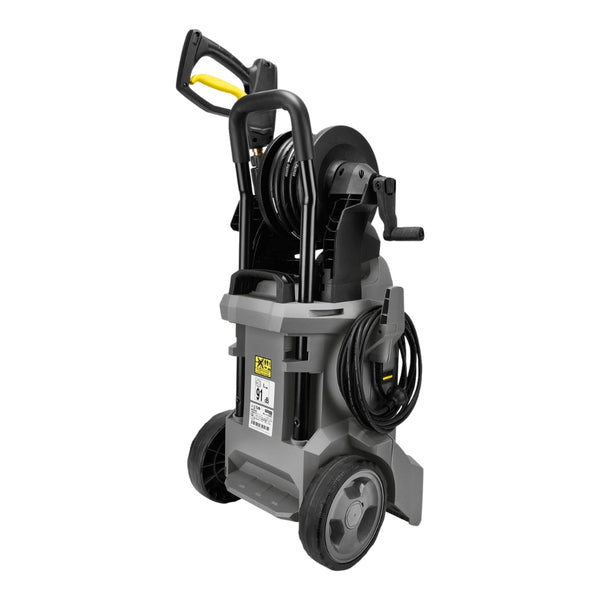
| Kärcher HDS 10/20-4 M | 240 bar (max) | up to 1,000 L/h (16.7 L/min) | about 4,000 | up to 1,000 L | 80–155°C, diesel burner; 400 V 3-phase |
Three things stand out. All four sit inside the Class A range on their listed figures. Class is set by maximum output capability, so confirm the data plate rather than relying on a working-pressure figure. Pressure and flow do not rise together. The Therm-RP1200 has the lowest pressure in the group but the second-highest flow, while the MC 6P has the highest pressure but not the highest flow. And one hour of trigger time on any of them produces more than a thousand litres of dirty water that has to go somewhere legal.

When hot water earns its place
Heat is the difference between moving oil and removing it. Freshway's hot water listings in this class range from 120°C wet steam on the PP6012MAG skid to 140°C on the Therm-RP1200 and up to 155°C on the HDS 10/20-4 M.
There is also a middle path. The MC 6P is a cold water machine, but its listing says it accepts inlet water up to 80°C. A site with a hot water supply can feed it warm water for greasy jobs without running a burner on the machine.
Burner machines add fuel to the routine. The Therm-RP1200 lists a 35-litre diesel tank, the HDS 10/20-4 M a 25-litre tank, and the PP6012MAG two 45-litre tanks for petrol and diesel. Fuel storage, refuelling and burner servicing all become part of the site's maintenance plan. Freshway's service and repairs team can help keep burners and pumps on schedule.
Power and fuel on an industrial site
Most yard-class electric machines are three-phase. The MC 6P and Therm-RP1200 are listed on 415 V, and the HDS 10/20-4 M on 400 V three-phase, so check the outlet near the wash area before ordering. Leads and plugs live in wet conditions. SafeWork NSW's page on electrical inspection and testing covers equipment exposed to moisture and points to AS/NZS 3760 for testing methods and frequency.
Where there is no suitable power, engine-driven units fill the gap. The PP6012MAG is a skid with forklift pockets and lifting points, designed for truck or trailer mounting. Engines bring exhaust, though. SafeWork NSW's carbon monoxide guidance says work in enclosed or restricted spaces carries a higher risk, and recommends substituting electrically powered plant where practicable. Keep engine units outdoors and use electric machines inside workshops and sheds.

Safety lockouts and isolation
Two kinds of lockout matter in a yard. The first is the equipment being washed. SafeWork NSW's plant and machinery guidance describes lock out tag out (LOTO) isolation procedures for tasks including cleaning of plant. Before a conveyor, mixer or loader is washed down, it should be isolated, locked and tagged under the site's procedure.
The second is the washer itself. The Therm-RP1200 listing describes a Total-Stop system that shuts the motor off when the trigger is released, plus optical flame monitoring, a safety thermostat and a low-fuel cut-out. The MC 6P uses flow-activated control. These features protect the pump and burner, but they do not replace operator controls. WorkSafe Victoria's alert lists the main jetting risks as the jet piercing skin, flying debris, and a flailing hose, out-of-control nozzle or separated coupling striking someone.
Spec-sheet fields to check on a pressure washer
- Flow in L/min. Convert L/h by dividing by 60. For yards, compare flow before pressure.
- Bar × L/min. A quick output comparison, and the basis for the AS 4233.1 class.
- Duty statement and pump design. Continuous-use hours, RPM, piston material.
- Heat. Maximum temperature, burner fuel and tank size, or maximum inlet temperature for cold machines.
- Power supply. Single or three phase, voltage and plug rating, or engine type.
- Safety systems. Total-Stop or flow-activated control, flame monitoring, low-fuel cut-out.
- Chemical handling. The MC 6P lists two onboard detergent tanks, and the HDS 10/20-4 M two 10-litre tanks.
Common mistakes to avoid
- Buying on PSI alone. A high-pressure, low-flow machine can cut mud loose and then leave it on the slab.
- Using cold water for daily oil and grease. More chemical becomes the workaround, and more chemical goes into the runoff.
- Running a petrol or diesel unit inside a shed. Use electric plant indoors where practicable.
- Washing plant that is not isolated. Locks and tags go on before the lance comes out.
- Washing on open ground near a stormwater pit. The NSW EPA says runoff from washing cars, equipment or work floors must not enter stormwater drains, and should be confined to a designated wash bay.
Checklist for site supervisors
- Soil type recorded for each wash area: mud, oil, or mixed.
- Machine flow, heat and duty statement matched to that soil and the shift length.
- Three-phase outlet or engine location confirmed, with engines kept outdoors.
- LOTO procedure in place for every item of plant that gets washed.
- PPE set by risk assessment, with an exclusion zone around the operator.
- Wash bay with a collection pit directed to sewer, or treatment on site. In Sydney, Sydney Water lists truck washes among businesses likely to produce industrial trade wastewater, so check approval requirements.
- Hoses, couplings and leads inspected before each shift.
Frequently asked questions
Shouldn't we just buy the highest-pressure machine for the yard?
Not on pressure alone. For heavy mud, flow carries the soil away, so compare L/min and bar × L/min first, then check heat and pump duty.
Can we hose the yard straight into the stormwater pit?
No. NSW EPA says washing runoff must not enter stormwater drains. Use a wash bay that drains to sewer under a trade waste agreement, or treat the water on site.
We have no three-phase power. Is hot water out of the question?
No. Engine-driven skids such as the Nilfisk PP6012MAG-35HG run off-grid, and Freshway also lists single-phase hot water models. Check each listing for its power supply.
Isn't it fine to run a petrol unit inside if the roller door is open?
Not a safe assumption. SafeWork NSW says enclosed spaces raise carbon monoxide risk and recommends electric plant where practicable.
Next steps with Freshway
Compare yard-class machines in the industrial pressure washers collection, and narrow down by heat in hot water pressure washers, or by power source in electric and petrol pressure washers. Check each product page for current pricing and full specifications.