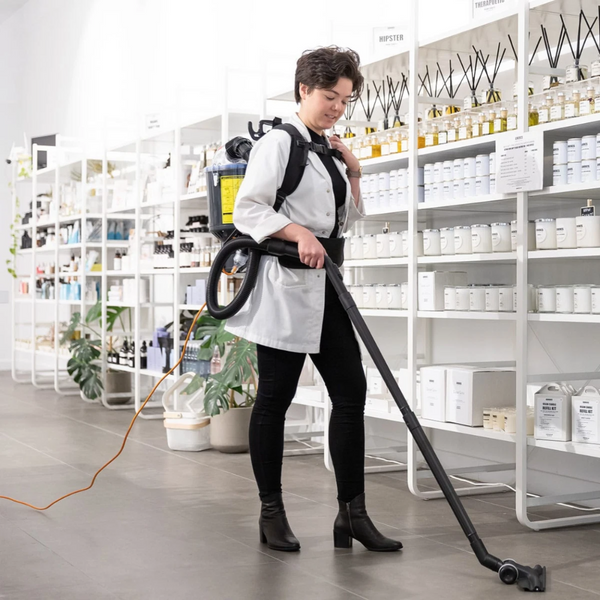
Pacvac is the brand most Australian commercial cleaning teams standardise on, and the range has grown to the point where the model decision is no longer obvious. There are now three backpack tiers plus two canisters, and the differences between them are filtration, harness and configuration rather than raw suction.
Filtration and harness, not the price tier
The Pacvac backpack range splits into three tiers. The Thrift 650 at A$339 is the entry machine for general commercial work. The Superpro 700 at A$389 adds a heavier-duty harness and a wider consumable range. The Superpro Micron at A$499 adds finer filtration for dust-sensitive environments. Suction is broadly similar across all three.
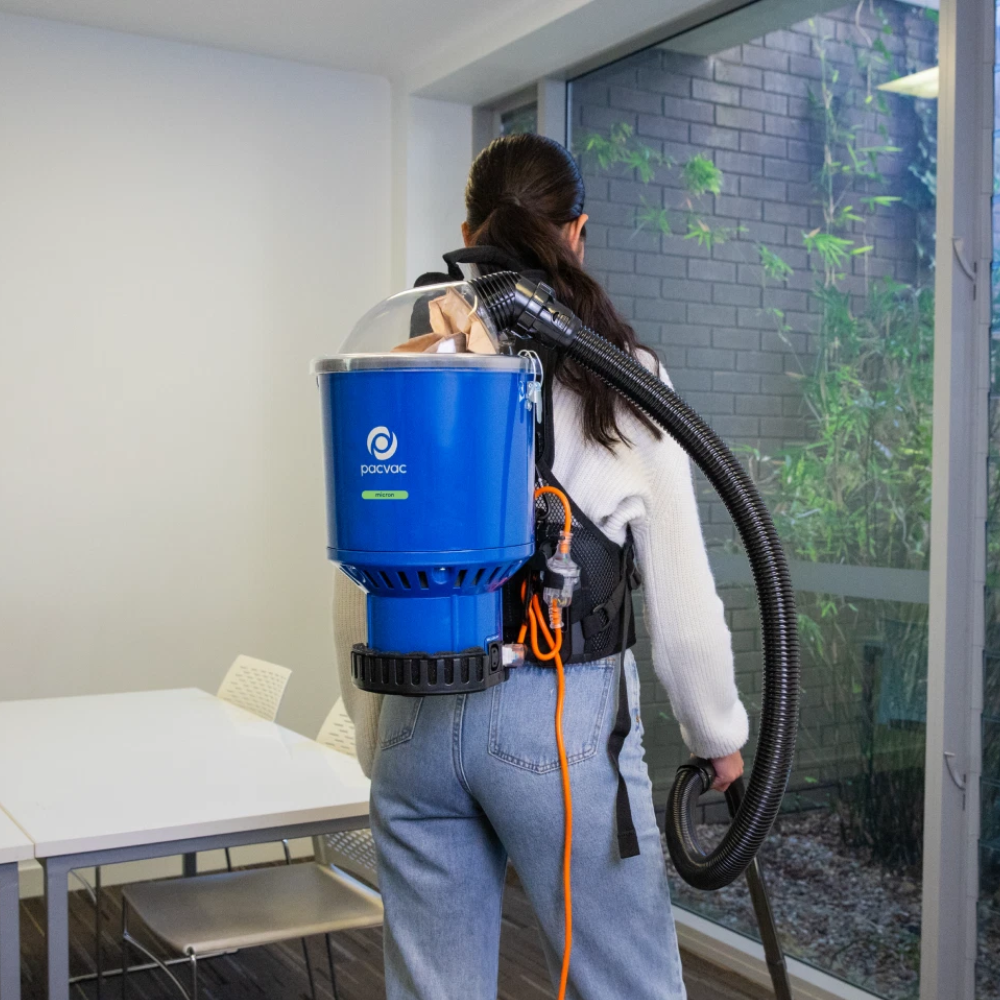
That is the key point most price comparisons miss. Moving up the range buys you filtration, configurability and harness comfort — the things that determine whether a team can wear the machine for a full shift, and whether the site accepts the machine at all.
Prices are Freshway catalogue prices as at 16 September 2026 and are subject to change. Confirm the current price, and whether GST applies, before quoting.

The range at a glance
| Model | Form | Positioning | Price |
|---|---|---|---|
| Glide 300 | Canister | Compact canister for smaller sites and vehicle use | A$299.00 |
| Thrift 650 | Backpack | Entry commercial backpack | A$339.00 |
| Superpro 700 | Backpack | The standard commercial workhorse | A$389.00 |
| Hush (with HEPA filter) | Canister | Quiet canister for noise-sensitive buildings | A$429.00 |
| Superpro Duo | Backpack | Dual configuration for larger teams and mixed tasks | A$479.00 |
| Superpro Micron | Backpack | Finer filtration for dust-sensitive environments | A$499.00 |
Note the ordering. The Hush canister at A$429 sits between two backpacks on price, and the only reason to choose it is noise. Where a site is cleaned during business hours in a quiet environment, that is sometimes the deciding factor rather than a specification the buyer originally intended to trade on.
Superpro 700, Duo and Micron: what actually differs
| Superpro 700 | Superpro Duo | Superpro Micron | |
|---|---|---|---|
| Price | A$389.00 | A$479.00 | A$499.00 |
| Primary difference | Baseline commercial specification | Dual configuration for mixed tasks | Finer filtration stage |
| Consumable support | Widest — bags, filters, harnesses, switches, motors | Shares most Superpro consumables | Filter consumables differ |
| Suits | General commercial cleaning, multi-level buildings | Teams running more than one configuration | Sites with dust sensitivity or fine-dust loads |
| Best for a fleet | Yes — standardise here | Only if you genuinely need two configurations | Only where filtration is specified |
The practical recommendation for most cleaning businesses is to standardise on the Superpro 700. It is the model with the deepest parts and consumable support, and standardising a fleet on one model means one set of bags, one set of filters and one set of spare harnesses rather than three.
Thrift 650: where it fits
The Thrift 650 at A$339 is A$50 below the Superpro 700 and does the same basic job. The trade-off is in the harness and in the range of available consumables rather than in cleaning performance.

It suits a small operation, a single-site user, or a site where the machine is shared between a few people rather than worn continuously. Where a cleaner wears a backpack for six or eight hours, the Superpro harness is worth the A$50 — that is the honest comparison, and it is an ergonomics decision rather than a specification one.
Filtration: what the micron models change
Filtration on a commercial backpack works in stages: a bag or cone filter captures bulk soil, a pre-motor filter protects the motor, and an exhaust filter governs what leaves the machine and re-enters the room.
The Micron tier targets that final stage. It matters where fine dust is present, where the building is occupied during cleaning, or where occupants have dust sensitivities. For general commercial cleaning — carpets, hard floors, offices — the standard Superpro filtration is the appropriate specification, and the micron upgrade is cost without benefit.
Where a site does specify filtration levels, check what is actually required rather than defaulting to the highest option. We stock both genuine and compatible Pacvac filters and Pacvac dust bags, so the filtration level can be raised on a machine you already own rather than requiring a new purchase.
Bags, filters and what a year actually costs
Pacvac consumables are where the ownership cost sits, and the choice between genuine and compatible matters more here than on the machine itself.
| Item | Fits | Price |
|---|---|---|
| Disposable paper dust bag, 2.5 L, pack of 10 | Velo | A$15.50 |
| Disposable paper dust bag, 5 L, pack of 10 | Thrift, Micron | A$22.95 |
| Disposable SMS cone dust bag, pack of 10 | Superpro series | A$21.95 |
| Reusable SMS cone dust bag, 5 L | Superpro series | A$19.95 |
| Reusable SMS sealed dust bag, 15 L | Glide 300 series | A$18.50 |
| Pre-motor cone filter | Superpro series | A$19.95 |
| Exhaust foam filter | Superpro 700 | A$9.50 |
Harness and frame service kit SEK018
|
Superpro backpack | A$75.00 |
| Thrift filtration service kit | Thrift 650 | A$48.00 |
Two decisions drive annual cost. Reusable bags cost more per unit and replace disposable bags only where the site will actually empty and reuse them — many teams buy reusable and then use them once. And the harness service kit at A$75 is what keeps a backpack comfortable into its third year; sites that skip it usually replace the whole machine earlier than necessary.
How long a Pacvac lasts, and what shortens it
A Pacvac backpack in commercial daily use commonly runs for several years, and the failures that end its life early are predictable:
- Motor brushes and motors — available separately, so motor wear is a repair rather than a replacement machine.
- Harness and frame — the part that fails first because it takes the physical load. The service kit exists for exactly this.
- Seals and latches — cheap parts that, when ignored, cause air leaks and the impression of lost suction.
- Filters run past their interval — the single most common cause of reported suction loss, and almost never a motor problem.
We stock 60-plus Pacvac parts and consumables, including motors, switches, latches, cords and harness components, and our service team handles backpack vacuum repairs.
Frequently asked questions
- How long does a Pacvac last?
- In daily commercial use, several years is normal. The motor, brushes and harness are all available as separate parts, so the machine does not have a defined end of life — it reaches a point where the cost of another round of parts exceeds the value of the machine, which is usually later than owners expect.
- How much does a Pacvac cost?
- In our range the machines run from A$299 for the Glide 300 canister to A$499 for the Superpro Micron backpack. The Thrift 650 is A$339 and the Superpro 700 is A$389. Consumables are a separate annual cost, driven mostly by bag type and filter replacement.
- Are Pacvac vacuums good?
- Yes, and they are the de facto standard in Australian commercial cleaning for a reason: parts and consumables are continuously available and the machines are designed to be repaired. The practical caveat is that they are commercial machines, so the filtration and harness specifications are worth matching to the site rather than buying the cheapest tier.
- Which Pacvac should I buy for a cleaning business?
- The Superpro 700 at A$389 for most teams, because it has the widest consumable and parts support. Standardising a fleet on one model means one set of bags, filters and spare harnesses. Choose the Thrift 650 for occasional or single-operator use, and the Micron only where filtration is specified.
- Can I use compatible bags in a Pacvac?
- Yes, and our listings say which are genuine and which are compatible. For disposable paper and SMS bags the difference is usually small. For pre-motor and exhaust filters, the filter is doing the work that protects the motor, so the specification is worth checking.
References
Standardising a fleet?
Tell us how many crews you run and how many hours a machine is worn each day, and we will put together a Pacvac specification with a consumable par level so bags and filters stop being a recurring emergency. Browse the Pacvac range or ask our team to spec a fleet.