Corded Backpack vs Battery Backpack for Multi-Storey Sites
Plan backpack vacuums floor by floor: battery for lifts and lobbies, corded for long runs.
Shop now
Two pieces of Australian safety guidance sit quietly behind every backpack vacuum decision in a tower. SafeWork NSW gives commercial cleaning equipment as an example of plug-in gear that should be inspected and tested at least once every six months. WorkSafe Victoria suggests providing a vacuum cleaner on each level of a multi-level building, so cleaners are not carrying one up and down stairs. Neither says "buy corded" or "buy battery". Both shape the answer.
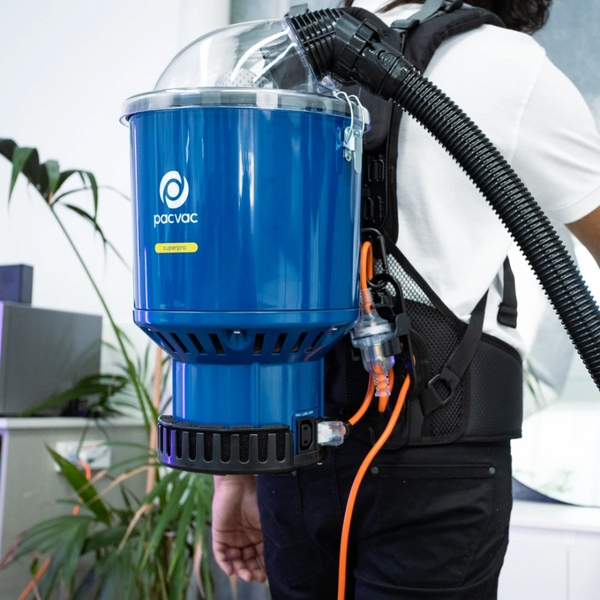
This guide reads the guidance from a buyer's side and applies it to the things that actually differ between corded and battery backpacks on multi-storey sites: lifts and lobbies, leads, runtime, charging, weight and noise. Two matched pairs from Freshway's listings, the Pacvac VELO and Velo Go and the Nilfisk GD5 and GD5 Battery, keep the comparison fair.
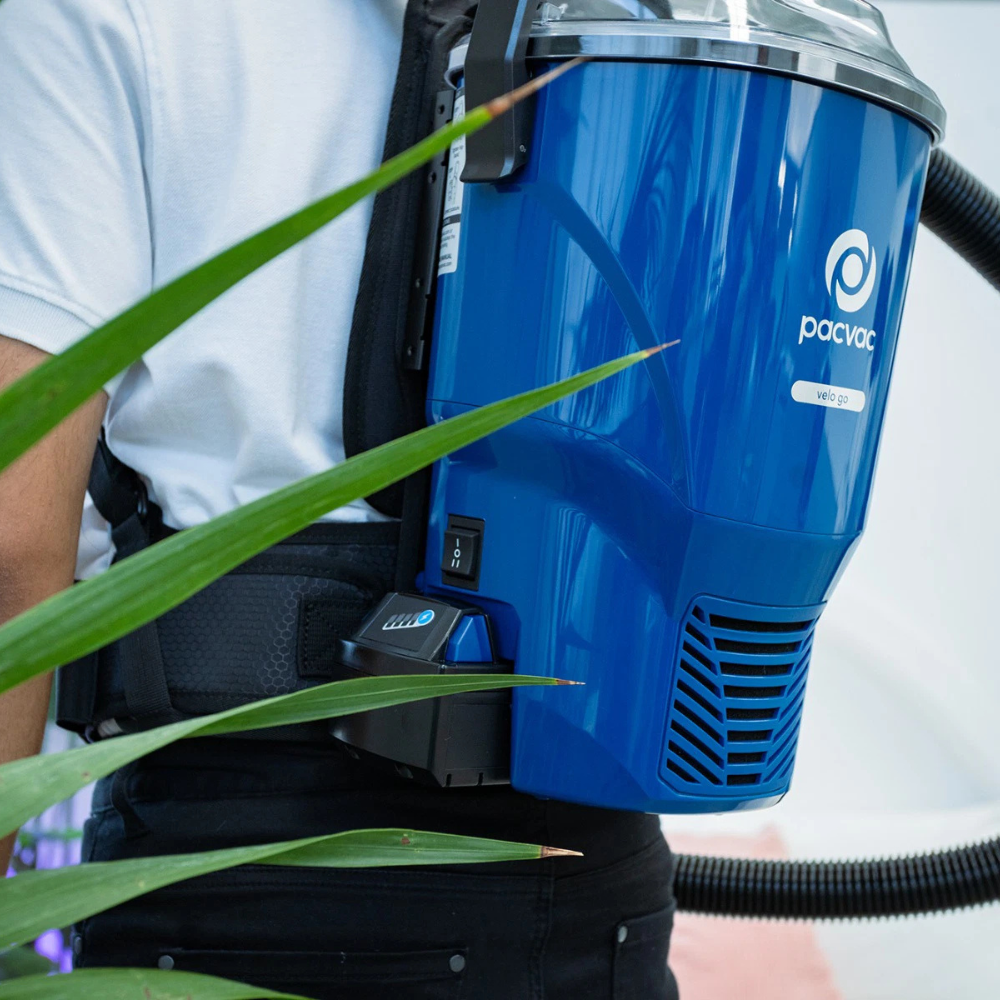
Corded vs battery backpack vacuum: the short answer
On multi-storey sites, battery backpacks win where cords create risk or slow the work: lobbies, lifts, stairwells and occupied floors. Corded backpacks win on long, after-hours runs where outlets are plentiful and runtime would otherwise run out. Most building-services contracts end up with a mix, planned floor by floor and charged on site.
The sections below explain where each type earns its place, starting with the specs.
The matched pairs, side by side
Comparing within one brand removes most of the noise. These figures are taken from each Freshway product page.
| Freshway listing | Power source | Listed weight | Reach or runtime | Dust capacity | Listed noise |
|---|---|---|---|---|---|
| Pacvac VELO corded | 900 W motor, mains | 3.9 kg | 18 m power cord | 2.5 L | 65.3 dB(A) |
| Pacvac Velo Go | 2 × 18 V lithium-ion, 250 W (400 W boost) | 4.5 kg with batteries | Up to 50 minutes | 2.5 L | Under 69 dB |
| Nilfisk GD5 corded | 1,300 W motor, mains | 4.2 kg | 15 m detachable cord | 5 L | 59 dB(A) |
| Nilfisk GD5 Battery | 36 V lithium-ion, 650 W motor | 8 kg including battery | Up to 60 minutes | 5 L | 65 dB(A) |
Two patterns stand out. In both pairs the battery model is heavier: 0.6 kg more for the Pacvac (4.5 − 3.9) and 3.8 kg more for the Nilfisk (8 − 4.2). And in both pairs the battery model has a time limit where the corded model has a distance limit. Everything else in this article follows from those two trade-offs.
Lift and lobby constraints
Lifts and lobbies are where a cord hurts most. Each floor change means unplugging, coiling, riding the lift and finding a new outlet. In a lobby, the lead crosses the path of tenants and visitors. A battery backpack goes into the lift and starts again on the next floor without anyone hunting for an outlet.
WorkSafe Victoria's safer way to clean: vacuuming sheet adds a planning point. To cut lifting and carrying, it suggests a vacuum on each level of a multi-level building, and light backpack vacuums with adequate lumbar support and cushioning for stairways. Its cleaning injury hotspots page lists backpack vacuum cleaners among mechanical aids and goods lifts among the layout features that reduce pushing, pulling and carrying. For a buyer, that points towards stationing machines by floor or zone rather than moving one machine through the whole building.

Cord management risks
A corded backpack still needs a lead, and leads are a known trip hazard. WorkSafe Victoria's slips, trips and falls guidance says to remove loose mats and objects, including electrical cords, from walk areas.
SafeWork NSW's electrical risks at the workplace fact sheet goes further. It lists not running leads across the floor, through doorways or over sharp edges, using RCDs (safety switches) for portable equipment, and testing commercial cleaning equipment at least once every six months, for example. It also notes that extension leads connected to frequently moved equipment are prone to damage.
For a buyer, that means every corded machine carries a testing and tagging cost, plus the time it takes to manage the lead well. A detachable cord, as listed on the Nilfisk GD5, at least means a damaged lead can be swapped without retiring the whole machine.
Runtime planning floor by floor
Battery runtime is easiest to plan in floors, not hours. Time one typical floor with your current machine, then divide the listed runtime by it. As an example, if a floor takes 20 minutes of actual vacuuming, the Velo Go's listed 50 minutes covers about two and a half floors (50 ÷ 20 = 2.5), and the GD5 Battery's 60 minutes covers three (60 ÷ 20 = 3). Both figures are "up to" runtimes, so leave a margin.
A corded machine has no such ceiling, but its limit is reach. The VELO's 18 m cord and the GD5's 15 m cord set how far the operator can go from each outlet before moving the plug. On an open-plan floor that may be two or three outlet moves; in a corridor of small offices it may be one per room.
Charging logistics
Battery machines move work from the floor to the charging point. SafeWork NSW's lithium-ion battery guidance asks for chargers specifically designed for the battery type and voltage, for batteries not to be left charging unattended or for long periods, and for storage in a cool, dry place away from heat sources and flammable materials. Damaged or swollen batteries should be taken out of use.
In a tower, that usually means one agreed charging spot per building, often the cleaners' room, rather than chargers plugged in wherever a machine ends the shift. Charge time sets the rotation. The Velo Go is listed with a 1 hour 45 minute charge cycle, and the GD5 Battery is listed with a fast charger in the box. Plan the number of machines so one can charge while another works.
Weight and harness
A backpack's weight sits on the operator for the whole shift, so small differences add up. On the listings, the corded VELO is the lightest of the four at 3.9 kg, and the GD5 Battery is the heaviest at 8 kg including its battery. All four listings describe an ergonomic harness designed to spread the load, and the two Nilfisk listings describe theirs as fully adjustable.
WorkSafe Victoria's vacuuming sheet also recommends emptying vacuums frequently to reduce weight. That matters more on the 5-litre GD5 models, where a full bag adds weight, than on the 2.5-litre Pacvacs, which need emptying more often.

Noise after hours and in occupied buildings
SafeWork NSW's noise code of practice sets the workplace exposure standard at 85 dB(A) averaged over eight hours. All four listed figures sit well below that, from 59 dB(A) on the GD5 corded to under 69 dB on the Velo Go. The code bases the standard on exposure over a shift, so lift motors, plant rooms and other site noise still count.
The more practical question is tenants. On occupied floors, the lower listed figures help day cleaning, and a battery machine also removes the lead from the walkway. After hours, noise matters less and the corded machine's unlimited runtime matters more.
Hybrid fleets: who gets which machine
- Battery: lobbies, lifts, stairwells, occupied floors and quick touch-ups between tenancies.
- Corded: long after-hours runs on vacant floors with outlets close together.
- Shared spares: filters, bags and harness parts for both types, from the vacuum parts and accessories range.
- One charging point per building, with a simple sign-in, sign-out routine.
Keeping both types within one brand family, as with the VELO and Velo Go or the two GD5 models, can simplify training and spare parts. Check each listing for which parts are shared.
Spec-sheet fields to check on a backpack vacuum
- Weight as worn, including the battery.
- Cord length and whether it detaches, for corded models.
- Listed runtime and charge time, remembering runtimes are usually "up to" figures.
- Dust capacity, against the area per floor.
- Listed noise, for occupied buildings.
- Filtration, such as the H13 HEPA filter listed on the VELO corded, where dust or allergens matter.
- What is in the box: some battery vacuums ship without batteries or chargers.
Common mistakes to avoid
- Buying on runtime alone without timing a real floor.
- Running corded machines through lobbies during business hours.
- Charging batteries wherever the shift happens to end.
- Letting corded machines drift past their test-and-tag date.
- Carrying one machine through the whole building instead of stationing machines by floor or zone.
Frequently asked questions
Is a battery backpack vacuum strong enough for commercial carpet?
Check suction, airflow and floor tool on the listing rather than assuming. Battery models trade some power and weight for freedom from the cord.
How many floors will one battery charge cover?
Time one floor, then divide the listed runtime by it. At 20 minutes a floor, a 50-minute runtime covers about two and a half floors.
Do battery vacuums need test and tag?
Chargers and any plug-in leads are electrical equipment, so include them in your inspection and testing routine and follow the lithium-ion charging guidance.
Which is lighter, corded or battery?
In both matched pairs on Freshway's listings, the corded model is lighter, by 0.6 kg for the Pacvac pair and 3.8 kg for the Nilfisk pair.
Next steps with Freshway
Shortlist one model from each of Freshway's battery-powered backpack vacuums and corded backpack vacuums ranges, then check each product page for current pricing and inclusions. For the wider corded-versus-cordless picture beyond backpacks, read corded vs cordless commercial vacuums and choosing the right cordless backpack vacuum. Contractors equipping several buildings can ask about trade terms through the B2B dealer page.