HEPA Filtration: Backpack vs Canister for Dust-Sensitive Sites
Same H13 grade, different air paths: match the format to the room.
Shop now
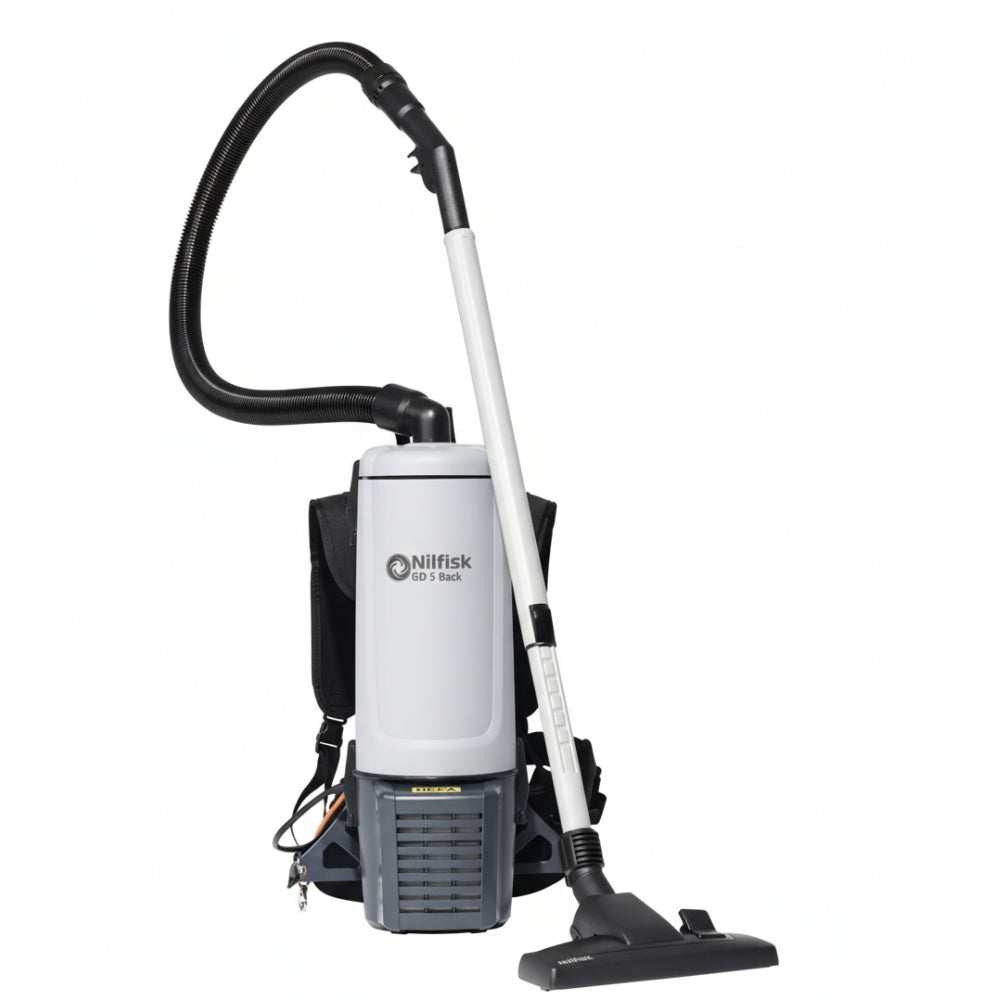
H13. That is the filter grade Freshway lists for both the Nilfisk GD5 HEPA backpack and the Nilfisk VP300 HEPA TC canister. Same brand, same grade on paper. Yet one machine sits on the cleaner's back at 4.4 kg and the other rolls behind them at 5 kg, one is listed at 62 dB(A) and the other at 57 dB(A), and the HEPA stage sits in a different place in each air path.
For dust-sensitive sites such as aged care, clinics, childcare and schools, those differences decide which format works. This guide does not re-explain what HEPA is; Freshway's commercial HEPA vacuum guide covers that. It looks at the choice from the operator's side: what each format is like to use, service and check when the people in the room are the reason for the filter.
HEPA backpack vs canister vacuum: the short answer
Choose a HEPA backpack where cleaners move between small rooms, stairs and furniture, and a HEPA canister where long carpet runs, lower listed noise and a bigger bag matter more. The filter grade can be identical. What differs is where the HEPA stage sits, how often bags change and how cleanly operators service it.
Here is how the two Nilfisk listings compare on the fields that matter for dust-sensitive work.
| Field | Backpack: Nilfisk GD5 HEPA | Canister: Nilfisk VP300 HEPA TC |
|---|---|---|
| Listed HEPA grade | Certified HEPA H13 | HEPA H13 (standard) |
| Where the HEPA part sits | Pleated cartridge inside the machine, described as a pre-motor barrier | Boxed cassette in the exhaust port, after the motor |
| Capacity | 5 litres | 10-litre dust bag |
| Listed noise level | 62 dB(A) | 57 dB(A) |
| Listed weight | 4.4 kg | 5 kg |
| Cord | 15 metres, detachable | 10 metres, detachable |
| Listed motor | 1300 W | 800 W |
What HEPA claims on a listing tell you
Read the wording, not just the badge. Across Freshway's vacuum listings, filtration is described in several different ways: "certified HEPA H13" on the GD5 HEPA, "HEPA H13 filter (standard)" on the VP300 HEPA TC, "H13 HEPA Hypercone 4-stage" on the Pacvac Velo, and "HEPA-rated Hypercone filter" on the Pacvac Superpro Duo. A listing that gives a grade (H13, H14) tells you more than one that says "HEPA-rated".
The second question is which part carries the grade. On some machines it is a cartridge ahead of the motor, on others an exhaust cassette. The grade on the label also says nothing about seals, bag quality or how the machine behaves when it is opened. Those depend on the format, which is where the backpack and canister split.
Backpack HEPA layouts
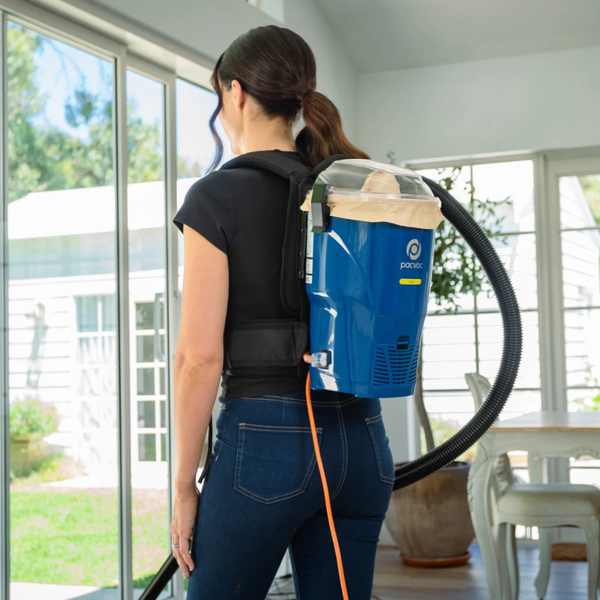
On the GD5, Freshway lists three filtration parts. There is a paper bag sold in packs of five for the GD5, GD10 and Pullman Janitor JV500, a separate pre-filter that sits inside the canister, and a 200 g pleated HEPA cartridge that the listing describes as a pre-motor barrier. Air passes the bag, then the filters, then the motor, all inside a body the operator wears.
What that means in use:
- The 5-litre container fills faster than a 10-litre canister bag on the same floor, so bag changes come round more often.
- Every bag change happens wherever the operator is standing, often in a corridor or a resident's room. Plan a set change point instead.
- The cleaner carries the whole machine. SafeWork NSW lists sustained or awkward posture among the risk factors that make a manual task hazardous, so harness fit is a health issue, not a comfort extra.

Canister HEPA layouts
The VP300 HEPA TC puts its listed H13 stage at the other end of the air path. Freshway's listing for the VP300 HEPA filter (part 107402902) describes a boxed H13 cassette that drops into the exhaust port and filters the air after it leaves the motor. Upstream sit the 10-litre dust bag and a main sack filter, which Freshway lists as fitting both the VP300 ECO and VP300 HEPA.
From the operator's side, a canister means less weight on the body, a bag that, going by capacity alone, fills about half as often as a 5-litre backpack container on the same floor, and a hose that drags round furniture. Bag changes can often wait until the machine is back in the cleaners' room. The trade-off is reach: the listed cord is 10 metres against the GD5's 15, so expect more outlet changes in long wards.
Case review: one aged-care wing, two formats
Take a typical aged-care wing: resident rooms off a long carpeted corridor, a lounge, a nurses' station and a set of stairs to the next floor. Here is how the two formats tend to sort themselves.
Resident rooms. Rooms are small, furniture is close together and residents are often present. A backpack moves between bed, chair and wardrobe without a hose snagging on equipment. The listed noise level is higher than the canister, so time room vacuuming around care routines.
Corridor and lounge. Long runs of carpet with people nearby suit the canister: lower listed noise, a larger bag and no load on the operator's back.
Stairs. WorkSafe Victoria's safer vacuuming guide suggests light backpack vacuums with lumbar support and cushioning for stairways, or a vacuum kept on each level to avoid carrying.
In a layout like this the practical answer is often both: a backpack for rooms and a canister for corridors and common areas, on the same filter grade.
Filter change discipline and verification
A HEPA stage only works if the stages before it are kept in order. The NSW Clinical Excellence Commission's environmental cleaning procedures for soft floors have the operator check the dust bag and filters before starting, check the cord and plug, and replace or clean the bag and filters again after the job. A damaged cord or plug means the machine is removed from use, tagged and reported.
Simple checks that work on both formats:
- Look at seals and the filter seat every time a filter comes out. A HEPA filter with a gap around it is not doing its job.
- Never run a machine with a filter missing or still damp from washing.
- Record bag and filter changes per machine, so you can see when one unit loads filters faster than the rest.
- If suction falls with a fresh bag fitted, check the pre-motor stage first on a backpack and the main filter on a canister.
Electrical checks sit alongside. SafeWork NSW's electrical risks fact sheet gives commercial cleaning equipment as an example for more frequent testing, for example at least once every six months.
When L, M or H class overrides HEPA
Some dust-sensitive sites are also dusty sites: a ward under refurbishment, a school with sanding work, a builder's clean before handover. That changes the question. WorkSafe Queensland's guide to vacuums for hazardous dusts classes machines as L, M or H under AS/NZS 60335.2.69. It states plainly that HEPA does not mean H-class and that an L-class machine cannot be upgraded by adding a better filter. It lists respirable crystalline silica, lead dust and asbestos among the dusts that need an H-class machine.
So a HEPA backpack or canister is a daily-cleaning tool for occupied spaces, not a substitute for a classed machine. For construction or refurbishment dust, choose from the hazardous dust vacuums collection and match the class to the dust.
Occupied-space cleaning
Where residents, patients or children are present, three things matter beyond filtration.
Exhaust direction. The Victorian Department of Health's cleaning procedures for infection control say floors in hospitals and day-care facilities should be vacuumed with a machine fitted with a particulate-retaining filter, and that exhaust air should be directed away from the floor to avoid spreading dust. Check where each machine's exhaust points before buying.
Noise. On these two listings the canister is the quieter machine (57 against 62 dB(A)). Do not assume the smaller machine is the quieter one; compare the listed figures.
Trip risk. Corded backpacks trail a lead behind a moving operator. In wards with mobility aids, a cordless backpack from Freshway's battery-powered backpack vacuums range removes the trailing cord. Check each listing's filtration before assuming it matches a corded HEPA model.

Consumables to stock
- GD5 HEPA backpacks: GD5/GD10 paper bags, a spare pre-filter and a spare pleated HEPA cartridge per machine, plus a harness support for high-use units.
- VP300 HEPA canisters: 10-litre bags, a spare main sack filter, a spare 107402902 HEPA exhaust cassette and a spare 10-metre detachable cord.
- Both: a damp cloth for wiping the machine after use (a step in the CEC procedure) and sealable waste bags for full dust bags.
All of these are listed in Freshway's vacuum parts and accessories collection. Search by part number and confirm the listed compatibility against your model.
Procurement checklist
- Filter grade stated on the listing (H13, H14), not just "HEPA".
- Where the HEPA part sits, and whether a spare is listed.
- Listed noise level for each format, compared like for like.
- Bag capacity against the size of the rooms or runs it will clean.
- Cord length, and whether the cord is detachable.
- A dust class (L, M or H) for any construction or refurbishment work.
Frequently asked questions
Isn't a HEPA backpack enough for builders' dust in a ward refurbishment?
No. WorkSafe Queensland states that HEPA does not mean H-class. For construction dust, choose a machine with the dust class the work needs, such as M or H.
Doesn't a canister always filter better because it is bigger?
Not necessarily. The GD5 HEPA backpack and VP300 HEPA TC canister are both listed with H13 filtration. The canister's advantages are its larger bag and lower listed noise, not a higher filter grade.
Surely the backpack is the quieter choice for occupied rooms?
Check the listing. On these two Nilfisk models the canister is listed at 57 dB(A) and the backpack at 62 dB(A). Compare published figures rather than judging by size.
Can I fit a HEPA filter to a standard backpack to make it suitable for aged care?
Only if the listing names a HEPA part for that model, and even then the seals and bags matter. For aged care, start with a machine sold with a stated HEPA grade.
Next steps with Freshway
Compare backpack options in the HEPA filtration backpack vacuums collection with HEPA canisters in the canister and barrel vacuums collection. Check each product page for current pricing, filter details and availability, and order the spare HEPA part with the machine.