A floor scrubber battery rarely fails at a convenient moment. Runtime falls by twenty minutes, then the operator starts skipping the far end of a route, and eventually the machine returns to the charger before the shift is finished. A floor scrubber battery charging guide should therefore protect capacity through a repeatable routine rather than treating the charger as a place to park the machine overnight.
This guide is for cleaning supervisors, facility managers and contractors responsible for battery-powered scrubber-dryers in retail, healthcare, education, warehousing and commercial buildings. It covers charger matching, ventilation, charging records, opportunity charging, water and terminal checks, fault symptoms and replacement planning.
Define the Route Before Setting a Charging Rule
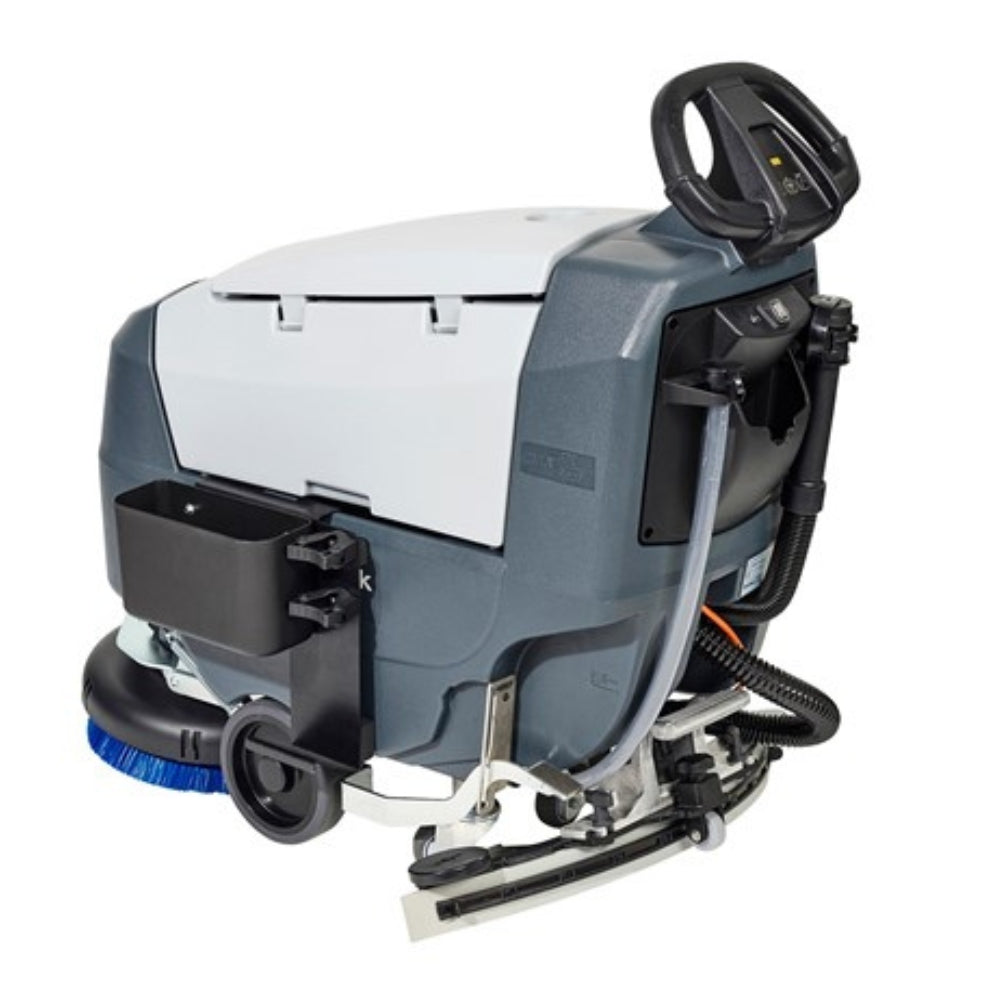
Start with the work the machine must complete, not with a generic instruction to charge after every use. Record the route area, shift length, floor finish, soil level, water pick-up and the number of trips back to a filling point. A compact Nilfisk SC401 is listed by Freshway with a 43 cm cleaning path and theoretical productivity of up to 2,330 square metres per hour, while the larger SC6500 1100C has a 1,000 mm cylindrical deck and a theoretical rate of up to 9,000 square metres per hour. Those figures show why one charging interval cannot cover every site. Theoretical productivity also assumes continuous movement, so doorways, lifts, congested aisles and tank refills consume time that a brochure figure does not.
Compare the planned route with the runtime stated for the exact machine and battery configuration. Add a reserve for cleaning after an unexpected spill, moving between buildings or a late request. If the route routinely uses more than the available shift capacity, the answer may be a second battery, a mid-shift charging point or a different machine. A longer charger connection cannot correct a scrubber that is undersized for the duty.

Match the Charger to the Battery and Machine
The charger is part of the machine specification. Confirm the charger model, output, connector and charging profile from the current manual and match them to the battery installed. A connector that plugs in does not prove compatibility. The wrong profile can overcharge one battery type, leave another persistently undercharged, or create a thermal or gas risk. Keep the charger identified with the machine and prevent staff from mixing chargers between models.
Inspect the charger cable, plug, strain relief and connector before connection. Look for cuts, exposed conductors, heat marks, bent pins, corrosion or a loose housing. Do not use a damaged charger, and do not bypass an interlock or repair a high-voltage component unless the person is competent and authorised. The Work Health and Safety Regulations 2011 require risks arising from electrical plant and workplace activity to be managed, while the manufacturer's instructions define the equipment-specific method.
Prepare a Safe Charging Position
Choose a level, dry position with enough ventilation for the battery type and charger. Keep the area free of cardboard, paper, solvents and other combustible material. Protect the charger from splashes, hoses, traffic and accidental contact. If the battery is a flooded lead-acid type, the charging area must also address the gases the manual identifies; sealed batteries do not remove the need to follow the manufacturer's ventilation and temperature limits.
Park with the machine switched off, controls neutral and parking brake applied. Follow the manual's disconnect sequence before opening any battery compartment. Remove jewellery and metal watches, use insulated tools where specified, and keep the battery terminals away from tools or loose parts. Provide the spill and first-aid controls required by the site risk assessment. The SafeWork NSW hazardous-chemical and electrical guidance is a useful cross-check for the controls around battery electrolyte, charging equipment and staff instruction.
Use a Consistent Plug-In and Start Sequence
Record the machine, battery set, charger, start time and state of charge indicator. Connect in the sequence the manual specifies, confirm the charger has entered its normal cycle and check that the cooling fan or indicator behaves as expected. Never leave a charger showing a fault in the hope that the battery will recover. A hot connector, repeated restart, flashing fault code or smell of overheated insulation requires the charger to be isolated and the fault reported.
The charge should normally run without interruption. If an automatic profile includes a cooling or float stage, do not disconnect during it merely to move the machine. Where the site needs the scrubber before the full cycle is complete, the decision should follow the battery and charger instructions rather than a supervisor's estimate. Write the approved exception into the method so operators do not improvise.
Decide Whether Opportunity Charging Is Allowed
Opportunity charging can keep a machine productive during breaks, but it is not universally appropriate. Check the manual for the installed battery chemistry and charger. Some systems permit short partial charges; others require a full cycle before use. A pattern of frequent top-ups may also prevent the charger from completing the balancing or finishing stage the battery needs.
Where opportunity charging is approved, give each charger a clear location and set a minimum connection time. Record the start and finish rather than treating a ten-minute connection as a full recovery. Do not use a second charger of unknown output to speed up the process. A charge plan based on measured runtime and route demand is more reliable than adding chargers until the problem appears to disappear.
Inspect Terminals, Cables and Battery Condition
Inspect the battery and compartment at the interval set by the manual and site risk assessment. Check terminals for corrosion, loose clamps, cracked cases, swelling, electrolyte residue and damaged vent caps. Look along cables for chafing where they pass through the chassis. Clean only with the method and materials approved for the battery; a damp cloth used indiscriminately can bridge terminals or introduce contamination.
If the battery is flooded, watering is a technical task rather than a daily top-up. Use only the water grade the manufacturer specifies and check level after charging where the manual directs. Never add acid or an electrolyte substitute. A sealed battery should not be opened. The WorkSafe Victoria plant guidance reinforces the need for inspection, maintenance and competent repair of powered plant before it creates a hazard to operators or nearby people.
Control Temperature and Ventilation
Battery capacity and charger behaviour are temperature-dependent. A charging area beside an oven, boiler, roller door or unshaded loading dock can push the battery outside the conditions in the manual. Cold conditions can also reduce available runtime even when the battery is healthy. Measure the actual charging location and correct the environment rather than compensating with longer charging.
Keep ventilation paths clear. Do not box a charger into a cupboard or cover it with cleaning cloths. If the manufacturer requires extraction, gas detection or a designated battery room, treat that as a fixed site control. The Nilfisk Australia technical documentation and local support channel are the correct place to confirm the charger and battery instructions for the exact model.

Record Runtime and Charging Performance
Use a simple battery log that links the machine, battery set, charger, date, start and finish time, state of charge, runtime achieved and any fault. The record exposes a failing charger, an ageing battery or a route that has quietly expanded. It also stops operators from rotating batteries between machines without anyone knowing which set is underperforming.
Review the log weekly for trends. A shorter runtime after a complete charge, a charger that finishes unusually quickly, a battery that becomes hot or a repeated low-voltage warning should be escalated. If a battery is replaced or temporarily removed, update the record before the next shift. When the set reaches end of life, use a responsible collection route such as the Australian Battery Recycling Initiative and the site's waste contractor requirements rather than placing it in general waste.
Plan Replacement Before Runtime Fails
Replacement planning uses evidence, not a calendar guess. Track the age of the battery set, the number of cycles where available, average runtime, charge duration and repair history. When the route needs more reserve than the battery can provide, compare a replacement set, a second battery and a machine with different capacity. Include charger compatibility, handling weight and the space needed for safe charging.
Give Operators a Short Daily Checklist
Before use, confirm the charger has completed normally, inspect the cable and connector, check the battery indicator and look for damage or residue. During use, note a sudden loss of runtime, a hot battery, an unusual smell or a warning on the display. At the end of the route, park in the approved charging position, switch off, connect using the correct sequence and record the result.
The daily check should take minutes and produce a clear stop condition. Staff need to know what to do when the charger faults, the battery overheats or the machine cannot complete a route. A supervisor should own escalation and replacement decisions. Detailed battery maintenance remains with a competent person following the machine manual.
Procurement Checks That Protect the Whole System
When specifying a scrubber, ask for the exact battery type, charger, charging time, runtime basis and replacement part. Confirm whether the quoted package includes the charger and battery set rather than assuming it does. Ask how the battery is watered, inspected and recycled. A lower machine price can carry a higher lifetime cost if the charger is proprietary, the charging point needs electrical work or the battery is difficult to handle.
Install the approved charging point before delivery. Provide a level position, ventilation, electrical protection, signage and enough clearance to move the machine safely. Train the operator against the delivered manual, then verify the first three charging cycles. Record any difference between the sales specification and the delivered equipment.
Questions We Get Asked Most
- Should a floor scrubber be charged after every shift?
- Follow the manual for the installed battery and charger. Many commercial scrubbers are returned to the charger after each shift, but some battery systems allow opportunity charging and others need a full cycle. Record start and finish times and do not assume a short top-up restores full runtime.
- Can a scrubber be left connected to the charger all weekend?
- Only where the charger has an approved automatic finishing or float mode and the manufacturer permits it. Check ventilation, temperature and charger condition before leaving it unattended. A charger that continues to drive current after completion needs investigation rather than another day of use.
- Why does runtime fall even after a full charge?
- The battery may be ageing, one cell may be weak, the charger may not complete its profile, the charging area may be too hot or cold, or the route may have become heavier. Compare the battery log with floor area, water use and brush pressure before replacing parts.
- Is tap water suitable for topping up a battery?
- Do not add tap water unless the manufacturer's current instructions say so. Impurities can affect a battery, and sealed batteries should not be opened. Use the specified water grade and the correct level procedure, or leave the task to a competent battery technician.
Conclusion
Protect runtime by matching the charger and battery, charging in a safe position and recording every cycle. Treat heat, damage, watering and short runtime as evidence that needs investigation. For a multi-machine fleet, keep the log per machine and per battery set so a weak set cannot hide behind the performance of another.
The right routine is repeatable, documented and specific to the delivered equipment. It gives supervisors a defensible way to decide when to keep operating, when to stop and when to plan replacement.
For broader machine selection, compare the commercial floor scrubber range, read the battery floor scrubber selection guide and use the floor scrubber maintenance checklist to connect battery care with the rest of the service routine.