A floor scrubber is only as good as the material touching the floor. The same machine can leave a vinyl floor streaked with a brush, restore a grouted tile with a pad that never reaches the joint, or wear through a sealed finish with a grade that was chosen for the wrong soil. Floor scrubber brushes and pads are not interchangeable, and the choice between them decides both the result and the life of the floor.
This guide is for cleaning supervisors, facility managers and contractors specifying contact material for scrubber dryers. It covers floor type and finish, brush and pad grades, how the material interacts with chemistry, and the checks that keep the result consistent.
Floor Scrubber Brush vs Pad: Match the Contact Material
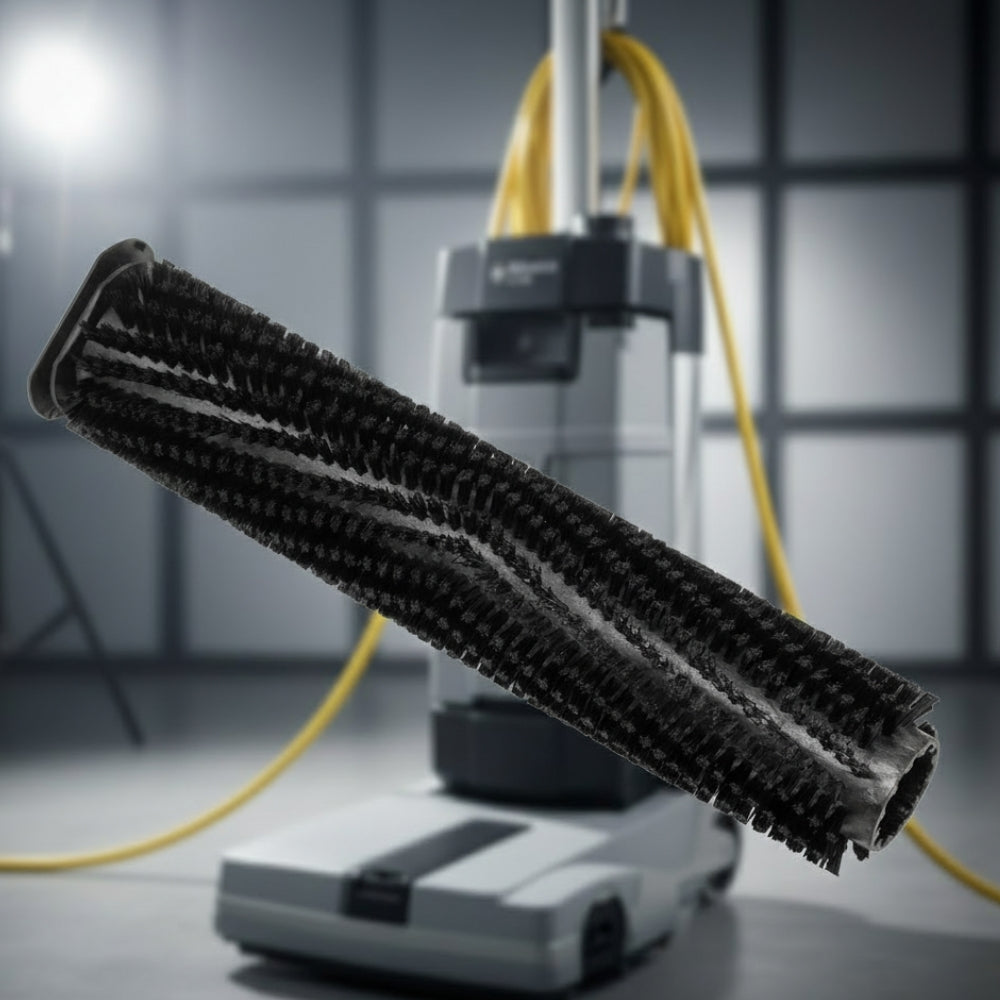
A brush has bristles that reach into texture, grout lines and uneven surfaces. A pad is a flat abrasive or non-abrasive disc that works the surface evenly and suits smooth, sealed floors. The difference is mechanical: a brush cleans the profile of the floor, a pad cleans the plane of it.
That is why the first question is not which one is better, but which floor is under the machine. A quarry tile with deep grout needs a brush or a cylindrical deck. A sealed vinyl or polished concrete floor needs a pad, because a brush can leave swirl marks and work the finish unevenly.
The second question is the soil. A brush lifts soil from texture and grout, and it is more aggressive on heavy or compacted soil. A pad is better for fine film, tyre marks and the maintenance of a finish. Where a site has both, the practical answer is usually a pad for the daily route and a brush for the periodic deep clean.
Identify the Failure Mode Before Comparing Products
Four failures point to the contact material. A floor that is still dirty in the grout lines after scrubbing needs a brush or a cylindrical deck. A floor with swirl marks or a dulled finish needs a softer pad. A floor that is clean but streaked needs better recovery and a cleaner pad. A floor that is wearing through in traffic lanes needs less aggressive contact and a finish maintenance program.
Diagnosing first stops the purchase being decided by price. A cheaper brush that is too stiff for the floor costs more in refinishing than a better pad would have cost. A pad that is too soft for the soil leaves the operator making extra passes, which costs labour and water.
The diagnosis should also consider the machine. A disc deck takes pads and brushes of a specific size and fixing. A cylindrical deck takes cylindrical brushes that also sweep debris. Buying the right material for the wrong deck is a common and expensive mistake.
Start With Floor Type, Finish and Soil
Vinyl, linoleum, sealed concrete, epoxy, terrazzo, quarry tile, porcelain, safety flooring and polished concrete all behave differently. Smooth sealed floors suit pads. Textured, grouted and anti-slip floors suit brushes. Natural stone may need a specific pad and chemistry, and some finishes should not be scrubbed at all.
The finish matters as much as the substrate. A floor with a polymer finish is being cleaned through the finish, and an aggressive pad removes the finish along with the soil. A floor with no finish is being cleaned directly, and a brush may be appropriate where the surface is sound. Where the finish is unknown, a test patch under the machine settles the question quickly.
Soil type completes the picture. Fine dust and film suit a soft pad and a neutral cleaner. Grease and food soil need a degreaser and a pad or brush that can agitate it. Compacted soil in grout needs a brush with the right stiffness and a chemistry that softens it. The contact material and the chemistry have to be chosen together.
Which Brush or Pad Suits Which Floor?
Match the material to the floor profile and the soil.
Pads suit smooth sealed floors and finish maintenance, brushes suit grout, texture and heavy soil, and cylindrical brushes suit mixed floors where debris and scrubbing happen in one pass, with the grade chosen for the finish rather than the machine.
On the pad side, a soft or white pad suits daily cleaning and light buffing on delicate finishes. A red or medium pad suits general scrubbing. A green or heavy pad suits deep cleaning on sound floors. A black or stripping pad removes finish and should never be used for routine cleaning. Colour conventions vary between manufacturers, so the grade on the product, not the colour, is the specification.
On the brush side, soft brushes suit textured floors that need cleaning without scratching. Medium brushes suit general tile and grout. Hard brushes suit heavy soil on sound surfaces but can open grout and scratch some finishes. Cylindrical brushes add a sweeping action and suit sites with debris, and they need the correct bristle type for the floor.
Where a site has mixed floors, the practical solution is two decks or two machines rather than one compromise. A pad on a grouted floor leaves the joints dirty, and a brush on a polished floor leaves marks that cannot be removed without refinishing.
Choose Pads, Brushes and Chemistry Together
The contact material and the chemistry work as a pair. A soft pad with a neutral cleaner cleans a sealed floor without removing the finish. A brush with an alkaline degreaser cuts grease in a grout line. A stripping pad with a stripper removes finish, and a brush with the same stripper can damage the grout.
The sequence matters. Sweep or vacuum the debris before scrubbing, because grit under a pad or brush scratches the floor. Apply the chemistry at the label dilution, allow the dwell, scrub with the chosen material, and recover the water. Skipping the pre-sweep is the most common reason a floor is scratched during a scrub.
Where a site changes chemistry, the contact material may need to change too. A stronger alkaline product with a soft pad may be safer than a neutral product with a hard pad, and the result may be better. The test patch is the place to compare those combinations.

Water Recovery and Wet-Floor Controls
The contact material affects recovery. A brush leaves water in the texture and grout, where the squeegee cannot lift it all. A pad leaves a more even film, which the squeegee can recover more completely. On a grouted floor, that difference shows as a floor that stays damp in the joints after the machine has passed.
Signage and barriers should follow the machine, cover the routes people use, and stay in place until the floor is dry. On a textured floor, the drying time is longer because the water sits in the profile, and the area may need air movement before it is released.
Australian duties require the risks of the task to be managed, and the framework sits in the Work Health and Safety Regulations 2011, with practical guidance from WorkSafe Victoria and SafeWork NSW. Manufacturer guidance, such as Nilfisk Australia, states which decks and materials the machine is designed for.
Edges, Details and Mixed Floors
A scrubber never reaches every part of a floor, and the contact material has to match the areas the machine cannot. Edges, corners, risers and the space under fixtures need a hand pad or a brush, and the material used by hand should match the floor in the same way the machine material does. Using a stripping pad by hand on a sealed floor produces the same damage as using one on the machine.
Mixed floors are the common case in commercial buildings: vinyl in an office, tile in a washroom, quarry tile in a kitchen and sealed concrete in a loading area. Each has a different profile and a different tolerance, so a single pad or brush for the whole building is a compromise that shows in the result. The method should list the material per area, and the trolley should carry the grades the route needs.
Details also include the transition strips, thresholds and lift floors, which are often the first places to show marks. A soft pad and a neutral cleaner are usually enough there, and the operator should know which pad is acceptable on each surface before the machine is started.
Maintenance Inputs That Protect Uptime
Pads and brushes are consumables with a performance life. A pad loads with soil and finish and stops cleaning evenly long before it wears out. A brush loses bristle length, splays and stops reaching the grout. A cylindrical brush can become clogged with hair and debris. Each affects the result before it affects the machine.
The daily routine is short: check the pad or brush for wear and loading, check the squeegee, empty and rinse the recovery tank, and check the solution filter. The weekly routine covers the deck, the brush drive and the squeegee linkage. The service interval covers the motor, the drive and the water system.
Keep the specified grades in stock and labelled by machine. A substitute pad that is not the same grade changes the finish on every pass, and a brush with different bristles changes the result on grout. The consumable is part of the machine's specification, not an accessory.

What to Record in the Approved Method
- Floor and finish: substrate, coating and the condition of the finish in each area.
- Contact material: pad grade or brush type, with the machine deck and the part number.
- Chemistry: product, dilution and dwell used with the chosen material.
- Sequence: pre-sweep, scrub, recovery and drying, recorded as the method.
- Result: the finish, any marks or damage, and the date the material was changed.
That record is what makes the choice repeatable across operators and sites, and it is the evidence for the next purchase when a floor or a machine changes.
Questions we get asked most
- Should I use a brush or a pad on a floor scrubber?
- Use a pad on smooth, sealed floors where the finish needs to be protected, and a brush on grout, texture and heavy soil where the bristles need to reach into the profile. Mixed floors usually need both, with separate decks or machines.
- Why does my scrubber leave swirl marks?
- Usually because the contact material is too aggressive for the finish, or because grit was left on the floor before scrubbing. Check the pad or brush grade, pre-sweep the area, and test a grade softer than the one in use.
- Can a brush be used on vinyl?
- Only with care and the correct soft brush. Standard brushes can leave marks and work the finish unevenly on vinyl and linoleum. A pad is the safer default on smooth sealed floors.
- How often should pads and brushes be replaced?
- When they stop performing, not on a fixed calendar. A pad is replaced when it loads and stops cleaning evenly; a brush when the bristles shorten, splay or stop reaching the grout. Record changes against the machine, and note the floor area where the material was used.
Conclusion
The contact material is a specification, not an accessory. Match the pad or brush to the floor profile and the soil, choose the chemistry to work with it, and pre-sweep so the material cleans rather than scratches.
Then keep the specified grades in stock, record the result and replace on performance. That is what keeps a scrubber producing the same finish on every floor rather than depending on whichever pad was on the shelf.
Manufacturer information: Nilfisk Australia and Karcher Australia. Work health and safety: Work Health and Safety Regulations 2011, WorkSafe Victoria and SafeWork NSW.
Compare scrubber pads, brushes and cylindrical decks in the Freshway floor care range.