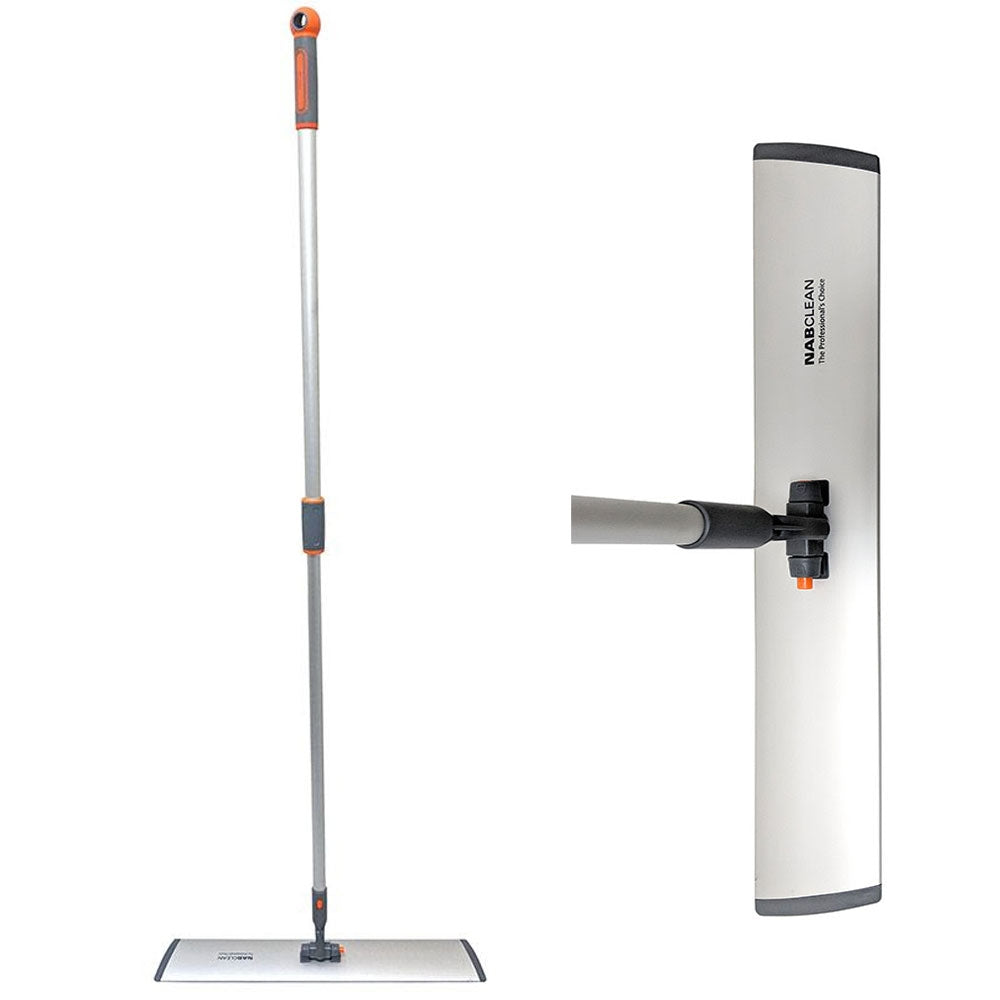
Flat mops and string mops are not two versions of the same tool. A flat mop is a large pad on a swivel head, designed to cover area quickly with a controlled amount of solution. A string mop is a bundle of yarn on a handle, designed to carry a lot of water and to scrub. Choosing between them is a question of area, soil load and how much solution the floor can take, not of which one is more modern.
This guide is for cleaning supervisors and contractors choosing mop systems for commercial floors. It compares coverage, solution control, scrubbing, edges, manual handling and cost, and sets out how to run a trial that reflects the route rather than a single patch.
Flat Mop vs String Mop: Choose by Area and Control
Start with the area. A flat mop covers a wide strip per pass and is usually the faster tool on large, open floors with light soil. A string mop covers a narrower strip but carries more solution, which suits smaller areas with heavier soil or spills. On a long corridor, the flat mop wins on passes; in a washroom or a kitchen, the string mop may win on soil.
Then the solution. A flat mop system usually controls the amount of solution applied through a pre-soaked pad, a spray or a press. A string mop depends on the wringer and the operator, and it is easy to leave too much water. On a sealed or polished floor, the flat mop's control is a quality advantage; on a porous or rough floor, the string mop's extra water can be useful.
Then the soil. Fine dust and film suit the flat mop; grease, mud and food spills suit the string mop or a scrubber. Where a site has both soil types, the practical answer is a flat mop for the daily route and a string mop or scrubber for the heavy areas, with separate colour-coded equipment.
Define the Site Condition That Changes the Answer
Floor type is the first condition. Smooth vinyl, sealed concrete, terrazzo and polished tiles suit flat mops. Quarry tiles, grout lines, rough concrete and safety flooring need the mop to reach into the texture, which usually means a string mop or a flat mop with a scrubbing edge. Matt and anti-slip finishes need a method that does not leave a film.
Building layout is the second. A flat mop with a swivel head reaches under desks, benches and fixtures more easily, and it turns in tight spaces. A string mop is better in a large open area where the operator can work in straight lines, and it is easier to use with a bucket in a room without a trolley.
The third condition is the labour model. A flat mop system often uses a trolley with a press and several pads, which suits a team working a floor. A string mop and bucket suits a single operator working a smaller area or a route with stairs.
Which Mop Covers More Area?
The flat mop, on most open commercial floors.
A flat mop covers a wide strip with a consistent solution load and fewer passes, while a string mop covers a narrower strip and needs more passes, so the flat mop usually wins on area per hour where the soil is light and the floor is smooth.
The advantage depends on the route. A flat mop's swivel head lets the operator work around furniture and into corners without changing tools, and the pad can be changed without carrying a bucket. A string mop's advantage appears where the floor needs more solution or more scrubbing, because it can carry water and apply pressure in a way a flat pad cannot.
On mixed routes the fastest method is usually a combination: a flat mop for the open floor and a string mop or a hand tool for the heavy spots. The comparison should be run on the real route with the real soil, not on a clean patch in a store room.
Solution Control and Wringing Method
Flat mops control solution through pre-soaked pads, spray bottles or a press. The operator applies a measured amount and changes the pad when it loads, which keeps the floor from being flooded. The risk is a pad that is too wet or too dry, and the method should define how many pads are used per area and how wet they should be.
String mops control solution through the wringer. A side-press or downward-press wringer works better than a roller, and a dual-bucket system separates clean solution from dirty. The operator's technique still matters: a mop that is not wrung enough leaves a film, and one that is wrung too dry does not clean.
Both systems benefit from a measured dose. A bucket filled to a line with a measured chemical dose, or a spray bottle with a labelled dilution, is more reliable than a splash. The residue that follows an overdose is the most common reason a floor looks dull, regardless of which mop is used.
Colour Coding and Cross-Contamination
Both mop types can be colour coded, but a flat mop system is easier to keep separated because the pads are flat, stackable and easy to label. A string mop needs more storage space and a clear labelling system, and the mop head should be stored so the colour is visible.
The handle and bucket are part of the colour system. A shared handle that moves between colours, or a bucket used for washrooms and then for kitchens, defeats the coding. Assign handles and buckets by colour and store them as a set.
Laundry keeps the system honest. Pads and mop heads should be washed by colour, and a commercial laundry contract should require separation. Where the site washes on site, the machine should not be shared with residents' or staff laundry.
Handle Fit and Manual Handling
Flat mops are usually lighter and use a swivel head, which reduces twisting and reaching. String mops are heavier when wet, and wringing adds a repeated manual task. On a site with a large mopping workload, the manual handling difference is a real cost, and it shows in fatigue and turnover as well as in time.
Handle length should suit the operator and the surface. A handle that is too short forces a stoop; one that is too long reduces control. Adjustable handles help where several people share the equipment, and a grip that works with gloves is essential in wet work.
Where the site has stairs, a flat mop system with a small bucket or a spray method is easier to carry than a string mop and bucket. Where the site has a long corridor, a wider flat mop head and a trolley with a press reduce the number of trips.
Laundering, Drying and Replacement
Flat microfibre pads need a wash without softener and a drying method that protects the fibre. String mops tolerate a hotter wash but take longer to dry and need space to hang. Both should be dry before storage, because a damp mop grows odour and spreads it on the next floor.
Replacement follows performance. A flat pad is retired when it stops lifting soil or sheds lint; a string mop when the yarn mats or the head becomes uneven. Colour fading is also a reason to retire, because it makes the zone ambiguous.
The store should have a drying position and a reorder point per colour. A site that runs out of one colour substitutes another, and the system collapses quietly.
Measure Labour and Consumable Cost
Compare the two systems on minutes per area, solution used, laundry cost and replacement interval. A flat mop often wins on labour and solution, while a string mop wins on purchase price and on heavy soil. The comparison only makes sense on the same route with the same operator.
Include the bucket or trolley cost. A flat mop system usually needs a press or a trolley, which a string mop does not, and that capital cost has to be recovered in labour and solution savings. Where the site already has a trolley, the incremental cost is lower.
Include the consumable price per use as well: a microfibre pad that survives 200 washes costs less per clean than one that survives 50, and a string mop that is re-headed twice a year costs less than one replaced monthly. Measure over a full week rather than a single clean, and record the result per floor type and soil load. The differences in labour and solution show up across a route, and a single patch can be misleading. This guide to commercial mops and buckets covers the equipment selection in more detail.
Edges, Corners and Furniture
Most of the time difference between mop systems appears at the edges. A flat mop with a swivel head reaches along skirting and under furniture without changing tools, and a pad can be turned to work into a corner. A string mop needs the operator to lift and place the yarn, which is slower and less precise, and the mop head can leave a line of water at the skirting if it is not wrung properly.
Furniture changes the method. A flat mop can work under a desk or a bench with the handle angled, and it can be lifted out without dragging soil back across the floor. A string mop is harder to control under low furniture and tends to leave water where it cannot be seen. On sites with heavy furniture, the flat mop's reach is a quality advantage as well as a speed one.
Edges also need a separate tool for the last few centimetres. A hand pad or a small brush for corners, and a detail cloth for skirting, complete the method regardless of which mop is used. Where the site has a lot of edges, the labour saved by the flat mop is partly offset by the detail work, so the comparison should include it.
Entrances and mats are the other edge case. Mats trap grit, and a mop that is used over a mat pushes the grit into the yarn. Mats should be vacuumed or shaken out before the floor is mopped, and the mop should not be used as a mat cleaner.
Questions to Settle Before Ordering
Confirm the following before a mop system is ordered.
- Area and route: the floor area per zone, the route and the number of trips to a bucket or press.
- Floor and soil: the surface and the dominant soil, with the mop type for each zone.
- Solution: the dose, the wringer or press, and how often the solution is changed.
- Colour: the zone colours, handles and buckets assigned to each, and the storage position.
- Laundry and drying: the wash method, colour separation and the drying position.
- Cost: time per area, solution per area, laundry and replacement interval.
That list turns a choice between two mops into a route decision, which is the level at which the difference actually shows.


Questions we get asked most
- Is a flat mop faster than a string mop?
- On smooth, open floors with light soil, usually yes: a flat mop covers a wider strip with a controlled solution load and fewer passes. On rough floors or heavy soil, a string mop can be faster because it carries more water and scrubs harder.
- Which mop is better for washrooms?
- A string mop or a dedicated flat pad in a washroom colour is the practical choice, because washrooms need more solution and more scrubbing around fittings. The mop must never be shared with kitchen or general areas.
- How do I control how much water a mop leaves?
- Measure the dose, use a wringer or press that works, and change the solution before it becomes dirty. A flat mop controls water through the pad and press; a string mop controls it through wringing technique and a dual-bucket system.
- How often should mops be replaced?
- When they stop performing: a flat pad when it sheds lint or stops lifting soil, a string mop when the yarn mats or the head becomes uneven. Replace before the mop starts costing more in labour than a new one costs to buy.
Conclusion
Choose the flat mop for open floors, light soil and controlled solution, and the string mop for heavy soil, rough surfaces and spill pick-up. Most commercial sites need both, assigned by zone and colour rather than standardised on one tool.
Then control the dose, dry the mops, measure the route and replace on performance. That is what makes the choice between flat and string a decision about the floor rather than about habit.
Manufacturer information: Agar cleaning chemicals. Work health and safety: Work Health and Safety Regulations 2011, SafeWork NSW and WorkSafe Victoria. Public health: NSW Health environmental health.
Compare flat mops, string mops, handles and buckets in the Freshway mopping range.