Cleaning Units in Practice: Using CU Without Being Misled
Multiply listed bar by L/min, then check duty, nozzle and site power before you buy.
Shop now
840 against 1,320. Those Cleaning Units come from two machines Freshway lists at the same 120 bar: the Kranzle KHD7/122TS at 7 L/min, and the Kranzle K2160TST at 11 L/min. A Sydney buyer who shortlists on pressure alone would treat them as equals. The CU figure shows they are not, and it still leaves out nozzle distance, duty and how the gun is used.
How should buyers use pressure washer cleaning units in practice?
Use Cleaning Units as a rough comparator only: multiply the Freshway-listed bar figure by the listed litres per minute, then keep that number in its place. CU does not measure nozzle distance, spray angle, dwell, duty cycle or site power. Treat a CU tie as a shortlist, not a finished buying decision.
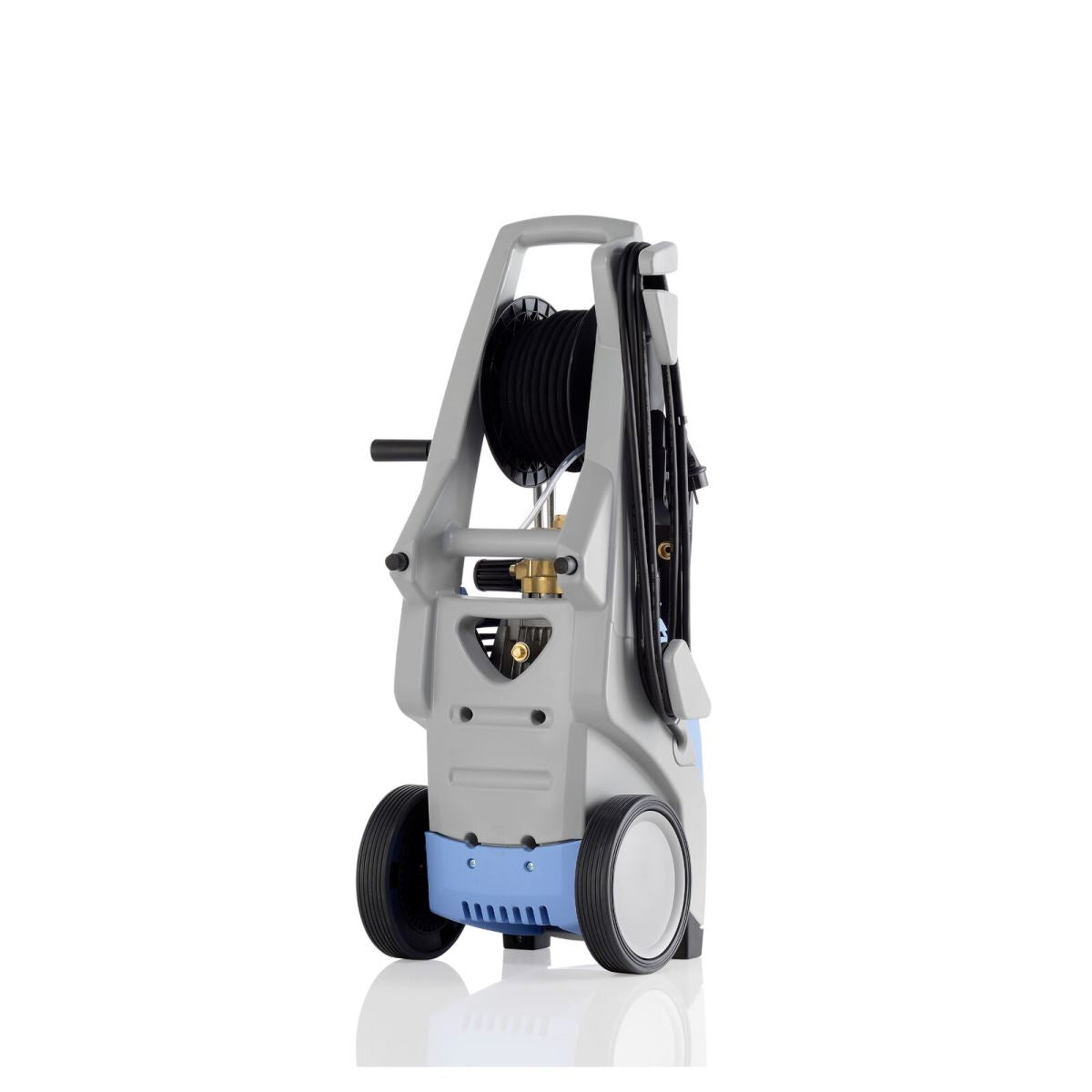
The formula and the safety-class background are already worked through in Freshway's guide to pressure washer parameters, bar, PSI, L/min and Cleaning Units. This article is the field follow-on: how to use that number without being misled when you compare live machines and write a purchase brief.
CU as a rough comparator
CU is a convenient shorthand for pressure times flow. It is useful when two spec sheets are written in mixed units, or when one salesperson talks only in PSI and another talks only in bar. Once both machines are expressed as Freshway-listed bar times Freshway-listed L/min, you can see whether a "higher pressure" option is actually moving more water, or simply running a narrower jet at a similar flow.
It is not a cleanliness score, a productivity rate, or a substitute for walking the site. Two machines can share a CU figure and still differ in hose length, motor speed, plug rating and whether the pump stops when the trigger is released.
The formula in metric, worked from listed figures
On the Freshway pages used here, bar and litres per minute are printed in the technical specifications. Multiply those two figures; do not convert a PSI heading and then guess the flow. Recomputed CU for the four machines below is:
- Kranzle KHD7/122TS: 120 bar × 7 L/min = 840 CU
- Kranzle KHD10/122TS: 120 bar × 10 L/min = 1,200 CU
- Kranzle K1152TST-10A: 120 bar × 10 L/min = 1,200 CU
- Kranzle K2160TST: 120 bar × 11 L/min = 1,320 CU
The KHD7/122TS and the K2160TST are the cleanest contrast: same listed 120 bar, a 4 L/min gap, and a 480 CU gap that comes entirely from flow. The KHD10/122TS and the K1152TST-10A land on the same 1,200 CU, which is exactly where a buyer who stops at the shortcut gets into trouble.
What CU ignores on the job
The multiplication uses the pump figures on the product page. It does not know how far the nozzle sits from the surface, how wide the fan is, how long the operator dwells on a stain, or whether a Vario lance has been opened down from the listed operating pressure. Freshway lists a Vario Nozzle 042 lance with the KHD10/122TS; that accessory is there so the operator can change the jet, which is useful in the field and invisible to the CU number you wrote down in the office.
CU also ignores soils, water temperature, chemistry and recovery. A wash pad that must hold oil and solids still needs the collection path and pre-treatment your water authority requires, regardless of how tidy the CU comparison looked on a spreadsheet. The NSW EPA's reminder that the drain is just for rain applies to the job, not to the nameplate.
Nozzle distance and angle
Impact at the surface falls as the standoff increases and as the jet is laid over at a shallow angle. CU cannot tell you the right distance for mossy concrete versus a painted cill, because those distances are a method choice, not a pump specification. What it also cannot tell you is the injury risk if the jet is brought in too close to skin, a boot or a gloved hand.
WorkSafe Victoria's safety alert on high-pressure water jetting warns that the jet may pierce the skin, that contaminated material may be injected into the body, and that flying debris or a flailing hose can injure people nearby. A NSW Resources safety alert on fluid injection from high pressure water cleaning describes an operator who tripped in a cramped area, dropped a lance that failed to shut off, and received a fluid-injection injury. Train operators to hold a stable stance, keep unused couplings capped, and treat a dropped gun as a stop-and-inspect event, not as a reason to buy a higher CU machine.

A worked comparison without treating CU as the answer
| Machine (Freshway listing) | Listed bar and flow | Recomputed CU | What the CU number does not show |
|---|---|---|---|
| Kranzle KHD7/122TS | 120 bar, 7 L/min | 120 × 7 = 840 | 10-amp 240 V supply, 1,400 RPM motor, Total-Stop when the trigger is released |
| Kranzle KHD10/122TS | 120 bar, 10 L/min | 120 × 10 = 1,200 | 15-amp 240 V supply, 2,800 RPM motor, 10 m hose, 23 kg compact frame, Vario lance included |
| Kranzle K1152TST-10A | 120 bar, 10 L/min | 120 × 10 = 1,200 | Same CU as the KHD10/122TS, but a 10-amp plug, 2,800 RPM motor and a 15 m hose on a reel |
| Kranzle K2160TST | 120 bar, 11 L/min | 120 × 11 = 1,320 | 10-amp 240 V supply, 1,400 RPM motor, 15 m hose on a folding reel |
The two 1,200 CU machines are the cautionary pair. If you buy on CU alone you could specify a 15-amp compact unit for a site that only has a standard 10-amp outlet, or a 10-amp reel machine for a van-loaded route that needed the 23 kg carry frame. Check the product page for the plug, hose and chassis before the CU figure is allowed to settle the shortlist. Current models sit in the Kranzle pressure washers and commercial pressure washers collections.

When duty cycle and site power matter more
A CU comparison says nothing about how long the pump can run, or whether the site can actually supply it. Freshway lists the KHD7/122TS and the K2160TST on a 10-amp 240 V plug, and the KHD10/122TS on a 15-amp 240 V plug. That is a site constraint, not a marketing footnote. If the only outlet on a residential wash is a standard 10-amp point, the 1,200 CU compact unit that needs 15 amps is the wrong shortlist member, whatever the arithmetic says.
Total-Stop, which Freshway lists on the KHD7/122TS, KHD10/122TS and K1152TST-10A, shuts the motor down when the trigger is released. That is a duty and seal-life feature, and it is also a control for a gun that is dropped or set down. It does not appear in the CU figure. Motor speed is listed at 1,400 RPM for the KHD7/122TS and K2160TST, and at 2,800 RPM for the KHD10/122TS and K1152TST-10A; record it, but do not invent a run-hour rating the page does not give. For portable electrical plant that moves between sites, SafeWork NSW's page on electrical inspection and testing is the right place to check your testing interval, not a CU table.
Spec-reading habits that keep CU honest
Read the technical block, not the headline PSI in the title. Write down bar and L/min as printed on the Freshway page you are buying from. Recompute CU yourself. Then add, in the same notebook line, the plug rating, hose length, weight, and whether Total-Stop or a Vario lance is listed. If a page gives flow only in litres per hour, divide by 60 before you multiply; do not average two flow figures to invent a CU.
WorkSafe Victoria's plant guidance sits over the whole purchase: the machine has to be suitable for the work and used with the information, instruction and training that goes with it. CU helps you compare output. It does not finish that duty.
Buying mistakes that start with CU alone
- Choosing the higher CU and then finding the only available outlet is a 10-amp point.
- Treating a 1,200 CU pair as interchangeable when one has a 10 m hose and a carry frame, and the other has a 15 m reel.
- Ignoring nozzle distance and then blaming the machine when a painted surface marks or a courtyard takes twice the expected time.
- Using CU to skip a site walk for power, water, runoff and where the hose will actually land.
Other electric and petrol ranges are also listed under pressure washers and cleaners. Apply the same method: listed bar, listed L/min, recomputed CU, then the duty details the shortcut leaves out.
Frequently asked questions
Is a higher CU always the right commercial washer?
No. CU is only bar times L/min. Check plug rating, hose length, duty features and the surface before you treat a higher figure as the right buy.
Can I convert PSI myself and still use CU?
Only use bar and L/min printed on the Freshway page you are comparing. If a page does not list bar, do not invent one just to complete the sum.
Do two machines with the same CU perform the same?
Not necessarily. The KHD10/122TS and K1152TST-10A both recompute to 1,200 CU, yet they differ in plug rating, motor speed and hose length.
Does CU tell me how far to hold the nozzle?
No. Distance and angle are a method choice and a safety issue. CU describes pump output, not impact at a particular standoff.
Comparing pressure washers in Sydney, Melbourne and Brisbane
Bring the surfaces you wash, the outlet you will actually plug into, and the hose run on site, and Freshway can help match a commercial pressure washer from the listed bar and flow rather than from a CU figure on its own. Freshway supplies commercial pressure washers to businesses in Sydney NSW, Melbourne VIC and Brisbane QLD. Same-day delivery is available in Sydney; Melbourne and Brisbane receive fast delivery. Call 1300 567 002, or start with the commercial pressure washers collection.