Pressure Washer Parameters Explained: Bar PSI LPM and Cleaning Units
Read bar, PSI and L/min together before comparing two pressure washers.
Shop now
1,200. That is what a 120 bar, 10 L/min pressure washer multiplies out to in bar × L/min. It is also the number behind the cleaning-unit shortcut and behind the safety classes that apply to high-pressure water jetting. Pressure alone gives you 120, flow alone gives you 10, and neither tells you what you are buying.
Buyers comparing commercial pressure washers in Sydney can use the same conversions and safety classes before they shortlist a model.
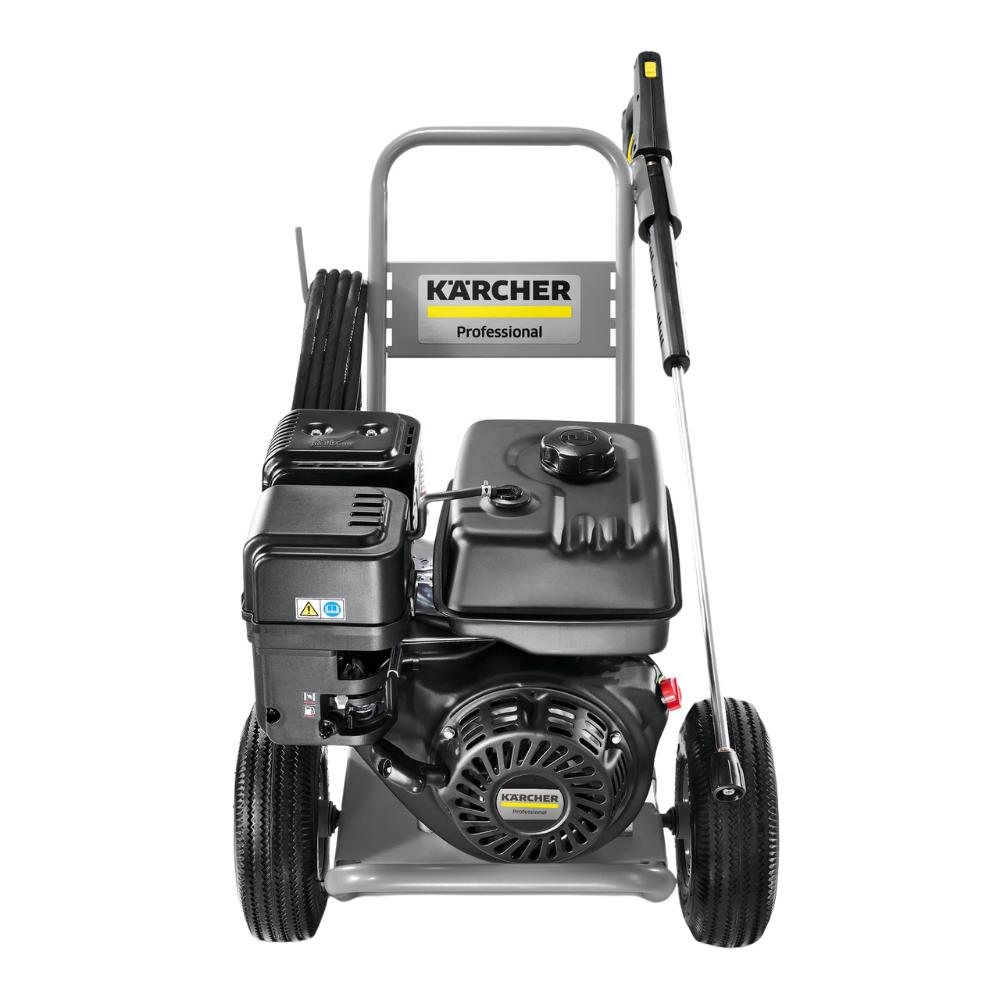
Pressure washer bar, PSI and LPM: the conversions in one place
Multiply bar by 14.5 to get PSI, and multiply US gallons per minute by 3.785 to get litres per minute. Spec sheets mix both systems, so convert every quote to bar and L/min first. A 120 bar, 10 L/min washer is the same machine as 1,740 PSI at 2.64 US gallons per minute.
The factors come from Enviropipes' unit conversion table: 1 psi is 6.895 kPa, so 1 bar (100 kPa) is about 14.5 psi, and 1 US gallon is 3.785 L. The sums in this guide use the slightly more exact 14.504 for bar to PSI, which is 100 ÷ 6.89476 rounded to three decimals. Watch the gallon itself, because Melbourne Jetter Centre notes that an imperial gallon is 4.546 L against 3.785 L for the US one. Some sheets also print flow in litres per hour. Divide by 60: the Kärcher HD 6/15-4 Classic lists up to 600 L/h, which is 10 L/min.

From pressure and flow to power: the derivation
Pressure times flow is hydraulic power, and both the metric and the US shortcuts are multiples of it. The steps below show where each constant comes from, so you can check any spec sheet yourself.
- Hydraulic power in watts equals pressure in pascals multiplied by flow in cubic metres per second.
- 1 bar is 100,000 Pa and 1 L/min is 1/60,000 m³/s.
- Each unit of bar × L/min is therefore 100,000 ÷ 60,000 = 1.667 W, so kW = bar × L/min ÷ 600, the same rule given in TRHC's cleaning power guide.
- US cleaning units are PSI × GPM, which is (14.504 × bar) × (L/min ÷ 3.785) = 3.83 × (bar × L/min).
So 1,200 bar × L/min is about 4,600 cleaning units and 2.0 kW of hydraulic output. The table applies the same arithmetic to six listings from Freshway's range, using the listed figures. Hydraulic kW is output at the pump head, not electrical input.
| Machine | Listed pressure | Listed flow | bar × L/min | Hydraulic kW | Cleaning units |
|---|---|---|---|---|---|
| Kranzle K1050P | 130 bar (1,880 PSI) | 7.5 L/min | 975 | 1.6 | 3,736 |
| Kranzle KHD10/122TS | 120 bar (1,740 PSI) | 10 L/min | 1,200 | 2.0 | 4,598 |
| Karcher HD 6/15-4 Classic | 150 bar (2,175 PSI), top of working range | 10 L/min (600 L/h) | 1,500 | 2.5 | 5,747 |
| DeWalt DXPW3194XE | 3,100 PSI (213.7 bar) | 9.4 L/min | 2,009 | 3.3 | 7,698 |
| Karcher HD 7/20 G Classic | 250 bar (3,626 PSI) | 11.7 L/min | 2,925 | 4.9 | 11,207 |
| BAR4013C-H | 4,000 PSI (275.8 bar) | 15 L/min | 4,137 | 6.9 | 15,850 |
Cleaning units: what the shortcut hides
Cleaning units rank pump output well and say little about what reaches the surface.
The Kranzle pair shows why. The K1050P lists the higher pressure, 130 bar against 120, yet the KHD10/122TS comes out about 23% ahead on bar × L/min (1,200 against 975) because it moves a third more water. Pressure alone would have ranked them the other way round.
Published results do not track the arithmetic exactly either. Kärcher's Australian pressure washer comparison chart lists the K5 at 2,300 PSI and 8.0 L/min with an area performance of 40 m²/h, and the K7 at 2,600 PSI and 8.5 L/min with 60 m²/h. On bar × L/min the K7 is about 20% higher (1,524 against 1,269), but its listed area performance is 50% higher. The chart does not say how area performance is measured, so treat it as the brand's own figure.
Several factors sit outside the product altogether: nozzle choice, hose losses, working distance, water temperature, detergent and dwell time. Use the figure to rank pump output, then confirm the rest with the supplier. The pressure-versus-flow trade-off in practice is covered in Freshway's flow rate versus PSI guide.
Why bar × L/min appears in safety documents
Safety guidance classifies jetting systems by bar × L/min, not by pressure alone.
The NSW Resources safety alert SA14-03 describes a Class A system as one with an output capability between 800 and 5,600 bar litres per minute, and a Class B system as anything above 5,600. It points to AS/NZS 4233.1 and 4233.2 for safe operation and for construction and performance. Pumps Australia gives the same bands and adds that operators of Class A and Class B units need specific training to meet the standards. Its worked example is a 10 L/min machine at 120 bar: 1,200 bar litres per minute, Class A.
That makes the table above more than a curiosity. Every machine in it lands between 975 and 4,137 bar × L/min, inside the 800 to 5,600 band. WorkSafe Victoria lists the main risks of jetting: the jet piercing the skin, contaminated material injected into the body, flying debris, and a flailing hose or separated coupling. Ask the supplier for the declared class of any machine you shortlist, and check your own training and procedures against it.

Working pressure, maximum pressure and duty cycle
A single pressure figure can hide three different numbers.
The Kärcher HD 6/15-4 Classic lists a working pressure of 70 to 150 bar (adjustable) and a maximum of 190 bar, with flow of 450 to 600 L/h. The DeWalt DXPW3194XE lists a "maximum pressure" of 3,100 PSI, the Kranzle K1050P is "adjustable up to" 1,880 PSI, and the Kärcher HD 7/20 G Classic lists a working pressure of 3,626 PSI. Those are different claims. Use the working figure, at the flow listed with it, for the bar × L/min sum, because a peak figure inflates the result.
Duty cycle is rarely printed on a specification line, so ask for it: hours per shift, continuous or intermittent use, and what the warranty assumes. The Kärcher chart shows why the question matters, listing a trade warranty of 1 year on the K5 and K7 beside 7 years for domestic use.
Spec-sheet inspection checklist
Run every quote through the same seven checks. They take a few minutes and catch most unit and rating mismatches. Do them on the exact model number, not the range name.
- Units: convert PSI to bar, and gallons or L/h to L/min, before comparing anything.
- Pressure type: working, maximum or adjustable range.
- Flow: at which pressure, and with which nozzle.
- Arithmetic: bar × L/min, then compare the result with the 800 and 5,600 bands.
- Supply: confirm the water source can deliver at least the listed flow, and note the maximum feed temperature.
- Duty and warranty: hours per shift, and which warranty applies to commercial use.
- Accessories: check hose, nozzles and surface cleaner against the listed flow, starting with Freshway's pressure washer accessories.
Quick-reference conversions
Keep the table beside the quote. Pressure uses 1 bar = 14.504 PSI. For flow, 1 L/min = 60 L/h = 0.264 US gallons per minute, so 7.5 L/min is 450 L/h and about 1.98 GPM, 10 L/min is 600 L/h and about 2.64 GPM, and 15 L/min is 900 L/h and about 3.96 GPM.
| bar | PSI | Seen in this guide |
|---|---|---|
| 100 | 1,450 | - |
| 120 | 1,740 | Kranzle KHD10/122TS |
| 130 | 1,885 | Kranzle K1050P (listed 1,880) |
| 150 | 2,176 | Kärcher HD 6/15-4 Classic (listed 2,175) |
| 175 | 2,538 | Kärcher HD 5/12 C Plus |
| 200 | 2,901 | - |
| 250 | 3,626 | Kärcher HD 7/20 G Classic |
Frequently asked questions
Is 120 bar enough for car wash?
120 bar is about 1,740 PSI, close to the 1,750 PSI that Kärcher lists for the K2, the smallest model in its comparison chart, so it is a mainstream pressure rather than a weak one. At the paint, nozzle angle and working distance matter as much as the pump rating, so start with a wide fan and work inwards.
Is 3000 PSI too much to wash a car?
3,000 PSI is about 207 bar. The pump rating is not the pressure at the paint, but it leaves little margin for error, so a washer with adjustable pressure and a wide fan nozzle is safer than a fixed high setting. Keep a generous working distance and test on a hidden panel first.
Is a 120 bar pressure washer good?
"Good" needs context. 120 bar is a mid-range pressure, and the flow and duty cycle that come with it decide whether it suits your job.
Next step with Freshway
If you are comparing quotes, put each machine through the checklist and send Freshway the shortlist for a second look at the numbers. You can browse pressure washers and cleaners or go straight to the commercial pressure washers range. Businesses that buy regularly can also ask about a trade account on Freshway's B2B page, where the terms are set out.
Supplied Across NSW, VIC & QLD
Freshway supplies pressure washers to businesses in Sydney NSW, and offers fast delivery to Melbourne VIC and Brisbane QLD. Click & collect from our warehouse at 208 Princes Highway, Arncliffe NSW 2205 is available by prior arrangement only. We will notify you when the order is ready for collection, or contact us on 1300 567 002 for a delivered quote to your site. Browse the commercial pressure washers collection.