Pressure Washer Pump Types for Commercial Work: What Spec Sheets Hide
Check the pump drive, not the piston count, before you buy a commercial washer.
Shop now
Three pistons do not make a triplex. Kärcher Australia describes the compact HD 4/8 Classic as having a three-piston axial pump. Its larger HD 6/15-4 M Classic has a crankshaft pump with a brass cylinder head. Both have three pistons. Brass heads and ceramic pistons do not settle it either, because they turn up on both designs.
What separates them is the drive: how the motor's rotation becomes a piston stroke, and how fast that happens. The drive decides heat, wear and how many hours a pump can carry each year. This guide works through the checks an engineer would make before signing off a commercial machine.
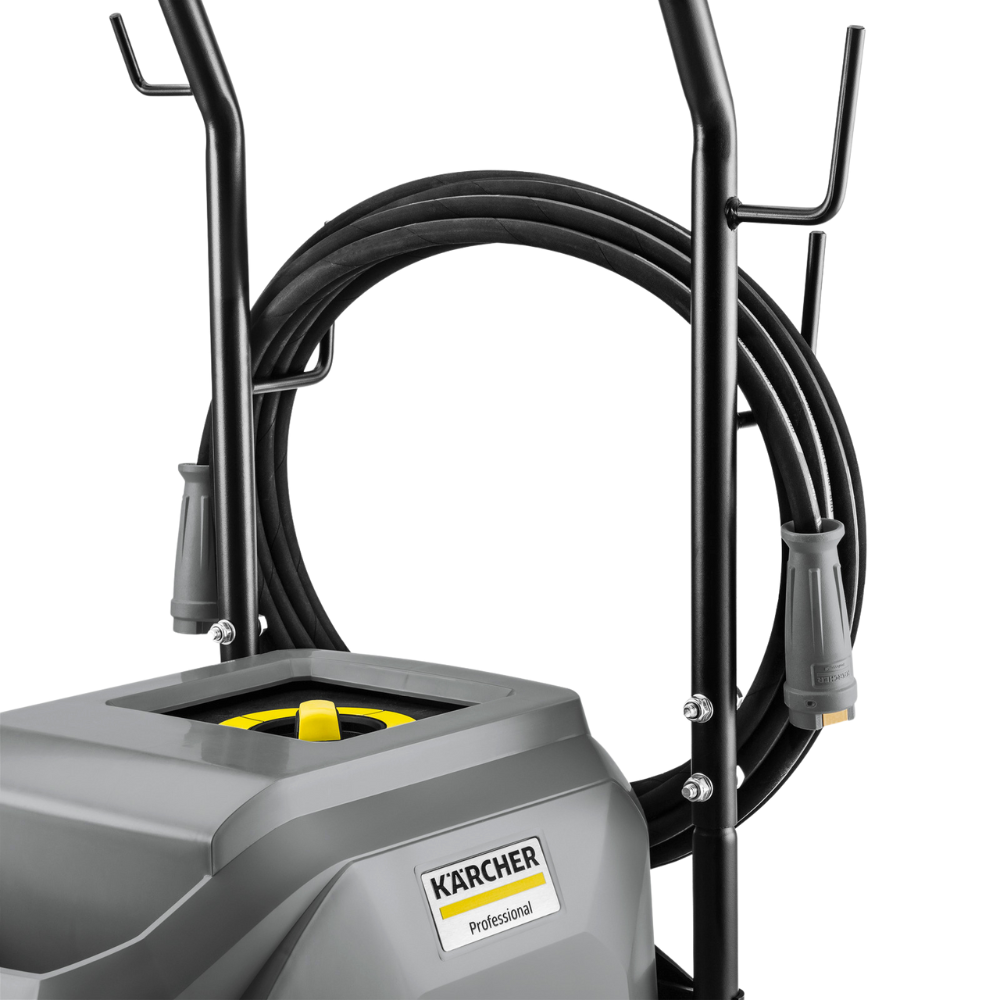
Pressure washer pump types for commercial use: the short answer
Commercial pressure washers use two pump families. Axial, or wobble-plate, pumps are compact and directly driven. Crankshaft pumps, often sold as triplex plunger pumps, turn rotation into a straight stroke and usually run slower. Choose by annual hours, bypass time and serviceability, not by piston count, brass heads or ceramic pistons.
Everything below helps you find those three facts when a listing does not state them.
The two pump families, and where the labels blur
In an axial pump, a tilted plate on the motor shaft pushes the pistons in turn. There are few moving parts and the pump speed is the motor speed. A crankshaft pump uses a crank and connecting rods, the same principle as an engine, so each piston travels in a straight line. It is larger and heavier, and it is often paired with a slower motor, a belt or a gearbox.
The labels blur at the top of the range. Kärcher Australia's super class page offers two versions of the same class: the Classic models with a crankshaft pump, and the standard models with a wobble plate pump and a brass cylinder head. The same page says super class machines have ceramic-coated pistons and slow-running motors. So a heavy, expensive machine can still be axial.
Freshway's listing for the Nilfisk MC 6P 250/1100 FA makes the same point from another brand. It describes an NA6 wobble disc pump with four ceramic pistons running at 1450 RPM.
Duty cycle: hours, starts and time in bypass
Spec sheets rarely print a duty cycle, so you have to build one. It has three parts.
- Hours per year with the motor running, not just hours spraying.
- Starts per hour, because every trigger pull loads the pump.
- Bypass time, when the trigger is closed and the pump keeps turning.
The third one does the quiet damage. Pumps Australia's High Pressure Water Cleaner Guidance Manual says a pressure cleaner should not run for more than 2 to 3 minutes without the trigger being pulled, to avoid overheating the pump head and damaging the seals. A cleaner who stops to move a vehicle, answer a phone or reposition a hose can pass that limit several times a shift.
Machines handle this differently. Freshway's listing for the Kranzle KHD7/122TS says the motor powers down when the trigger is released, and Kärcher Australia says the HD 4/8 Classic has automatic pressure relief. If the machine has neither, the operator's habits become part of the duty cycle.
Seals and oil: what wears, and when
Seals, valves and bearings are the parts that wear, and the oil protects them. The Pumps Australia manual gives a service schedule built on a hot-water washer working 750 hours a year. Its figures are pump oil after the first 50 hours and then every 750 hours; water seal packing, valves and oil seals after 2,500 hours or when pressure drops; and roller bearings after 3,500 hours. It also says to change oil early if it turns from honey to grey.
Treat those as reference points, not a promise for your model. The machine's own manual sets the interval.
Who does the work matters too. WorkSafe Victoria, summarising AS 4233.1, says only the maker, its agent or competent persons should repair or maintain high-pressure water jetting equipment, and that equipment should not be modified without written approval. Before you buy, ask who in your area can service the pump, and whether parts such as seal kits are stocked.
Thermal relief and the unloader
When the trigger closes, the unloader valve sends water back to the pump's suction instead of the hose. Pumps Australia explains that water in bypass heats up very quickly and can destroy seals and valves. A thermal valve dumps that water once it reaches a set temperature. A separate safety relief valve protects against over-pressure, though it notes this is not fitted on small machines.
Melbourne distributor Jetblaster adds a detail spec sheets often skip: whether the unloader is built into the pump head or fitted as a separate item. For petrol machines it recommends a bypass valve external to the pump head, and it treats a reduction gearbox as the industrial option against direct drive.
Those three questions (thermal valve fitted, unloader location, drive type) take a phone call to answer and say more about pump life than the pressure figure does.
Matching the pump to your hours
Work it out before you compare models. The steps below use the Pumps Australia reference figures only as a yardstick.
- Estimate running hours. A contractor running 3 hours a day, 5 days a week, 48 weeks a year logs 3 × 5 × 48 = 720 hours. A fleet wash bay at 6 hours a day, 6 days a week, 50 weeks a year logs 6 × 6 × 50 = 1,800 hours.
- Compare with the reference year. 720 hours is close to the 750-hour year in the schedule. 1,800 hours is 2.4 times it.
- Translate into service events. At 1,800 hours, oil changes every 750 hours come round 2.4 times a year, and a 2,500-hour seal interval arrives in about 1.4 years (2,500 ÷ 1,800). At 720 hours the seal interval is about 3.5 years away (2,500 ÷ 720).
- Add bypass exposure. If operators often leave the trigger closed for minutes at a time, favour a machine with motor shut-off or automatic pressure relief.
- Check the class and the power. Multiply working pressure in bar by flow in L/min. WorkSafe Victoria describes Class A as 800 to 5,600 bar litres per minute and Class B as above 5,600. The HD 6/15-4 Classic at 150 bar and 600 L/h (10 L/min) gives 1,500, so Class A. Its 3.4 kW input works out at about 14.2 A at 240 V (3,400 ÷ 240), more than a standard 10 A outlet supplies.
High hours plus long bypass periods point to a slow-running crankshaft pump with an external unloader. Low hours on a 10 A supply point to a compact machine, which will often be axial.

Spec-sheet fields to check on a pressure washer
Read a listing in this order. If a field is missing, ask Freshway or the brand's service agent before ordering.
| Field | What it tells you | Red flag |
|---|---|---|
| Pump type or drive | Axial (wobble plate) or crankshaft | Only "brass pump" or "3 pistons" with no drive stated |
| Motor speed or poles | Freshway listings show 4-pole motors at 1400 to 1450 RPM and other machines at 2800 RPM | No speed given on a machine sold for long shifts |
| Drive between motor and pump | Direct, belt or gearbox | Not stated on a petrol machine bought for long shifts |
| Bypass protection | Thermal valve, motor shut-off, automatic pressure relief | None listed, and operators who pause often |
| Unloader position | Built into the head or external | Unknown on a petrol machine |
| Maximum inlet temperature | Whether hot or pre-heated supply is allowed | Feeding hot water into a pump rated for cold |
| Phase and current | Whether your outlet can run it | More than 2.4 kW on a 10 A outlet |
Freshway's commercial pressure washers collection lists most of these fields in each product's technical section. Check each product page for current pricing.
Where maintenance takes over
Choosing the pump is the buying decision. Keeping it alive is a separate job, covered step by step in Freshway's pressure washer pump maintenance checklist. Use it to set the pre-shift checks and service log from day one, because the hours you estimated above only mean something if someone records the real ones.
Common mistakes to avoid
- Taking "three-piston" or "brass head" as proof of a crankshaft pump.
- Buying on maximum pressure. Working pressure and flow decide the class and the work rate.
- Leaving the machine idling in bypass while moving gear around.
- Skipping the inlet water filter. The Pumps Australia manual recommends one to maintain pump performance.
- Replacing hoses, guns or fittings by look alone. Parts from the pressure washer accessories range should match the machine's rated pressure and flow.
Quick-reference table: pumps on Freshway listings
Figures come from each Freshway product page, with the class product worked out from working pressure and maximum flow. A blank drive means the listing does not say.
| Machine | Pump as listed | Motor | Pressure and flow | bar × L/min |
|---|---|---|---|---|
| Kärcher HD 4/8 Classic | 3-piston axial, stainless steel pistons | Induction, 240 V, 10 A | 80 bar, 400 L/h (6.7 L/min) | about 533, below the Class A range |
| Kärcher HD 6/15-4 Classic | Crankshaft, ceramic pistons | 4-pole, 3.4 kW single phase | 70 to 150 bar, 450 to 600 L/h | 1,500 |
| Kärcher HD 7/10 CXF | Crankshaft, ceramic pistons | 4-pole, low speed | 100 bar, 700 L/h (11.7 L/min) | about 1,167 |
| Kärcher HD 10/25-4 SX Plus | 3-piston axial, brass head, ceramic pistons | 4-pole, water-cooled, 3-phase | 250 bar, up to 1,000 L/h (16.7 L/min) | about 4,167 |
| Nilfisk MC 6P 250/1100 FA | NA6 wobble disc, 4 ceramic pistons | 1450 RPM, 3-phase | 250 bar, 18.3 L/min | about 4,575 |
| Kranzle KHD7/122TS | Brass head, ceramic-coated pistons (drive not stated) | 4-pole, 1400 RPM | 120 bar, 7 L/min | 840 |
The two highest-output machines in the table use axial or wobble-disc pumps on slow-running motors. That is the point: the label tells you little until you check the drive, the motor speed and the bypass protection on each model.

Frequently asked questions
Is a three-piston pump the same as a triplex pump?
Not necessarily. Kärcher Australia lists the HD 4/8 Classic with a three-piston axial pump. Check whether the drive is axial or crankshaft.
Does a brass pump head mean a crankshaft pump?
No. Kärcher Australia pairs a wobble plate pump with a brass cylinder head on its standard super class machines.
How long can a pressure washer run in bypass?
Pumps Australia's guidance manual says no more than 2 to 3 minutes without pulling the trigger. Motor shut-off systems avoid the problem.
How often should pump oil be changed?
Follow the model manual. Pumps Australia's reference schedule gives 50 hours for the first change, then every 750 hours, or sooner if the oil turns grey.
Next steps with Freshway
Write down your yearly hours, how often operators pause and the outlet you will use. Then shortlist two or three machines from the full pressure washers and cleaners range and ask Freshway's Arncliffe team to confirm the pump drive, unloader position and service parts before you order.