Walk-Behind vs Ride-On Floor Scrubber: Size and Productivity
Turn the m²/h figure into real shift hours before picking a scrubber.
Shop now
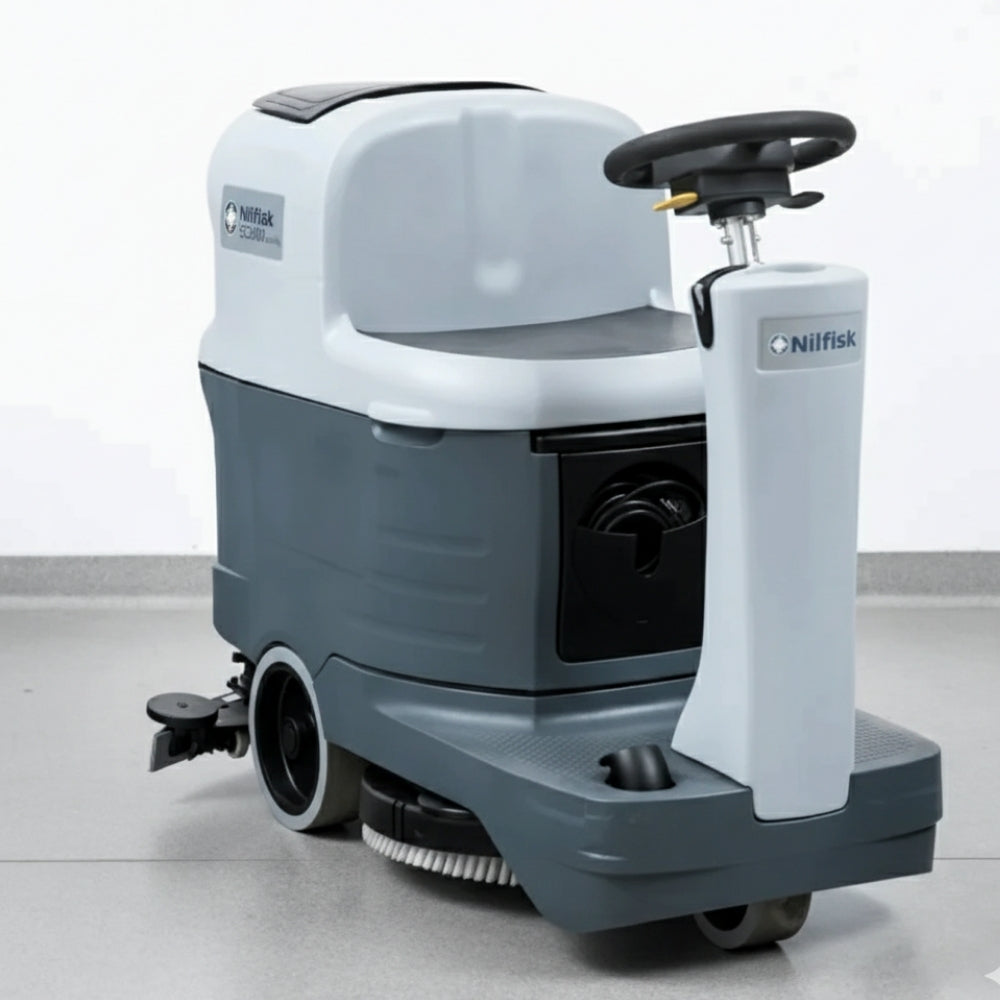
3,050 against 5,360. Those are the theoretical m² per hour on two Nilfisk listings, the SC550 D 61 walk-behind and the BR855 ride-on. Divide a 6,000 m² floor by each and you get 2.0 hours against 1.1 hours. That is before a single stop for water, batteries or a blocked squeegee, and it is the gap most buyers are really asking about when they search for walk behind vs ride on.
The number is a ceiling, not a forecast. This guide shows where it comes from, how to turn it into a realistic shift, and which other limits (aisles, batteries, storage, noise) decide the choice in practice. It uses figures from Freshway product pages and Australian sources, and every calculation can be repeated with your own floor.
Walk behind vs ride on floor scrubber: the short answer
Choose a walk-behind where the floor is congested, the turns are frequent and the cleaning window is long. Choose a ride-on where aisles are long, the area is large and the window is short. Between those cases, divide your area by the machine's theoretical rate, then allow for stops before deciding.
Tennant Australia draws the same line: walk-behinds for confined, changing layouts such as healthcare, retail and schools, and ride-ons for logistics, large commercial properties and transport hubs. Freshway's longer walk-behind and ride-on comparison covers labour and site access. This one is about size and productivity.
Where the productivity number comes from
For the machines below, the listed figure is simply scrubbing width multiplied by speed. The SC2000 53B lists a 53 cm path and 6 km/h: 0.53 m × 6,000 m/h = 3,180 m²/h, exactly the figure on the page. The SC4000 860D lists 860 mm and a 7 km/h transport speed: 0.86 m × 7,000 m/h = 6,020 m²/h, again exact. The SC550 D 61 works out the same way at about 5 km/h (0.61 m × 5,000 m/h = 3,050 m²/h), although its page does not state a speed.
A formula like that assumes the machine never stops, never turns and never overlaps a pass. Real floors have all three. So treat the listed rate as the ideal case for that width and speed, and measure your own.

From theoretical to a real shift
The table applies two calculations to a 6,000 m² floor. The first column is theoretical hours (area ÷ listed rate). The second uses an efficiency of 60%, which is an illustrative planning figure and not a specification. Replace it with a number you have measured on a site trial. Dividing by 0.6 turns 2.0 hours into 3.3.
| Machine | Type | Listed path | Tanks (solution / recovery) | Theoretical m²/h | Hours, theoretical | Hours at 60% |
|---|---|---|---|---|---|---|
| Nilfisk SC401 | Walk-behind | 43 cm | 30 L / 30 L | 2,330 | 2.6 | 4.3 |
| Nilfisk SC550 CYL 51 | Walk-behind | 508 mm | 50 L / 50 L | 2,550 | 2.4 | 3.9 |
| Nilfisk SC550 D 61 | Walk-behind | 610 mm | 50 L / 50 L | 3,050 | 2.0 | 3.3 |
| Nilfisk SC2000 53B | Micro ride-on | 53 cm | 70 L / 70 L | 3,180 | 1.9 | 3.1 |
| Nilfisk BR855 | Ride-on | 860 mm | 106 L / 106 L | 5,360 | 1.1 | 1.9 |
| Nilfisk SC4000 860D | Ride-on | 860 mm | 125 L / 125 L | 6,020 | 1.0 | 1.7 |
| Nilfisk SC6000 910C | Ride-on | 91 cm | 190 L / 190 L | 5,730 | 1.0 | 1.7 |
Two things stand out. The SC2000 micro ride-on has about the same theoretical rate as the SC550 D 61 walk-behind (3,180 against 3,050), so the difference between them is the operator's position, the tank size and the run time, not raw speed. And the jump to a full-size ride-on lifts the theoretical rate by 76% to 97% over the SC550 D 61. Check each Freshway product page for current pricing.
Aisle width and turning space
The scrubbing path is narrower than the machine, and the machine needs more room than its width to turn. Freshway's listings give overall dimensions for some models: the SC2000 53B is 1,270 mm long and 550 mm wide, the SC4000 860D is 1,590 mm by 920 mm, and the SC6000 910C is 1,780 mm by 1,170 mm.
Measure your narrowest aisle and the tightest turn, and compare with the width, not the path. Pallet racking aisles, shelving rows and doorways often decide the question before productivity does. Turning radius is not listed on these pages, so ask for it before you commit.

Battery run time and charging
Run time multiplied by the rate gives an upper bound on area per charge. The SC2000 lists up to 2.5 hours, so at 3,180 m²/h the ceiling is 7,950 m² per charge (2.5 × 3,180). The SC6000 910C lists up to 4.5 hours at 5,730 m²/h, so 25,785 m². Real figures are lower for the same reasons as before.
Charging is a scheduling problem as much as a capacity one. A machine that must charge during the shift is a smaller machine than its spec suggests. Freshway's floor scrubber battery charging guide sets out a routine that protects battery life, and Nilfisk's Australian ride-on range page highlights brush width, running time and recovery tank size as the specifications to look at.
Storage, transport and weight
A ride-on that does not fit through the storeroom door, or cannot be loaded onto a truck, is a poor fit however fast it is. The listed weights are a prompt: 151 kg for the SC401 with batteries, 340 kg gross for the SC2000, and 759 kg including battery for the SC4000. Check the floor loading of any lift or ramp, and where the charger will sit.
Also check how the machine gets from the storeroom to the work area. If it has to travel through public space or across a car park, add that to the route.
Cost drivers beyond the price tag
Every machine here carries costs beyond its purchase price. Add batteries and a charger, brushes and pads, squeegee blades, servicing and the operator's time, then check each product page for current pricing before you compare totals.
The cost that usually matters more is labour. A machine that finishes a floor in half the hours frees those hours for other work. In the table above, the SC4000 860D needs about 1.7 hours for 6,000 m² at 60% efficiency and the SC550 D 61 about 3.3, a difference of roughly 1.6 hours every time the floor is cleaned. That is the figure to weigh against each machine's purchase price and running costs. You can compare the models in Freshway's floor scrubber range.
Safety, noise and wet floors
A scrubber leaves a wet floor behind it, and wet floors are the starting point for much of the guidance. WorkSafe Victoria lists wet and slippery floor conditions among the most common causes of slips, trips and falls, and SafeWork NSW lists slippery surfaces from cleaning products and methods as a cause, with a checklist question on whether wet-floor signs are available and used correctly. A good squeegee and recovery tank are safety equipment as well as cleaning equipment.
Noise is rarely the deciding factor. The listed levels for these machines run from 59 dB(A) in silent mode on the SC550 to 69 dB(A) on the SC6000, well below the 85 dB(A) eight-hour exposure standard in SafeWork NSW's noise code of practice. Whoever drives a ride-on should go through your site's induction first, so confirm your own competency requirements.
Hybrid sites: when one of each makes sense
Tennant Australia's guide to choosing a scrubber argues for a combination rather than one machine type, matched to each zone. That is often the practical answer on a mixed site, such as a warehouse with offices, or a shopping centre with back-of-house.
| Site situation | Lean toward | Why |
|---|---|---|
| Congested layout, frequent turns, cleaning during opening hours | Walk-behind | Tighter footprint and turning, as Tennant Australia describes for healthcare, retail and schools |
| Long aisles or large halls with a short cleaning window | Ride-on | Wider path and larger tanks mean fewer stops, as Tennant Australia describes for logistics and large properties |
| Theoretical hours at your efficiency are longer than your window | Ride-on, or a second machine | Table above: the rate has to rise or the area has to be split |
| Open floor plus tight zones | One of each | Right machine per zone, as in a hybrid fleet |
Quick answers
Is a bigger scrubbing path always faster?
On paper, yes, since the rate is width times speed. In practice a wide machine that cannot turn or fit the aisle loses the advantage.
How many hours does a 6,000 m² floor take?
Between 1.0 and 2.6 hours at the listed theoretical rates in the table, and longer once you allow for stops. Divide by your own measured efficiency.
Is a micro ride-on closer to a walk-behind or a full ride-on?
On listed rate, a walk-behind. The SC2000 lists 3,180 m²/h against 3,050 for the SC550 D 61, so the difference is operator position, tank size and run time.
Do I need a licence to drive a ride-on scrubber?
Check your own site and state requirements. This guide does not treat it as a licence question, but your site's induction and competency rules apply before anyone drives one.
Are walk-behind scrubbers quieter?
Not by much. The listed levels run from 59 to 69 dB(A) across both types, so compare the specific model and its quiet mode.
Next steps with Freshway
Measure the floor and the narrowest aisle, work out the hours at your own efficiency, and shortlist two machines. Freshway's commercial floor scrubber buying guide covers the questions to ask a supplier. Businesses that buy regularly can ask about a trade account on the B2B dealer page.