Measuring Productivity: Sqm per Hour Backpack vs Canister
Time productive vacuuming on a marked floor before you trust any sqm per hour claim.
Shop now
Two cleaners finish the same 800 m² office floor on the same night. One wears a backpack and logs 48 minutes of vacuuming. The other pulls a canister and logs 71 minutes. Both floors look acceptable under the lights. The productivity gap is real, but the headline "sqm per hour" figure on a sales sheet will not tell you which method belongs on your next tender unless you measure it the same way each time.
This guide is for ops analysts and supervisors who need a repeatable time-study method for vacuum productivity in square metres per hour, with backpack and canister formats compared on Australian sites.
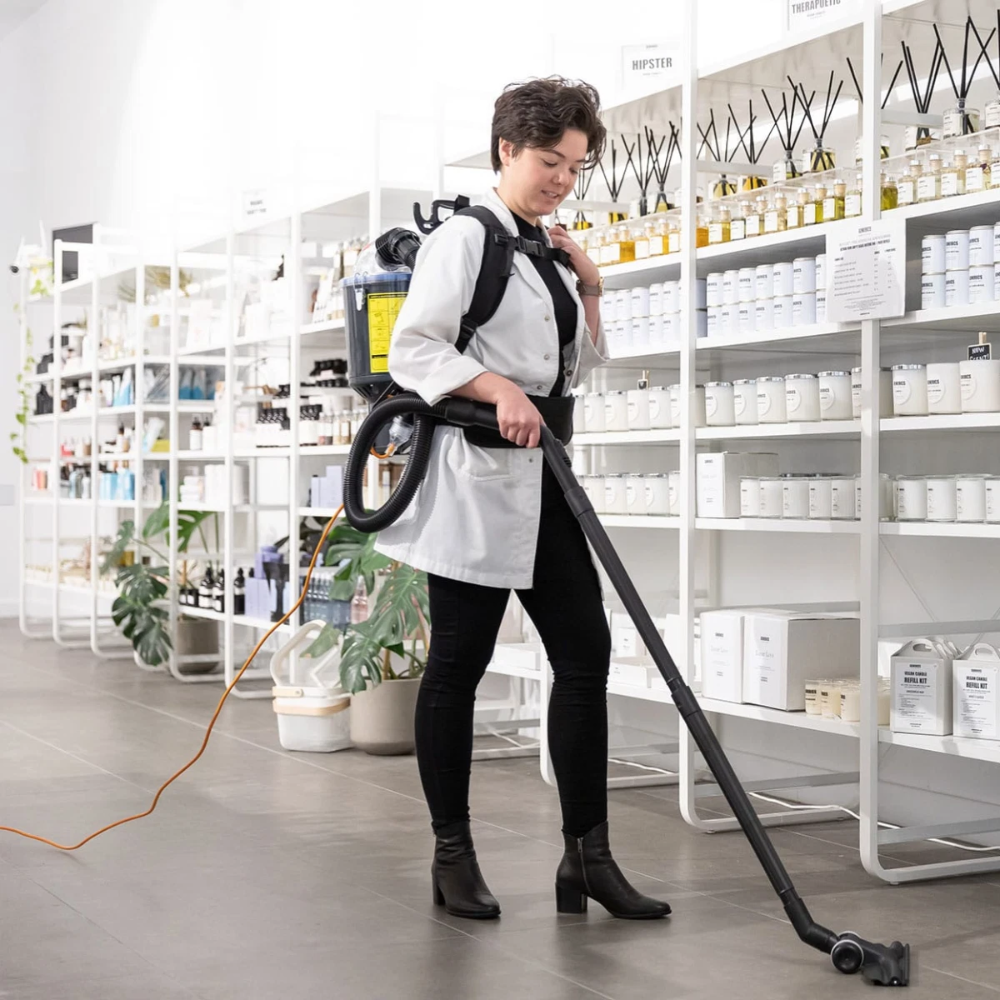
Vacuum productivity sqm per hour: the short answer
Vacuum productivity sqm per hour is cleaned area divided by productive vacuuming time, not the whole shift. Time a marked floor, subtract emptying and travel, and note furniture density. Backpacks often win on desks and stairs; canisters can win where a parked hose covers a room. Treat brochure rates as a start only.
The rest of this guide shows why published rates mislead, how to run a fair study, and how to report results without over-claiming.
Why sqm/hr figures mislead
A single productivity number hides the stops that dominate real shifts: moving chairs, lifting cables, emptying bags, waiting for lifts, and walking back to the cleaner cupboard. WorkSafe Victoria's vacuuming guidance focuses on posture, wand length and mechanical aids rather than speed targets, which is a clue that rushing vacuum work creates injury risk long before it creates savings.
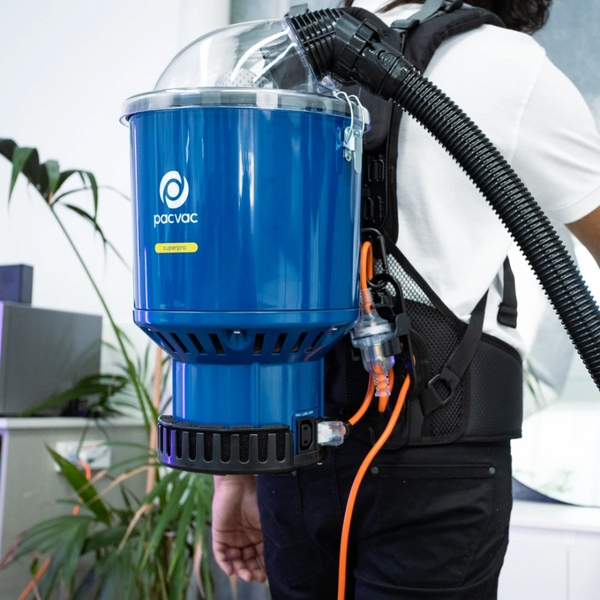
Format changes the stop pattern. A backpack keeps the motor with the operator, so above-floor tools and stairs cost less repositioning time. A canister parks, so long hose reach can clear a boardroom from one plug point, but every doorway and lift lobby becomes a tow. Freshway's own listings give motor watts, capacity and cord length; they do not publish a verified sqm/hr rate for the backpacks and canisters in this guide, so do not invent one from marketing copy.
How to run a time study
Use the same method for both formats on the same floor plate.
- Mark the area. Measure length × width of the vacuumed zone in metres. Subtract fixed islands you never vacuum (built-in counters, large planters) if they are permanent.
- Define productive time. Start the clock when the floor tool touches the carpet; pause for bag changes, cord moves, toilet breaks and conversations. Record pause reasons separately.
- Standardise the kit. Same floor tool type, same wand length setting, same bag fill starting point, same operator skill band where possible.
- Repeat. Run at least three passes on different nights or with different operators before you trust a mean.
- Calculate. sqm/hr = area (m²) ÷ (productive minutes ÷ 60).
Example maths you can recompute: an 800 m² floor vacuumed in 48 productive minutes is 800 ÷ (48 ÷ 60) = 800 ÷ 0.8 = 1,000 m²/h. The same floor in 71 productive minutes is 800 ÷ (71 ÷ 60) ≈ 800 ÷ 1.183 ≈ 676 m²/h. Those numbers are illustrations of the method, not Freshway benchmarks.
The furniture factor
Open plan with chairs pushed in is a different job from a packed call centre. Count choke points before you compare formats:
- Pedestal density and how often the tool must lift over cable trays.
- Under-desk clearance versus floor-tool height.
- Partition legs that snag a canister hose.
- Stairs, risers and mezzanines where a wheeled machine has to be carried or left behind.
SafeWork NSW lists repetitive force and awkward posture among factors that make a task a hazardous manual task. WorkSafe Victoria's cleaning injury hotspots page names backpack vacuums as a mechanical aid for handling equipment. A faster sqm/hr that forces bent spines all night is not a productivity win.

Format comparison ranges from Freshway listings
Use listed specs to explain why a time study might favour one format, not to invent coverage rates.
| Machine | Format | Listed motor | Dust capacity | Listed weight / notes | Listed cord |
|---|---|---|---|---|---|
| Pacvac Superpro 700 | Backpack | 1,000 W | 5 L | 5.4 kg (excl. cord/hose) | 18 m |
| Pacvac Thrift 650 | Backpack | 1,300 W | 5 L | 4.8 kg (machine only) | 18 m |
| Pacvac Glide 300 | Canister | 1,300 W | 15 L | 5.8 kg unit weight | 18 m |
| Numatic Henry HVR200 | Canister | 620 W | 9 L | Tub format; 10 m cable rewind | 10 m |
Capacity changes emptying frequency: a 15 L Glide 300 can stay on the floor longer than a 5 L backpack before a bag change pauses the clock. Cord length changes how often the operator walks back to an outlet. Neither figure is sqm/hr, but both belong in the study notes.
Improving technique without inventing speeds
- Set wand length so shoulders stay low, as WorkSafe Victoria's vacuuming guidance recommends.
- Work in overlapping lanes with a consistent walking pace; sprinting creates missed soil and rework.
- Empty bags at a planned fill level instead of waiting for suction to collapse mid-aisle.
- Stage the canister at the centre of a wing so the hose covers both sides before the machine moves.
- On backpacks, keep spare tools on the harness or trolley so the operator does not walk back empty-handed.
SafeWork NSW's guidance on slips, trips and falls is relevant when cords and hoses cross walkways during a timed run: a faster pass that leaves a trip hazard is not finished work. WorkSafe Victoria also covers hazardous manual handling controls that belong beside any productivity target.
Reporting and records
Report three numbers, not one: productive sqm/hr, total elapsed time including pauses, and a furniture-density note (low / medium / high). Add the machine model, bag type and operator ID. Keep fatigue in view; SafeWork NSW's fatigue guidance matters when night crews are pushed to hit a rate that only a rested day crew achieved once.
For tenders, show the method and the range across repeats. A single heroic night is marketing, not a KPI.
Worksheet: put your own numbers in
- Area measured: _____ m²
- Furniture density: low / medium / high
- Machine and format: __________________
- Productive minutes (tool on floor): _____
- Pause minutes and reasons: _____
- sqm/hr = area ÷ (productive minutes ÷ 60): _____
- Repeat dates and operators: _____
- Decision: keep format / trial other format / change prep (chair stacking, cable tidy)

Caveats and limits
- Do not convert motor watts into sqm/hr. Watts describe power draw, not coverage speed.
- Do not use scrubber theoretical m²/h figures as vacuum rates; different machines, different soil.
- Carpet pile, sand load and filter condition change results between seasons.
- A backpack that is faster on stairs may still lose on a long empty warehouse aisle where a canister parks once.
- Injury risk and complaint rates belong next to the productivity cell on any dashboard.
Compare formats in Freshway's backpack vacuums and canister and barrel vacuums ranges, and read the existing commercial backpack vacuum Australia guide before you rewrite a scope of works.
Frequently asked questions
What is a good vacuum productivity sqm per hour?
There is no universal good rate. Measure your own floors with productive time only, then set a range from repeated studies on the same furniture density.
Are backpacks always faster than canisters?
No. Backpacks often save time on stairs and cluttered desks; canisters can win where a long hose covers a room from one park point and the larger bag empties less often.
Should I time the whole shift or only vacuuming?
Use productive vacuuming time for sqm/hr, and record pauses separately so you can see whether bags, cords or furniture prep are the real bottleneck.
Can I use brochure productivity rates in a tender?
Treat brochure rates as unverified unless you can reproduce them under your site conditions. Show your method and measured range instead.
Next steps with Freshway
Run one paired study on a typical floor with a backpack and a canister from Freshway's vacuum cleaners range, then lock the method into your SOP. Check each product page for current pricing and stock, and browse the Knowledge hub for related vacuum guides before you change fleet mix.