Ergonomics and Injury Risk: Backpack Harness vs Pulling a Canister
Fit the harness, set the wand and rotate tasks before blaming the machine.
Shop now
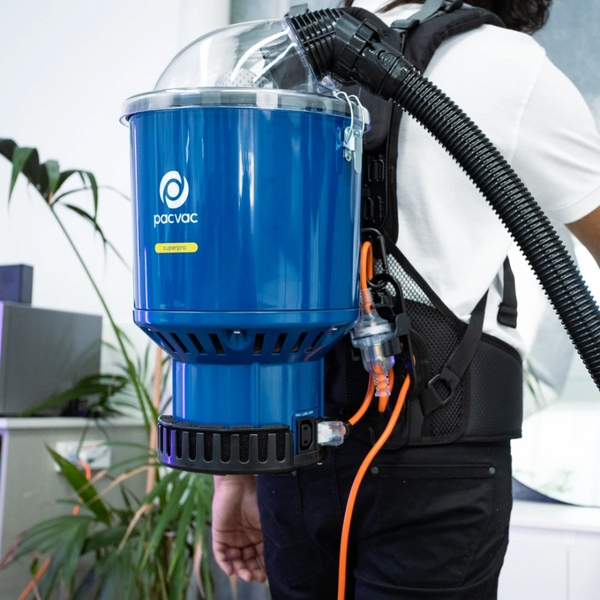
Two cleaners start the same night shift on the same open-plan office floor. One wears a backpack vacuum with the hip belt done up. The other pulls a canister by its hose between desk pods. Neither is doing anything wrong. By the third hour, though, the backpack operator's shoulders have carried every metre of the shift, and the canister operator has stopped again and again to tug the machine around chair legs and bend to free the hose. Which of them goes home sore depends less on the badge on the machine than on fit, technique and how the shift is organised.
This review follows both operators through the factors that decide injury risk, from harness fit and pull forces to rotation, training cues and spec-sheet weights. It is written from the operator's side, using Australian regulator guidance and the weights Freshway lists for real machines.
Commercial vacuum ergonomics: the short answer
Commercial vacuum ergonomics comes down to where the load sits and how often the body bends, twists or pulls. A fitted backpack harness carries the machine on the hips and frees both hands; a canister avoids carrying but adds pulling and stooping. Neither is safe by default: fit, wand length and rotation decide the risk.
Injury patterns in vacuuming work
Vacuuming is a manual task, and SafeWork NSW explains that a manual task becomes hazardous when one or more risk factors are present: repetitive or sustained force, high or sudden force, repetitive movement, sustained or awkward posture, or vibration. A movement counts as repetitive when it happens more than twice a minute, and a posture counts as sustained when it is held for more than 30 seconds. Pushing a floor tool back and forth meets the first test easily.
SafeWork NSW lists muscle and tendon strain, rotator cuff injuries and disc injuries among the musculoskeletal disorders that hazardous manual tasks cause, and WorkSafe Queensland notes that sprains and strains are the most common workplace injury, with the vast majority caused by hazardous manual tasks.
WorkSafe Victoria's guidance on vacuuming breaks the job down further. It names bending and twisting the back, reaching forwards and sideways, pushing and pulling the vacuum head with force, and lifting and carrying heavy vacuum cleaners upstairs or between areas. Mapped onto our two operators:
- Backpack operator: the risk is sustained load. If the harness is loose or set too high, the weight hangs from the shoulders for the whole run.
- Canister operator: the risk is repeated pulling, stooping to move or restart the machine, and lifting it on stairs and kerbs.
- Both: the wand and floor tool. A short wand or the wrong head forces bending and extra push force whichever machine is behind it.
Harness fit: getting the load onto the hips
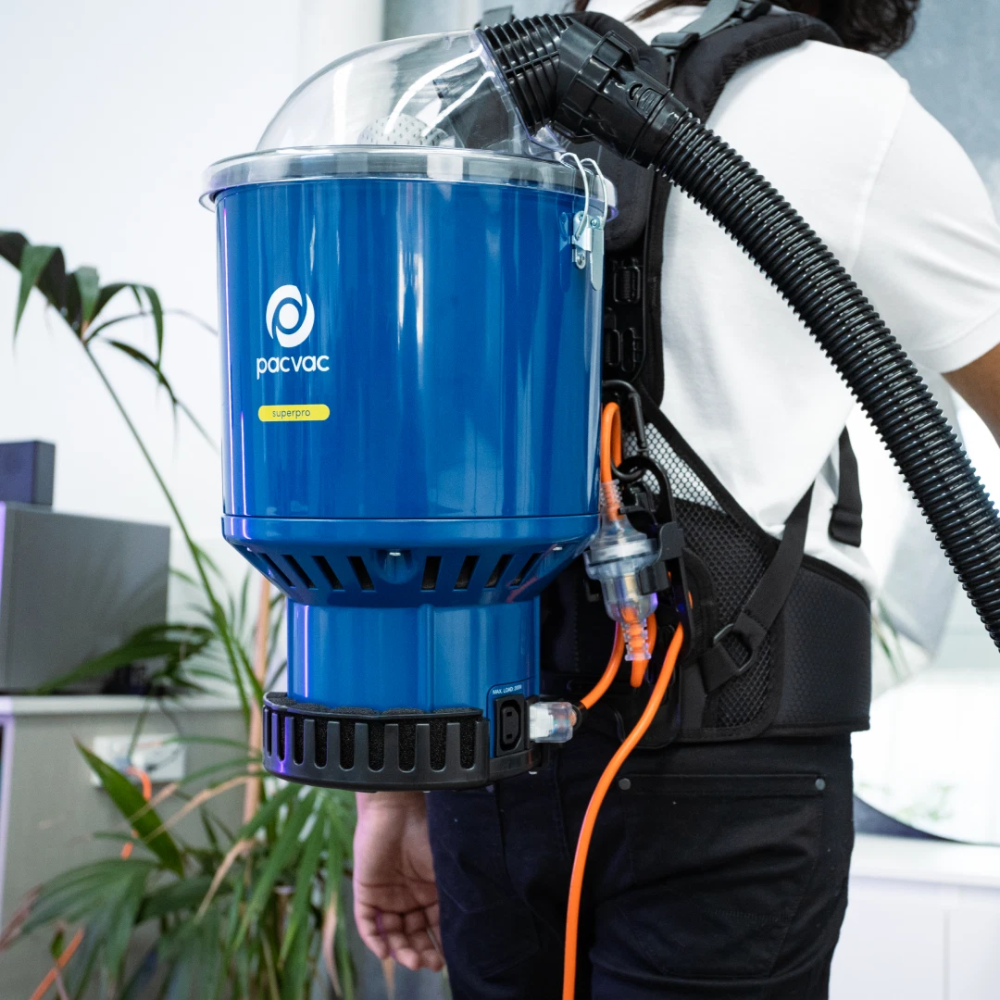
A backpack only delivers its ergonomic case when it is adjusted to the person wearing it. Freshway's listing for the Pacvac Superpro 700 describes an Ecoharness with thick padding and a breathable mesh back-rest designed to transfer the machine's 5.4 kg to the hips. The Pacvac Superpro Go listing adds that its Ecoharness has three adjustable height settings, and the Thrift 650 is listed with a fully adjustable harness.
A practical fit routine at the start of each shift:
- Loosen every strap before putting the machine on.
- Set the harness height so the hip belt sits across the hips, not the waist, then do the belt up firmly.
- Tighten the shoulder straps only until the machine sits close to the back. If tightening them lifts the belt off the hips, they are too tight.
- Walk a few steps and turn. The machine should move with the body rather than swing.
- Adjust the wand so the elbow can stay close to the body while the floor tool lies flat.

Canister pull forces and the drag problem
A canister takes the machine off the operator's back, but it adds a different kind of effort. Most operators move a canister by pulling the hose, which loads one arm at a time, often while turning to see where the machine is going. Each snag on a chair leg or door frame becomes a short, sharp tug, and SafeWork NSW lists high or sudden force as a risk factor in its own right.
WorkSafe Victoria's vacuuming guidance points to the controls: lightweight vacuum cleaners with functional castors, information and training on technique such as "walking" the vacuum cleaner, and a vacuum cleaner on each level of a multi-level building so machines are not carried up stairs. It also suggests vacuums that are easy to empty, emptied frequently to reduce weight.
Small design details matter on a canister. Freshway's listing for the Kärcher T 10/1 Adv describes a large switch on top of the machine designed to be operated by foot, so the operator does not have to bend to turn it on and off.

Job rotation across a shift
Rotation is an administrative control, so it sits below better equipment and better fit in the hierarchy of controls. It still matters. WorkSafe Victoria's cleaning injury hotspots page advises making sure employees are not exposed to repetitive work for long periods, using job rotation and work variation, and it names backpack vacuum cleaners as a mechanical aid for handling equipment. SafeWork NSW gives two administrative examples that suit cleaning rosters well: rotate workers between different tasks, and arrange workflows to avoid peak physical demands towards the end of a shift.
In practice, break long vacuuming runs with lighter tasks such as bins or dusting, and schedule the heaviest areas early. Swapping between a backpack and a canister also changes which muscles do the work.
Training cues supervisors can use
Training works when it is specific to the task. SafeWork NSW states that "how to lift" training is not an effective way to protect workers from harm on its own, and that training should cover the specific manual task risks and how to control them. WorkSafe Victoria's guidance gives task-specific examples, and its manual handling hotspots describe a safe working zone between shoulder and mid-thigh height, with the elbows close to the body. Short cues an operator can remember:
- "Elbow in, wand long." Adjust the wand so the shoulder and elbow stay in a natural position close to the body.
- "Face the work." When vacuuming under furniture, face the area and push the tool forward rather than bending and twisting.
- "Right head, less push." Match the floor tool to the surface so the operator is not forcing it.
- "Empty early." A fuller bag is a heavier machine, on the back or on the castors.
- "Cord behind you." Keep the lead out of the walking path.
Ask operators directly as well. SafeWork NSW suggests a discomfort survey with three questions: what makes you sore at work, when do you feel discomfort, and what jobs do you avoid doing?
Spec weight fields: reading what the kilograms include
Weight is the first number buyers compare, but listings measure it differently. The table shows what Freshway's product pages state.
| Machine | Format | Listed weight | What the figure covers | Power |
|---|---|---|---|---|
| Nilfisk GD5 HEPA | Backpack | 4.4 kg | Not stated on the listing | 15 m detachable cord |
| Pacvac Velo Go | Backpack | 4.5 kg | With batteries | Two 18 V lithium-ion batteries |
| Pacvac Thrift 650 | Backpack | 4.8 kg | Machine only | 18 m cord |
| Pacvac Superpro 700 | Backpack | 5.4 kg | Excluding cord and hose | 18 m cord |
| Pacvac Glide 300 | Canister | 5.8 kg | Unit weight | 18 m cord |
| Kärcher T 10/1 Adv | Canister | 6.5 kg | Without accessories | 12 m cable |
Work through the numbers before drawing conclusions. On paper the Superpro 700 is 0.9 kg heavier than the Velo Go (5.4 kg minus 4.5 kg), but the Velo Go figure includes its batteries while the Superpro figure leaves out the hose. The real gap on the operator's back is therefore not 0.9 kg, and dust in the bag adds weight to both as the shift goes on.
The format changes what the number means, too. A backpack's weight is carried for the whole vacuuming run. A canister's 5.8 kg or 6.5 kg rides on castors along a flat corridor and only becomes a lifted load on stairs, kerbs and into vehicles, which is exactly the lifting and carrying WorkSafe Victoria flags. Compare weights within a format first.
When to switch format mid-shift
Many sites cut overall strain by changing machines as the work changes. WorkSafe Victoria suggests light backpack vacuum cleaners with adequate lumbar support and cushioning for stairways and elevated surfaces such as windowsills and doorways. Reasonable switch points:
- Switch to the backpack for stairwells, tiered seating, dense desk pods and above-floor dusting, where dragging a canister means constant tugging.
- Switch to the canister for long open corridors and large carpeted rooms, or when an operator reports shoulder or back discomfort after a long backpack run.
- Use the bigger bin where debris volume is high. Freshway lists 15 litres for the Glide 300 against 5 litres for the Superpro 700 and Thrift 650, so the canister needs emptying less often.
- Keep a machine on each level in multi-storey buildings instead of carrying one up the stairs. Freshway's guide to corded and battery backpacks for multi-storey sites covers that decision.
Checklist for site supervisors
- Harness straps and hip belts adjusted for each operator at the start of the shift, not left at the previous setting.
- Wands adjustable or extendable, and set so the elbow stays close to the body.
- Floor tools matched to the surface; worn heads replaced.
- Canister castors rolling freely and switches reachable without bending where possible.
- One machine per level, or a lift route planned, in multi-storey buildings.
- Cords routed away from walkways. SafeWork NSW lists loose cords and cables and changes from concrete to carpet among common sources of slip and trip risk.
- Vacuuming rotated with lighter tasks, and heavy areas scheduled early.
Quick-fire FAQ
Is a backpack vacuum always easier on the body?
No. A well-fitted harness puts the load on the hips, but a poorly adjusted one loads the shoulders for the whole shift. Fit, wand length and rotation decide the outcome.
How heavy is a commercial backpack vacuum?
Freshway lists the Nilfisk GD5 HEPA at 4.4 kg and the Pacvac Superpro 700 at 5.4 kg excluding cord and hose. Check what each figure includes before comparing machines.
Does a canister remove the manual handling risk?
No. It removes carrying on flat floors but adds pulling, bending and lifting on stairs. WorkSafe Victoria suggests keeping a vacuum on each level of a multi-level building.
Is general lifting training enough for vacuum operators?
No. SafeWork NSW says how to lift training is not an effective way to protect workers on its own. Training should cover the specific vacuuming risks and the controls in place.
Next steps with Freshway
Start with the operators: ask the discomfort survey questions, watch a shift, and note where the strain comes from. Then match machines to the work. Compare harness and weight details in the backpack vacuum range, castor and capacity details in the canister and barrel vacuum range, or browse all commercial vacuum cleaners, and check each product page for current pricing and stock. Worn cords, switches and motors can go to Freshway's Arncliffe workshop through the service and repairs page, which lists pick-up and delivery for commercial clients across Sydney. More vacuum guides are in the Freshway knowledge hub.