Soft Washing vs Pressure: Choosing Chemistry Over Bar
Let chemistry and dwell time do the work before reaching for more bar.
Shop now
Ten minutes. That is roughly the gap that decides most soft-wash versus pressure-wash arguments on commercial jobs: the time a correctly mixed detergent is left to sit before anyone squeezes a trigger. Skip it and the operator compensates with bar, a tighter nozzle and a closer stand-off. Keep it and the same machine often cleans the surface with far less force.
Our earlier guide, soft washing vs pressure washing, explains the two methods. This article is written for buyers and supervisors who need to decide, job by job, when to spend on chemistry and low-pressure kit instead of a bigger pump.
Soft washing vs pressure washing on commercial sites: the short answer
Choose soft washing when the soil is biological or loosely bonded and the surface can be damaged by force: render, painted cladding, signage, shade sails and vehicle paint. Choose pressure washing when soil is mechanically bonded, such as caked mud or gum. Most AU commercial jobs use chemistry first, then a measured low-pressure rinse.
Why biology changes the maths
Mould, algae and lichen grow into the pores of a surface. Blasting them with bar removes what sits on top and leaves roots behind, so regrowth shows up within weeks. A detergent with enough dwell time loosens the growth from below, which is why soft-wash crews talk about contact time rather than pressure.
Grime that has simply settled on a surface, such as road film on a truck panel, behaves differently. It is held by static and oily residue rather than roots, and a foaming detergent lifts it so the rinse can carry it away without abrasion.
Chemical dwell: the variable most crews skip
Dwell time is the minutes a detergent stays wet on the surface before rinsing. Three things shorten it on Australian sites: direct sun, wind and hot substrates. A product that works in a shaded Sydney loading dock in July can flash dry on a west-facing wall in January.
- Work in sections small enough to keep wet.
- Apply bottom-up on vertical surfaces so streaks do not form on dry areas below.
- Rinse top-down once the dwell time on the label is reached.
- Never let detergent dry on glass, anodised frames or paint.
Read the label and safety data sheet for every product. SafeWork NSW's hazardous chemicals guidance sets out the duty to manage chemical risks, including correct labelling and access to safety data sheets.
Low-pressure gear that makes chemistry work
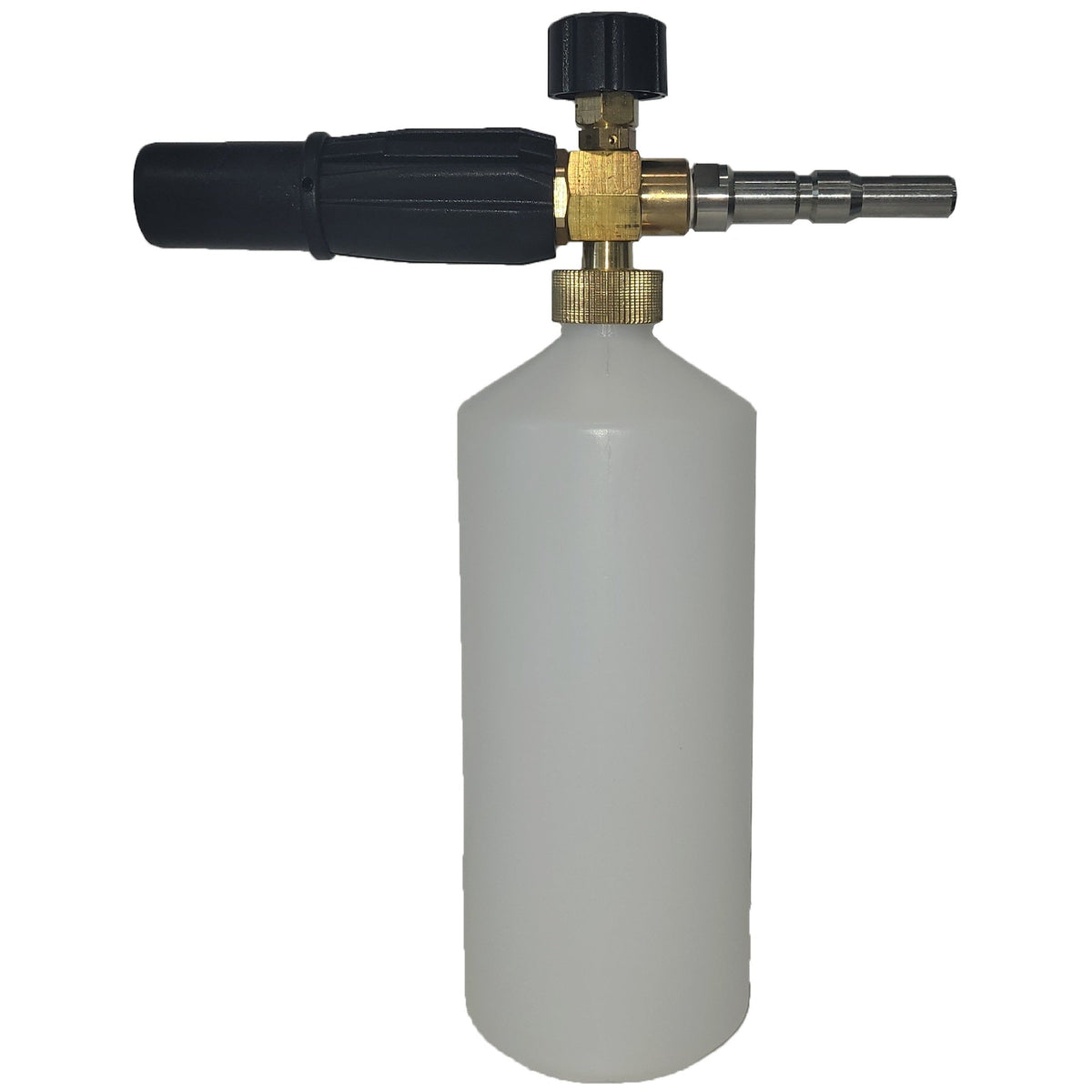
You do not need a dedicated soft-wash rig for every job. A foam lance on an existing cold-water machine lets an operator lay detergent down evenly and see where it has gone.

Freshway's listing for the Powershot D12 Quick Connect Foaming Lance describes a D12 quick connect coupler and a 1-litre chemical tank. Check that your trigger gun uses the same coupling before ordering; a lance that does not fit the gun is the most common return in this category. Other lances and couplings are listed under pressure washer accessories.
Spitwater's guide to mixing chemicals in a foamer is a useful AU reference on how the bottle ratio and machine flow both affect the final dilution.
When pressure washing is still the right call
Chemistry is not a cure-all. Use the pressure washer as the main tool when:
- Soil is physically bonded: dried concrete splatter, chewing gum, mud baked onto plant.
- The surface is hard and sound: broom-finish concrete, steel decks, sealed pavers.
- Runoff controls rule out the volume of detergent a soft-wash approach needs.
- Time on site is short and dwell time cannot be built into the schedule.
Even then, pre-wetting with detergent usually lets the operator step back and use a wider fan, which lowers the risk of etching.
Comparison table: chemistry first or bar first
| Job type | Main soil | Lead method | Why |
|---|---|---|---|
| Rendered or painted facade | Mould, algae | Soft wash | Force can lift paint and drive water behind render |
| Fleet vehicles | Road film, insects | Foam then rinse | Lifts grime without scrubbing grit into paint |
| Concrete forecourt | Oil, tyre marks, gum | Pressure wash with pre-treat | Bonded soil needs mechanical action |
| Shade sails and signage | Dust, bird droppings | Soft wash | Fabric and printed faces are easily damaged |
| Machinery and plant | Caked mud, grease | Pressure wash, hot water if available | Thick deposits need force and heat |
Spec checklist for a chemistry-first kit
- Coupling type: match the foam lance to the gun (D10, D12 or thread).
- Machine flow: foamers need steady flow to aerate; note the L/min on your machine's Freshway page.
- Detergent fit: Freshway lists Karcher PressurePro RM 838 Foam Cleaner as a 3-litre, silicone-free, VDA-compliant vehicle foam. Use vehicle products on vehicles and facade products on facades.
- Rinse nozzle: a wide fan for the final rinse, not a zero-degree tip.
- Capture plan: bunding, wet vac or wash bay drainage.

Browse detergents in cleaning chemicals and confirm current pricing on each product page.
Safety and runoff rules
High-pressure water is a recognised workplace hazard; WorkSafe Victoria's high pressure water jetting alert covers injection injuries and controls. Soft washing reduces that risk but adds chemical exposure, so eye protection and gloves are standard.
Runoff is the other constraint. The NSW EPA states the drain is just for rain, so detergent-laden water must not enter stormwater. On larger sites, Sydney Water's industrial trade wastewater pages explain when discharge to sewer needs approval.
Mistakes that waste chemistry
- Mixing stronger than the label in the hope of shorter dwell time.
- Spraying in full sun on a hot wall, then blaming the product.
- Using a vehicle foam on a building, or a building cleaner on paintwork.
- Rinsing with a narrow tip "to be sure", which undoes the point of soft washing.
- Forgetting to flush the foam lance with clean water at the end of the shift.
Frequently asked questions
Is soft washing just pressure washing with soap?
No. Soft washing relies on detergent and dwell time to do most of the cleaning, with a low-pressure rinse at the end. Pressure washing relies on force, with detergent as a helper.
Can I soft wash with my existing cold-water machine?
Often yes. A foam lance that matches your gun coupling lets a cold-water machine apply detergent evenly; the rinse is then done with a wide fan nozzle.
Does soft washing stop mould coming back?
It usually lasts longer than blasting because the detergent reaches the growth below the surface, but shade, moisture and drainage still decide how soon regrowth appears.
Where should the runoff go?
Not into stormwater. Capture it or direct it to an approved wash bay or trade waste connection, following NSW EPA and your water authority's rules.
Next steps with Freshway
Match a foam lance to your existing gun, choose a detergent made for the surface, and keep a wide rinse nozzle on the truck. Machines are listed under pressure washers; check each product page for current pricing and full specifications.