Common Spec Sheet Mistakes When Buying Commercial Vacuums
Convert the units, ignore the watts, and trial the shortlist before you sign.
Shop now
The vacuum with the biggest number on its spec sheet is often not the one that cleans fastest. On Freshway's own listings, a 620 W Numatic tub quotes more airflow than a 1,000 W backpack, and two backpacks with the same 1,000 W motor are listed 9 dB(A) apart. Watts describe what a motor draws from the wall. They say very little about what reaches the carpet.
This checklist is written for procurement officers and contract managers comparing quotes. It works through the spec lines that cause the most buying mistakes, shows how to put mismatched units on the same scale, and ends with a short trial you can run before signing off a fleet order.
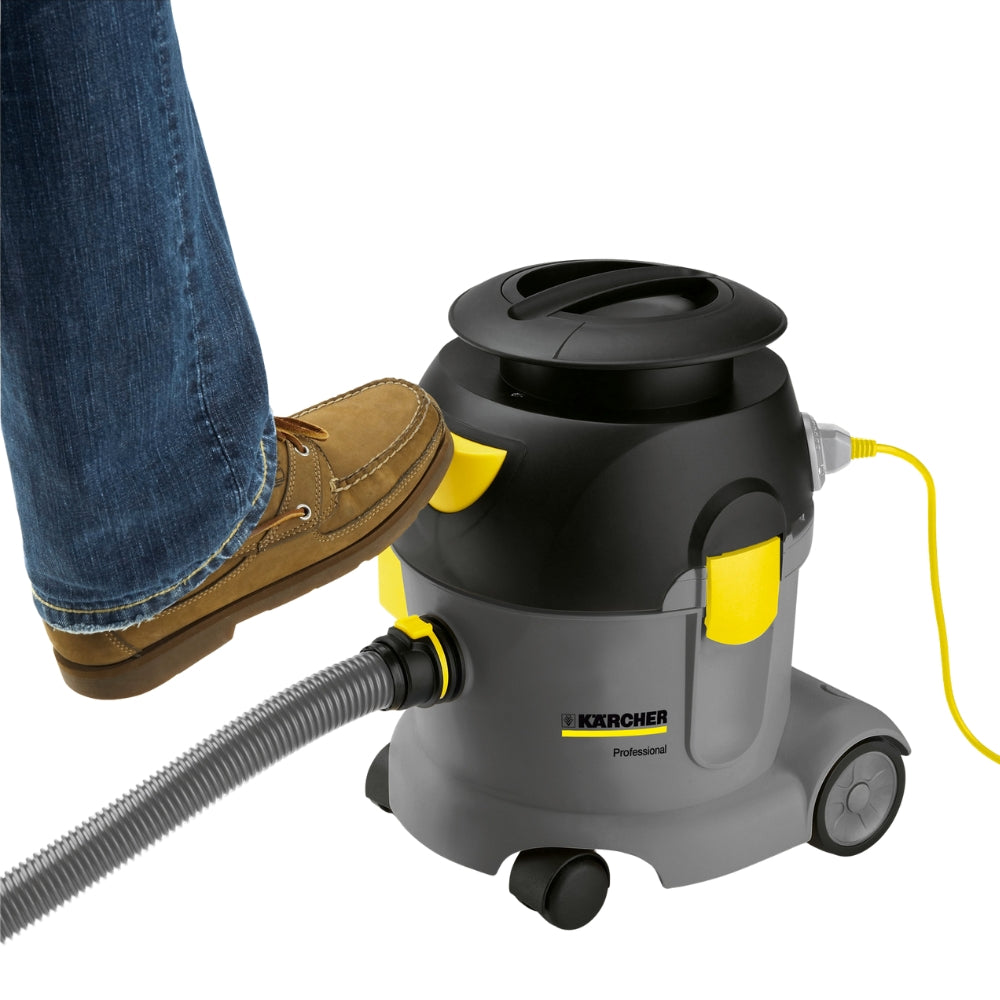
Commercial vacuum spec sheet: the short answer
Read a commercial vacuum spec sheet for airflow (L/s), sealed suction (kPa, mbar or mm water lift), filter class, usable capacity and weight as worn or pushed. Treat motor watts as an electrical rating, not cleaning power. Compare only figures measured the same way, and confirm runtime, noise and cord claims on site.
The rest of this guide takes each line in turn, using figures from Freshway's commercial vacuum cleaners range as worked examples.
Watts are not cleaning power
Motor wattage is the most prominent number on most listings and the least useful for comparing cleaning results. Three examples from Freshway's product pages show why:
- The Numatic Henry HVR200 is listed at 620 W with 42 L/s of airflow and 2,300 mm of water lift.
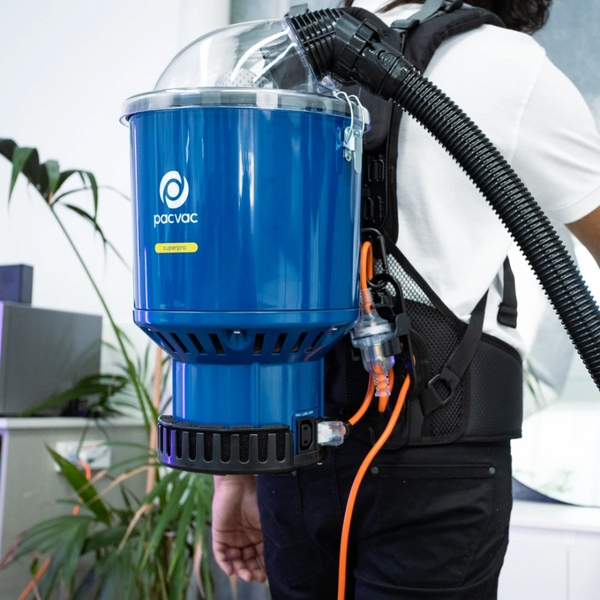
- The Pacvac Superpro 700 is listed at 1,000 W with 38 L/s and 22 kPa.
- The Pacvac Superpro Duo uses the same 1,000 W rating with a two-stage bypass motor and is listed at 45 L/s.
Same watts, different airflow. Fewer watts, more airflow. Motor design, fan stages, filter area and hose diameter all sit between the power point and the floor tool. Wattage still matters for one practical reason: it tells you what the machine will draw from a 240 V outlet, which helps when several machines share a circuit or an extension lead.
Airflow and waterlift: put them on one scale
Airflow is the volume of air the machine moves, usually in litres per second. It carries dry soil off carpet and into the bag. Sealed suction, sometimes called water lift, is the pressure the motor can pull with the inlet blocked. It matters for embedded grit, long hoses and wet pickup.
The trap is that brands quote suction in three different units. Before comparing, convert everything to kPa:
| Machine (Freshway listing) | Suction as listed | Converted to kPa | Airflow as listed |
|---|---|---|---|
| Pacvac Superpro 700 | 22 kPa | 22.0 kPa | 38 L/s |
| Numatic Henry HVR200 | 2,300 mm water lift | about 22.6 kPa | 42 L/s |
| Karcher T 10/1 Adv | 244 mbar | 24.4 kPa | 61 L/s |
| Makita VC011G (cordless) | 20 kPa max sealed | 20.0 kPa | 40 L/s (2.4 m³/min) |
The conversions are simple: 10 mbar equals 1 kPa, and 1,000 mm of water column is about 9.81 kPa. Once the units match, the four machines sit within a few kPa of each other on suction, while airflow ranges from 38 to 61 L/s. Even then, treat close figures as a tie. Brands do not always state where on the machine they measured.
Read the footnotes too. Freshway's listing for the Numatic Hetty HET200P gives 48 L/s with the note "motor only". A motor-only figure leaves out losses through the bag, filter and hose, so expect less at the floor tool.

Capacity claims
A "5 litre" backpack and a "15 litre" canister are describing the container, not how much dust you can collect before suction drops. Bags fill unevenly, and fine dust blocks bag pores well before the bag looks full.
For wet-and-dry machines, check that the listing separates dry and wet capacity. Freshway's listing for the Numatic Charles CVC370 shows 15 litres dry and 9 litres wet. Quoting the larger figure for spill work overstates the machine by six litres.
Noise numbers
Noise is where small-looking differences are large. SafeWork NSW's guidance on controlling hazardous noise sets the workplace exposure standard at 85 dB(A) averaged over eight hours. It also explains that every 3 dB increase doubles the noise intensity.
Apply that to two Pacvac backpacks on Freshway: the Superpro Micron is listed at 65 dB(A) and the Superpro Duo at 74 dB(A). A 9 dB gap is three doublings, so roughly eight times the sound intensity. For day cleaning in offices, libraries or wards, that gap matters more than any wattage difference. One caution: a quoted dB(A) figure is only comparable if it was measured at the same distance. If a brochure doesn't say where it measured, ask.
Filtration wording
"HEPA-rated", "HEPA H13", "4-stage filtration" and "M-class" are not interchangeable. H13 or H14 describes the filter media. A dust class (L, M or H) describes the whole machine, including seals and how dust is contained when the bag is changed.
The distinction has legal weight on Australian building sites. SafeWork NSW's silica dust clean-up guidance calls for M- or H-class rated vacuum cleaners. It also states that household vacuums should never be used where silica dust may be present, even if they have a HEPA filter. If a tender specifies a dust class, a HEPA backpack does not meet it.
Weight without harness
Weight lines often leave things out. Freshway's listing for the Superpro 700 gives 5.4 kg "excluding cord/hose". The Makita VC011G page lists a 5.6 kg skin weight and 7.6 kg with its two batteries. On a backpack, that two-kilogram difference sits on the operator for the whole shift.
SafeWork NSW lists sustained or awkward posture and repetitive movement among the risk factors for hazardous manual tasks. Ask for the weight as worn: machine, batteries, hose and wand. Then have the operators who will use it wear it.

Cable length
Cord length controls how much floor one power point covers. Freshway lists 18 m on the Superpro 700, 15 m detachable on the Nilfisk GD5, 12 m on the Karcher T 10/1 Adv and 10 m on the Henry HVR200. The Karcher page describes its 12 m cable as giving a 24-metre cleaning diameter. That figure assumes an empty room, not a working radius around desks and doorways.
Check whether the cord is detachable. A detachable lead can be swapped on site when it is damaged. A fixed cord sends the whole machine to the workshop. Either way, SafeWork NSW's electrical risks fact sheet refers to AS/NZS 3760. It gives commercial cleaning equipment as an example that needs more frequent testing, for example at least once every six months. Build the cost of tagging long leads into the comparison.
Battery Ah myths
Amp-hours alone do not compare batteries across brands, because voltage differs. Watt-hours do. Pacvac's spare battery on Freshway is listed at 18 V and 108 Wh, which works out to 6 Ah (108 ÷ 18). A pack with more Ah at a lower voltage can hold less energy.
Runtime claims carry their own conditions. The Makita VC011G page quotes up to 32 minutes on maximum suction with two 4.0 Ah batteries, while its kit version ships with 5.0 Ah batteries. The Karcher BVL 5/1 Bp quotes up to 64 minutes in its eco mode. The Numatic RSB150NX quotes up to 80 minutes on the NX300 battery, which is sold separately. Compare runtimes at the suction setting your crews will actually use. Then check whether the quoted price includes batteries and a charger. Freshway's battery-powered backpack vacuums collection lets you check each listing side by side.
Energy Safe Victoria's lithium-ion battery safety advice is to use chargers supplied or recommended by the maker of the product and to charge on a non-flammable surface. Plan the charging area before the batteries arrive.
Trial protocol
A spec sheet narrows the field. A trial decides it. Run each shortlisted machine on the same route, on the same day if possible:
- Same floor, same soil. Pick one carpet zone and one hard-floor zone on a live site.
- Fresh consumables. Start every machine with a new bag and a clean filter.
- Time the route. Record minutes per zone and how many times the operator stops to replug, empty or swap a battery.
- Check at half-full. Note whether pickup drops noticeably once the bag is half full.
- Listen. Ask someone at a nearby desk whether they could keep working through it.
- Ask the operator. Comfort after 30 minutes worn, plus how easy the bag change was.
Checklist for site supervisors
Before signing off an order, confirm each line against the brand's own spec sheet, not a reseller summary:
| Spec line | What to confirm | Common mistake |
|---|---|---|
| Power | Watts and plug for your circuits | Reading watts as cleaning power |
| Airflow and suction | Same units, same measuring point | Comparing "motor only" with at-hose figures |
| Capacity | Dry and wet figures listed separately | Quoting dry litres for spill work |
| Noise | dB(A) and the measuring distance | Treating 9 dB as a small gap |
| Filtration | Filter grade and machine dust class | Accepting HEPA where M or H class is required |
| Weight | As worn or pushed, with batteries | Comparing skin weight with kit weight |
| Cord or battery | Length, detachable lead, Wh and mode for runtime | Comparing Ah across voltages |
It is the same habit as reading a safety data sheet for a cleaning chemical: find the lines that change the decision, and ignore the adjectives.
Frequently asked questions
Is a higher wattage vacuum more powerful?
It draws more power, but it does not necessarily clean better. On Freshway's listings, a 620 W Numatic Henry quotes more airflow than a 1,000 W Pacvac Superpro 700. Compare airflow and sealed suction in the same units instead.
How do I compare kPa, mbar and mm water lift?
Convert them all to kPa. Divide mbar by 10, and multiply millimetres of water lift by 0.00981. For example, 244 mbar is 24.4 kPa and 2,300 mm is about 22.6 kPa.
Does a HEPA filter make a vacuum suitable for construction dust?
No. SafeWork NSW's silica guidance calls for M- or H-class rated vacuum cleaners and says household vacuums should not be used even with a HEPA filter. A filter grade is not a machine dust class.
Should I compare battery vacuums by amp-hours?
Compare watt-hours and the suction mode behind the runtime claim. Amp-hours only compare fairly at the same voltage, and runtimes quoted in eco mode will be shorter on full power.
Next steps with Freshway
Shortlist two or three machines per format, convert their figures with the table above, and then trial them on a live route. Freshway's backpack vacuums and canister and barrel vacuums collections list each machine's specifications on its product page, and the vacuum cleaners guide explains which format suits which job. Check each product page for current pricing and availability, and ask the Arncliffe team if a spec line is missing or unclear.