Pressure Washer Trailers for Mobile Contract Cleaning Crews
Choose a trailer-mounted, skid-mounted or trolley setup from live machines.
Shop now
The crew booked a 6 am basement wash at a Sydney strata block. The petrol washer was buried under buckets in the van. By the time they dragged it onto the driveway, a neighbour had heard the scrape of steel on concrete, and the first dirty litres were already heading for a grated pit.
Why a pressure washer trailer suits commercial Australia crews
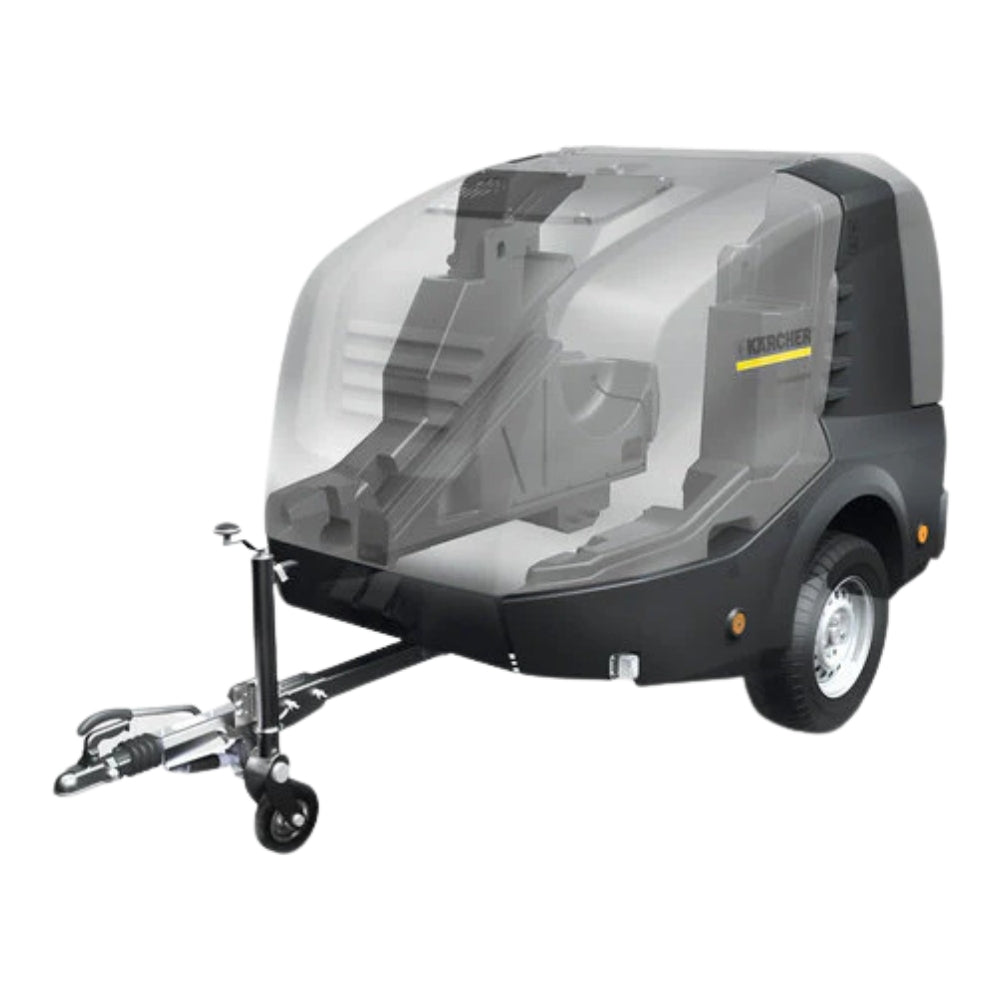
A pressure washer trailer for commercial Australia crews earns its place when they can wash without lifting a pump off a ute. Freshway lists the Karcher HDS 13/20 De Tr1 as a trailer-mounted diesel cleaner at 2900 PSI with a 30-metre hose reel. Skid or trolley units can form that setup too.
This article is about that setup choice. It does not repeat the broader buying brief in how to choose a pressure washer for commercial cleaning, or the power-source comparison in electric versus petrol pressure washers. Those pages help you pick pressure, flow and fuel. Here the question is how the machine travels, how water and hose are laid out, and how the crew stays legal on noise, runoff and towing.
Tank, pump and hose-reel layout
Three layouts show up on Australian contract work, and Freshway stocks machines for each of them.
The dedicated trailer unit is already built onto a chassis. Freshway lists the Karcher HDS 13/20 De Tr1 (part 1.524-952.2) as a trailer-mounted hot-water cleaner with a 19 kW (26 HP) Yanmar diesel engine, a diesel burner, 2900 PSI operating pressure, up to 1300 litres per hour, a 30-metre hose on an integrated reel, and an EASY!Force Advanced trigger gun with Servo Control plus a 1050 mm spray lance. The listed point of that reel is reach around plant or trucks without dragging the chassis.

The skid unit is designed to be mounted on a trailer or truck you already specify. Freshway lists the Nilfisk PP6012MAG-35HG as a hot-water skid at 3500 PSI (240 bar) and 21 litres per minute, with a Honda GX630 petrol engine, a diesel-fired burner up to 120°C wet steam, a belt-driven triplex brass pump with ceramic pistons, dual 45-litre fuel tanks, and a stainless-steel frame with forklift pockets and lifting points. The product page describes permanent mounting onto trucks, trailers or service vehicles.

The trolley-in-ute setup still has a place when the crew does not tow. Freshway lists the Karcher HD 7/15 G EASY! as a petrol cold-water cleaner with a Honda GX160 engine (4.8 kW), 2175 PSI (150 bar), 400–650 litres per hour, a 3.1-litre fuel tank, ceramic-piston crankshaft pump and a 42.5 kg tubular steel trolley with pneumatic wheels. That is a machine you can roll, not a trailer SKU.
Water-tank sizing follows the listed flow, not a guess. At 1300 litres per hour the HDS 13/20 De Tr1 uses about 21.7 litres per minute, so a 20-minute continuous wash needs about 433 litres of supply. At 21 litres per minute the Nilfisk skid uses 630 litres in 30 minutes. At 650 litres per hour the HD 7/15 G uses about 10.8 litres per minute, or about 217 litres in 20 minutes. Size the onboard tank and the refill plan against those figures, then keep a reserve for rinsing. Freshway does not need to sell the tank for the arithmetic to hold.
Weight and towing practicalities
Do not specify a trailer by pump pressure alone. The towing vehicle, towbar rating, trailer capacity, tyre ratings and licence class all cap what you can legally haul. NSW Government towing a trailer or caravan rules require a roadworthy combination, working lights and safety chains, a secured load, and a loaded trailer mass that does not exceed the lowest of the towbar, coupling, trailer and tyre ratings. Learner drivers must not tow, and P1 car-licence holders are limited to small trailers up to 250 kg unloaded weight.
The HDS page describes the trailer chassis as the way to avoid repeatedly lifting heavy washers on and off a ute. The Nilfisk skid page describes forklift pockets and lifting points for secure mounting, which is a planned lift, not a two-person wrestle on a driveway. The HD 7/15 G is listed at 42.5 kg; that figure is why some crews still choose a trolley over a trailer when towing is the constraint. Check current vehicle and trailer plates rather than assuming a car licence covers every loaded combination.
SafeWork NSW hazardous manual tasks guidance applies whenever people are lifting pumps, hose reels or full water containers. Design the trailer so daily work is hook-up, unroll and wash, not a deadlift at each site.
Noise for early strata jobs
An early-morning basement or podium wash is a neighbour issue as well as a hearing issue. SafeWork NSW noise at work and WorkSafe Victoria noise pages cover operator exposure. EPA NSW noise guidance is the neighbourhood backdrop for strata and shopping-centre contracts.
Agree start times in the site induction. Stand the trailer where the chassis and reel do not rattle against a concrete soffit. Use the hose length you already have — 30 metres on the HDS reel — so the engine can sit further from bedroom windows when the layout allows. Do not invent a silent mode the product page does not list.
Bunding and spill kits
Wash water is not rainwater. EPA NSW states that the drain is just for rain. Detergent, oil and grit belong in a contained path, not in a grated storm pit at the bottom of a car park ramp. Temporary driveway or podium jobs need portable containment before the trigger is pulled, and spent solids or oily waste should leave site under EPA NSW waste expectations.
Carry drain covers, a spill kit matched to fuel and detergent, and a written method for where dirty water goes. A trailer that arrives with a powerful pump but no containment plan is not ready for commercial work. Keep fuels for the HDS diesel system or the Nilfisk dual 45-litre tanks in labelled containers, upright and bunded, away from stormwater.
Security of gear overnight
A trailer parked behind a shopping centre is a target. Do not leave guns, reels and spare nozzles on display after the shift. If the site cannot lock the compound, take the trigger gun and any loose fittings with the crew. Record serial numbers and photograph the setup as it left the yard. None of that requires a special SKU; it does require a habit.
Spec a trailer kit
| Setup | Listed Freshway example | When it usually fits |
|---|---|---|
| Dedicated trailer chassis | Karcher HDS 13/20 De Tr1 at 2900 PSI, up to 1300 L/h, 30 m reel, all-diesel engine and burner | Crews that tow every day and want hook-up-and-wash without lifting the pump |
| Skid mounted to your trailer or truck | Nilfisk PP6012MAG-35HG at 3500 PSI, 21 L/min, dual 45 L tanks, forklift pockets | Fleets that already have a tray or trailer and want a permanently mounted hot-water plant |
| Trolley carried in a ute | Karcher HD 7/15 G EASY! at 2175 PSI, 400–650 L/h, 42.5 kg trolley | Jobs where towing is impractical and the crew can roll a cold-water petrol unit on site |
Add a flat-surface tool only when its listed pressure ceiling covers the washer you actually tow. Freshway lists the Kerrick KSC18/W as a 460 mm stainless-steel surface cleaner with wheels, rated up to 4000 PSI. The three washers above are listed at 2900, 3500 and 2175 PSI, so each sits under that ceiling. Still confirm hose fittings on both product pages before you order. Browse petrol pressure washers, diesel pressure washers and pressure washer accessories when you build the rest of the kit.
Maintenance on the road
A mobile rig fails in small, predictable ways: a kinked hose, a blocked inlet filter, a nozzle that has worn into a straight jet, or fuel that was left stale in a tank. Before each trip, use the same walk-around the NSW towing page expects of any trailer — tyres, lights, chains, couplings — then add the washer checks: water inlet, hose and reel, gun and lance, fuel caps, and a visual look at the pump for leaks.
Do not invent service intervals here. Follow the listed engine and pump instructions for the machine you own, and use Freshway’s Sydney service path when the fault is internal. Keep a spare nozzle and a hose tail in the lock box so a roadside failure does not become a missed strata window.
Frequently asked questions
Does Freshway sell a complete trailer package for every crew?
Freshway lists at least one dedicated trailer-mounted machine, the Karcher HDS 13/20 De Tr1, plus skid and trolley units you can mount or carry. Specify the layout from those live products rather than assuming a custom trailer SKU exists.
How large should the water tank be?
Multiply the listed flow by the longest continuous wash, then add rinse reserve. At 21 L/min, thirty minutes of washing uses 630 litres before you count rinsing or downtime.
Can we wash toward a car-park grate on an early strata job?
No. Wash water carries detergent, oil and grit, so it needs containment. A storm grate is not a trade-waste point.
Is a trolley petrol washer a better first step than a trailer?
It can be, when you do not tow and the listed 42.5 kg HD 7/15 G trolley suits the sites. Choose a trailer or skid when daily lifting and long hose runs are the real constraint.
Next steps with Freshway
Decide whether you need a dedicated trailer chassis, a skid to mount, or a trolley you can still lift, then read the listed pressure, flow and hose details on that product page. Compare petrol and diesel options in the collections above, and add recovery or surface tools only after the fittings match. Check current specifications before the next mobile job rather than copying an old quote.