Degreaser Selection: Commercial Kitchen vs Workshop Soils
Match kitchen fat and workshop oil to the listed chemistry, not a generic drum.
Shop now
Three listed figures separate kitchen fat from workshop oil faster than a catalogue photo. Agar Enyclean is a highly alkaline detergent degreaser at pH 12.8 ± 0.5. Agar Ammodet is listed at pH 11.8 with 1.4% free ammonia. Agar Presto is a concentrated caustic cleaner based on sodium hydroxide, written for carbonised food soils rather than a light daily mop.
Why kitchen and workshop soils need different degreasers
A commercial degreaser for kitchen versus workshop soils should match the fat or oil, the surface and the label. Kitchens often need a caustic or high-alkaline product that can dwell on vertical stainless steel. Workshops more often need a high-alkaline degreaser that can run through a washer onto concrete and metal.
The existing commercial degreaser guide covers the buying brief: soil, alkalinity, surface, dwell, rinse and documentation. This article takes the next step and compares two site classes that get lumped together on purchase orders: hospitality kitchens and mechanical workshops.
Kitchen constraints
Kitchen grease is usually animal fat, cooking oil and carbonised soil on stainless steel, tiles, ovens and extraction hoods. The chemistry has to saponify or emulsify that fat, cling long enough on vertical steel, and rinse so food-premises surfaces are not left slippery or filmed. Food Standards Australia New Zealand food safety pages and the Food Standards Code are the hygiene backdrop; they do not replace the product label or SDS.
Freshway lists Agar Presto as a 5-litre concentrated caustic cleaner and degreaser based on sodium hydroxide. The page describes saponification of aged, carbonised fats, a high-foaming cling for vertical tiles, hoods and machinery, and use in meat processing, abattoirs, commercial kitchens, ovens, hotplates and extraction hoods. It must be heavily diluted according to soil severity; the page does not publish a single universal ratio, so the label and SDS decide the mix.

Do not treat a caustic kitchen restorer as a wipe-and-walk product around unprotected skin, jewellery or food that is still on the line. Rinse as the label directs, keep it off food, and never mix it with acids or unknown bottles “to help it work”. Browse Agar kitchen cleaners when the job is the wider kitchen, not only degreasing, so sanitising and dishwashing chemistry stay on their own procedure.
Workshop oils and metals
Workshop soils are more often engine oil, hydraulic fluid, soot and tracked-in road film on concrete, tools and vehicle parts. Some of those soils respond to high alkalinity. Some, such as tar or adhesive, need a different chemistry altogether. The surface list matters as much as the soil: a product written for concrete and painted metal is not automatically written for every alloy on the bench.
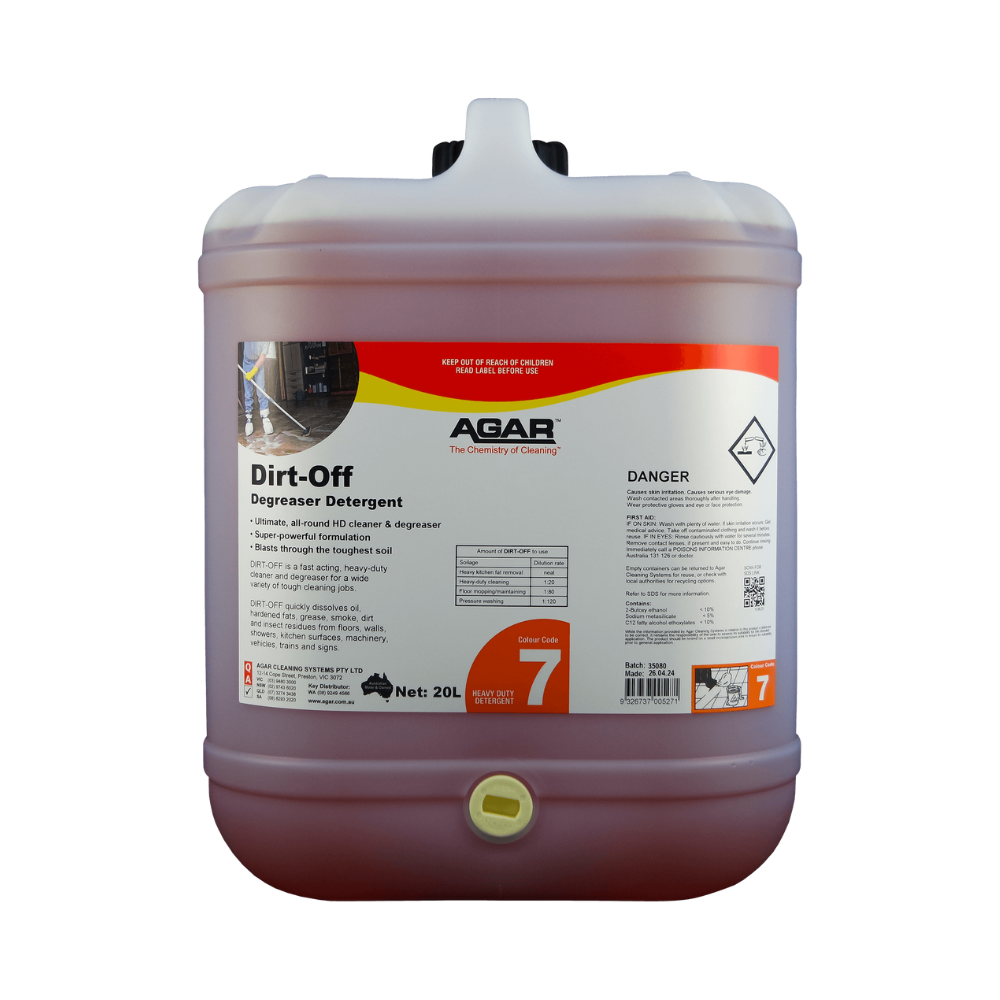
Freshway lists Agar Dirt-Off as a 5-litre high-alkaline heavy-duty detergent degreaser for industrial grease, carbon and baked-on oils. The page names industrial and automotive workshops, commercial kitchens, pressure-washer and autoscrubber use, and lists stainless steel, painted metal in good condition, glass, aluminium, porcelain, vinyl and concrete among safe surfaces. Application methods listed are mop and bucket, spray bottle, pressure washer, autoscrubber and steam cleaner.

Freshway lists Agar Enyclean as a 5-litre multipurpose detergent degreaser at pH 12.8 ± 0.5, free of ammonia, chlorine and petrochemical solvents, and written for workshops, kitchens and food plants. It is described as free-rinsing on concrete and compatible with autoscrubbers and steam cleaners. That high pH is a reason to wear the PPE on the SDS, not a reason to assume it replaces a caustic oven restorer.
Aluminium needs a label check, not a habit. Dirt-Off lists aluminium among its safe surfaces. That listing does not extend automatically to a caustic sodium hydroxide product. If the page or SDS does not name the metal, test an inconspicuous area or choose a product that does.
Foam versus thin detergents
Foam is a dwell tool on vertical steel. Thin liquids are often the better partner for machines that must pump, recover or rinse a floor.
- Presto is listed as high-foaming for vertical walls, ovens and range hoods, including foam-gun application.
- Ammodet is listed as high-foaming so it can hang on kitchen ducting and walls, with 1.4% free ammonia and a general mopping dilution of 1:100 to 1:200, or 1:60 for heavy grease. It is not suitable for polished floors or highly sealed timber because it can strip wax.
- Dirt-Off is described as controlled-foaming so it can run through pressure washers, autoscrubbers and steam cleaners.
- Enyclean is described as free-rinsing and autoscrubber compatible, which matters on large workshop slabs where leftover film becomes a slip.
Freshway lists Agar Ammodet as a thick orange concentrate at pH 11.8. The ammonia note is useful for kitchens and glass when the label allows that use, and for workshop floors when the surface is not a polished sealer. It is the wrong drum to park next to a newly sealed showroom floor.
Rinse and residue
Residue is how a degreaser becomes a slip or a contamination problem. Kitchen procedures need a complete rinse where the label requires it, especially after caustic work on food equipment. Workshop floors need a rinse or recover pass that does not sheet into stormwater. EPA NSW waste guidance applies when oily sludge or spent absorbent leaves the site.
More chemical does not fix a poor rinse. It only makes the wastewater harder to handle and the floor slower to dry. Dose from the label, then rinse until the surface no longer feels soapy.
Spec by soil class
| Site and soil | Listed Freshway example | What the page actually supports |
|---|---|---|
| Carbonised kitchen fat on ovens, hoods and food-plant steel | Agar Presto, 5 L caustic (sodium hydroxide), high foam | Vertical cling and saponification of aged fat; dilute by soil severity per label |
| Workshop oils, hydraulic fluid and carbon on concrete or metal | Agar Dirt-Off, 5 L high-alkaline degreaser | Pressure washer, autoscrubber and manual use; aluminium listed among safe surfaces |
| Shared kitchen and workshop floors that must rinse freely | Agar Enyclean, pH 12.8 ± 0.5, 5 L | High alkalinity without ammonia or chlorine; autoscrubber and steam-cleaner compatible |
| Heavy grease on unsealed floors or walls, plus glass when diluted | Agar Ammodet, pH 11.8 with 1.4% free ammonia | 1:60 for heavy grease, 1:100–200 for general cleaning; not for polished or highly sealed timber floors |
Keep solvent spotters in their own class. They are not a substitute for these alkaline or caustic degreasers on a whole kitchen line or a wash bay. If the stain is gum, tar or adhesive, use a product written for that soil instead of turning the degreaser stronger.
PPE and SDS
SafeWork NSW chemicals and hazardous chemical pages, and WorkSafe Victoria hazardous substances pages, all apply to storage, decanting, labelling and PPE. Read the current SDS for the drum you opened, not a memory of last year’s product.
Caustic Presto and high-pH Enyclean are not “stronger detergent” in the household sense. Eye protection, chemical-resistant gloves and the clothing the SDS names are part of the method. Decant into labelled bottles only. Return unused concentrate to the original drum.
Mixing mistakes
- Using Ammodet on a polished or highly sealed timber floor, which the page says can strip wax.
- Putting a high-foam caustic through a machine that the label does not name, then blaming the pump.
- Assuming a kitchen caustic is automatically safe on aluminium because another alkaline degreaser lists that metal.
- Mixing two degreasers, or a degreaser and an acid, to “save a step”.
- Skipping the rinse so the floor looks wet-clean and then opens to traffic.
- Sending oily rinse water to a storm grate because it is the nearest hole in the slab.
Browse Agar degreasers and cleaning chemicals when you write the approved-product list so the names on the wall match drums the store actually stocks.
Frequently asked questions
Can one degreaser cover both the kitchen and the workshop?
Sometimes, when the label names both soils and surfaces. Dirt-Off and Enyclean are listed for kitchen and workshop use. A caustic kitchen restorer such as Presto is written for carbonised fat, not as a generic workshop floor soap.
Is a higher pH always the right choice?
No. pH describes alkalinity, not a licence to ignore the surface. Ammodet at pH 11.8 is unsuitable for polished floors, and a caustic product still needs the correct rinse and PPE.
How should we treat aluminium parts and trims?
Use a product that lists aluminium, such as Dirt-Off, or test first. Do not assume a sodium hydroxide cleaner shares that listing.
Where do we find the dilution for Presto?
On the current label and SDS. The Freshway page says Presto must be heavily diluted by soil severity and does not replace those instructions with one fixed ratio.
Next steps with Freshway
Name the soil and the surface first, then choose from the listed kitchen and workshop options rather than ordering “a strong degreaser”. Review Presto when the job is carbonised food soil, Dirt-Off when oils must go through a washer or scrubber, and Enyclean or Ammodet when the listed pH and restrictions match the floor. Confirm the current label, SDS and surface list on each product page before the next mix.