Hot-Water Pressure Washer Heat Exchanger Care for Australian Duty
Keep hot-washer coils clear of scale and soot so heat actually reaches the lance.
Shop now
A western Sydney wash bay booked a Friday fleet clean and the hot washer came up only lukewarm. The burner still fired and the pump still made pressure, but heat-up took far longer than the previous week. Scale had insulated the inside of the coil and soot had coated the outside. The flame was working. The heat was not reaching the water.
What the coil does
Hot water pressure washer heat exchanger maintenance starts at the coil. Scale inside the tube and soot outside both steal heat before water leaves the lance. Watch heat-up time and outlet temperature, descale only with a labelled product, and stop the machine when heat falls off instead of forcing a longer burn.
Operators often call lukewarm water a burner fault when it is a heat-path fault. The coil is the tube nest in the burner chamber: water is already under pressure when it enters, the burner heats the coil wall, and the wall heats the water. Anything between flame and water reduces outlet temperature. This article stays on that heat path, not on choosing hot water versus cold water.
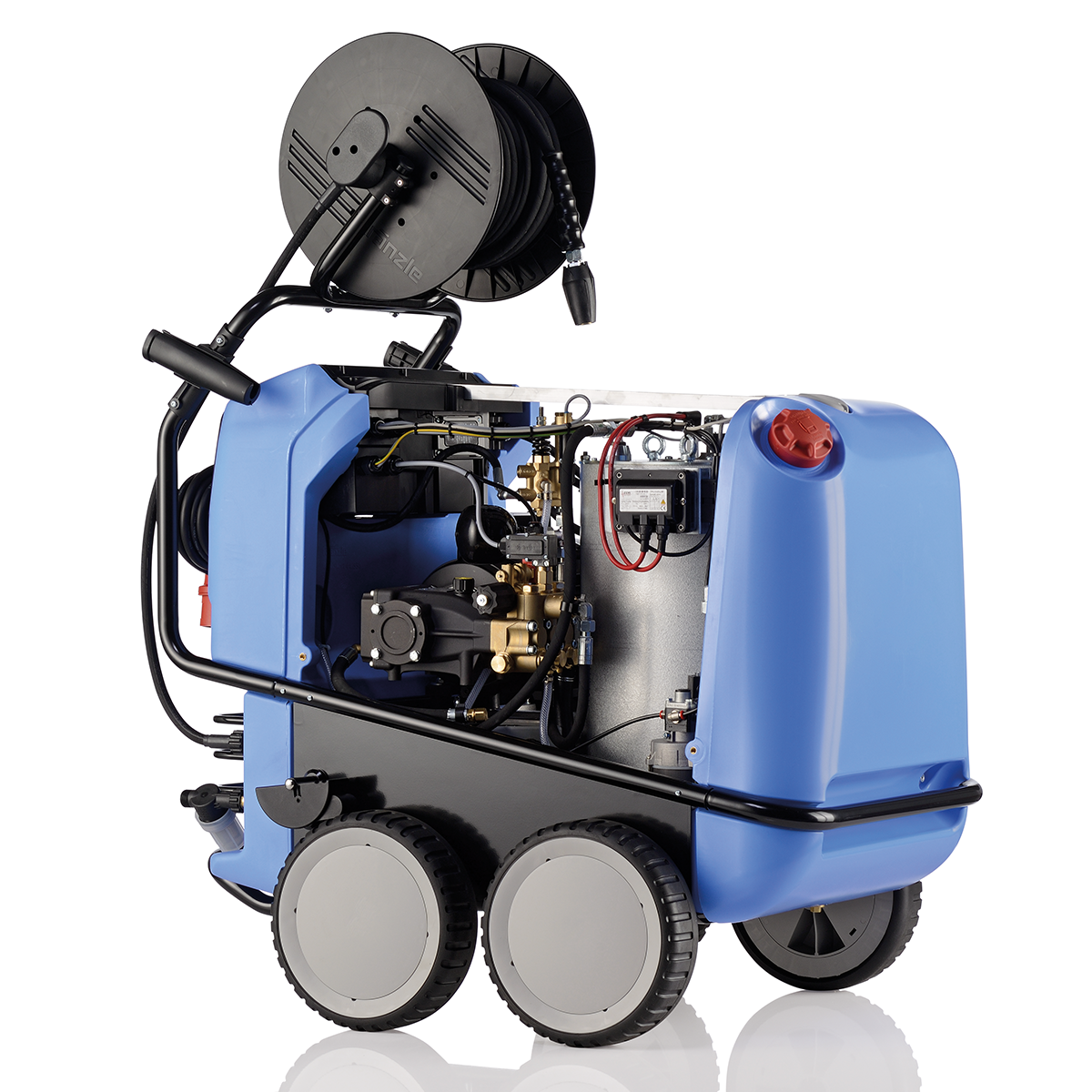
Freshway lists the Kranzle Therm-RP 1600 as an industrial hot-water cleaner with a stainless steel heating coil, a listed 2175 PSI operating figure, a 26.7 L/min flow rate and a 415 V, 20 amp supply. The product page states that the onboard diesel boiler heats water up to 140°C, and it names the stainless coil specifically for sites with mineral-heavy water that would rust a standard coil. At the listed flow, 26.7 litres per minute is 1,602 litres per hour (26.7 × 60).

Scale and soot symptoms
Scale forms when dissolved minerals drop out of heated water and plate the inside of the tube. Soot and unburnt residue collect on the outside when combustion is poor or the coil is never cleaned. The two look different and they ask for different work, but the operator symptom is often the same: long heat-up, lukewarm water, or a burner that seems to run harder than the job needs.
Check the machine in this order:
- Heat-up time has stretched compared with the same machine on the same inlet water last month.
- Outlet water is weaker in heat while pressure at the lance still feels normal.
- White or crusty deposit appears at fittings, the unloader or a leaking joint.
- The burner note changes, smoke increases on ignition, or the coil jacket shows a dry, black film when a competent person inspects it.
- Fuel use rises for the same wash programme.
Do not scrape a live coil or open a burner chamber to “have a look” while the machine is connected. Isolate fuel and power first. SafeWork NSW electrical and power guidance applies to the pump and ignition circuit before anyone removes a cover.
Descale intervals by water hardness
There is no single calendar interval that fits every Australian supply. Scale risk follows hardness and duty, not the date on the workshop wall. Sydney Water explains that hardness is measured as milligrams per litre of calcium carbonate, treats less than 60 mg CaCO3/L as soft and more than 60 mg CaCO3/L as hard, and states that Greater Sydney drinking water sits at about 57 mg/L — just under that line. The same what's in your water page notes that dissolved salts cause scale build-up in appliances.
That Sydney figure is a local snapshot, not a national average. Groundwater, some regional supplies and many inland bore feeds run harder than metropolitan treated water. If your wash bay is on a hard supply, inspect heat-up time more often and plan chemical descaling on a shorter cycle than a Sydney mains site with similar hours. If you move the same machine between a soft urban depot and a hard regional yard, treat those as two duty profiles, not one.
Only use a descale product the machine maker or a competent service bench names for that coil metal. A stainless coil, such as the Therm-RP 1600 listing, and a coated steel coil are not interchangeable chemistry experiments. Follow the current label and SDS. SafeWork NSW chemicals guidance and WorkSafe Victoria hazardous substances pages apply to how concentrates are stored, decanted and rinsed. Spent descale solution is waste; dispose of it under the site procedure and EPA NSW waste guidance, not down an unmarked drain.
Fuel quality and burners
A clean coil still fails to heat if the flame is weak, sooty or cutting out. Water in diesel, dirty fuel, a blocked fuel filter or a burner that is starved of air will coat the outside of the coil and waste fuel. The Therm-RP 1600 page lists a 35-litre diesel tank, adjustable burner performance and a four-way safety system with optical flame monitoring. Those devices protect the machine; they do not replace housekeeping on the fuel.
Keep the tank capped and do not top up from an unmarked can. Diesel and descalers are hazardous chemicals; SafeWork NSW hazardous chemical guidance covers storage and handling on the wash pad.
Freshway lists the Powerblast HW1310 as a single-phase hot-water washer with an anti-corrosion coated, non-seamed vertical boiler coil. The page lists 2000 PSI (135 bar) adjustable pressure, 10 L/min flow, a 240 V 15 amp supply, a 2800 RPM two-pole motor, a temperature range of 30–130°C, an 18-litre fuel tank, a delayed total-stop system and intelligent shutdown for leakage, nozzle blockage and dry running. It also states a two-year commercial warranty covering the machine and the burner coil. That coil wording is why the HW1310 belongs on a heat-exchanger care sheet, not only on a buying list.

When to stop using and book service
Stop unsupervised work and book a bench when any of these appear:
- The burner faults, will not light, or cuts out after a short run.
- Outlet water stays cool after a normal heat-up period.
- You smell unburnt fuel, see unusual smoke, or find damp diesel around the burner.
- The coil, fittings or pump weep water, or the machine shows dry-run or over-temperature behaviour.
- You have already cleaned filters and confirmed water and fuel supply, and heat is still missing.
Turning the thermostat higher to chase lost temperature cooks a scaled or sooted coil. It does not repair it. Freshway's Sydney service and repairs page is the path once those checks are done. Describe the symptoms, the water supply (mains or bore), the fuel, and the hours since the last descale so the bench is not repeating your first five steps. WorkSafe Victoria electrical safety pages make the same point as the NSW electrical guidance: damaged or live equipment is not a DIY task.
Log duty hours
Heat-exchanger care only becomes predictable when you log hours, not just breakdowns. Record engine or pump hours, burner hours if the machine displays them, inlet water source, any hardness figure the local water authority publishes, descale dates, fuel-filter changes and no-heat events. A machine that suddenly needs longer heat-up after a week on bore water is telling you something a calendar service will miss.
General hour-based checks — hoses, unloader, oil and filters — sit in Freshway's existing guide to pressure washer maintenance by duty hours. Use that log for the whole machine, then add coil-specific notes: heat-up minutes to a usable wash temperature, visible soot after a service cover is removed by a competent person, and whether the last job was on a hard or soft supply.
Spec for serviceability
| Listed feature | Kranzle Therm-RP 1600 | Powerblast HW1310 |
|---|---|---|
| Coil as described on the Freshway page | Stainless steel heating coil, named for mineral-heavy water | Anti-corrosion coated, non-seamed vertical boiler coil |
| Heat listing | Onboard diesel boiler up to 140°C | 30–130°C listed range |
| Flow and pressure as listed | 26.7 L/min; 2175 PSI | 10 L/min; 2000 PSI (135 bar), adjustable |
| Fuel tank | 35 litres | 18 litres |
| Supply | 415 V, 20 amp | 240 V, 15 amp |
| Burner and protection notes | Adjustable burner; four-way safety with optical flame monitoring | ATC temperature system; delayed total stop; shutdown for leak, blocked nozzle and dry run |
When you specify a new hot washer, ask how the coil is reached, what metal it is, and whether the burner has flame monitoring and dry-run protection. Freshway also lists the Kranzle Therm 895-1 with removable service covers, a digital panel, adjustable burner performance and a water inlet filter on a 415 V 20 amp three-phase supply. Those covers speed scheduled service once the machine is isolated; they do not make the coil a field-strip item.
Compare other Kranzle bodies in Kranzle pressure washers before you lock a specification. Check each product page for the current coil wording, fuel volume and electrical supply; those figures are what the store lists today, not a generic catalogue memory.
Preventing no-heat callouts
Most no-heat callouts start as skipped inspections. Write a short run sheet and keep it with the machine:
- Confirm water supply and a clean inlet filter before the burner is asked to work.
- Use clean diesel in a capped tank; do not run the burner on an unknown leftover fuel.
- Allow a normal heat-up, then feel the work — not the marketing temperature — at a safe distance from the lance.
- If heat-up time grows, log it that day and book descale or service rather than “just finishing the trucks”.
- After hard-water or high-hour weeks, schedule coil care before the next peak day, not after it fails.
Plan ramps and two-person moves before anyone tips a hot washer on a tail-lift. The aim is simple: keep flame, coil metal and water in contact, and stop when they are not.
Frequently asked questions
Is lukewarm water always a failed burner?
No. Scale inside the coil or soot on the outside can steal heat while the burner still fires. Check heat-up time and book coil service if pressure is present but temperature is not.
How often should we descale a hot-water pressure washer in Australia?
Match the interval to water hardness and duty hours, not a single national date. Sydney Water treats more than 60 mg CaCO3/L as hard; inspect more often on bore or known hard supplies.
Can we scrape soot off the coil ourselves?
Not while the machine is live, and not as an untrained workshop shortcut. Isolate fuel and power, then use the service path the manual or a competent bench names for that coil.
Does a stainless steel coil mean we can skip descaling?
No. Stainless steel resists corrosion compared with a plain steel coil, but minerals can still deposit inside the tube on a hard-water site.
When should we stop using the machine and send it to Freshway service?
Stop if the burner faults, heat does not return after normal supply checks, you smell unburnt fuel, or the coil or fittings leak. Describe those symptoms when you book the bench.
Next steps with Freshway
Treat the coil as a heat path that fails from scale and soot, then write hardness, hours and burner checks onto the same card. Review current hot-water machines in the hot-water pressure washers collection, compare Kranzle options where a stainless coil or service covers matter, and use the Sydney service bench when heat disappears. Check each product page for coil wording, flow and supply before you reprint the workshop sheet.