Floor Sealer Recoat Windows in Australian Humidity
Let humidity and a tack-free touch test set the wait before the next sealer coat.
Shop now
At Sydney Observatory Hill the Bureau of Meteorology records a mean 9 am relative humidity of 69 percent across the year, and 74 percent in February, March, May and June. A water-based sealer laid on that kind of morning is trying to release water into air that is already wet. The label window still matters. The room air decides whether you will meet it.
Why humidity stretches recoats
Floor sealer recoat time in humidity across Australia should be read from the label, then stretched when the room air is already wet. Water-based films release water as they cure. Wait until the coat is dry and not sticky, then add the extra minutes the current label names before the next coat.
Agar's Australian floor-sealing systems guide states that local climate matters because floor sealers and finishes are affected by humidity in the air. That is an application fact, not a reason to guess a new interval. If the film is still cool, cloudy or tacky, it is not ready, even if the shift clock says the usual wait has passed.
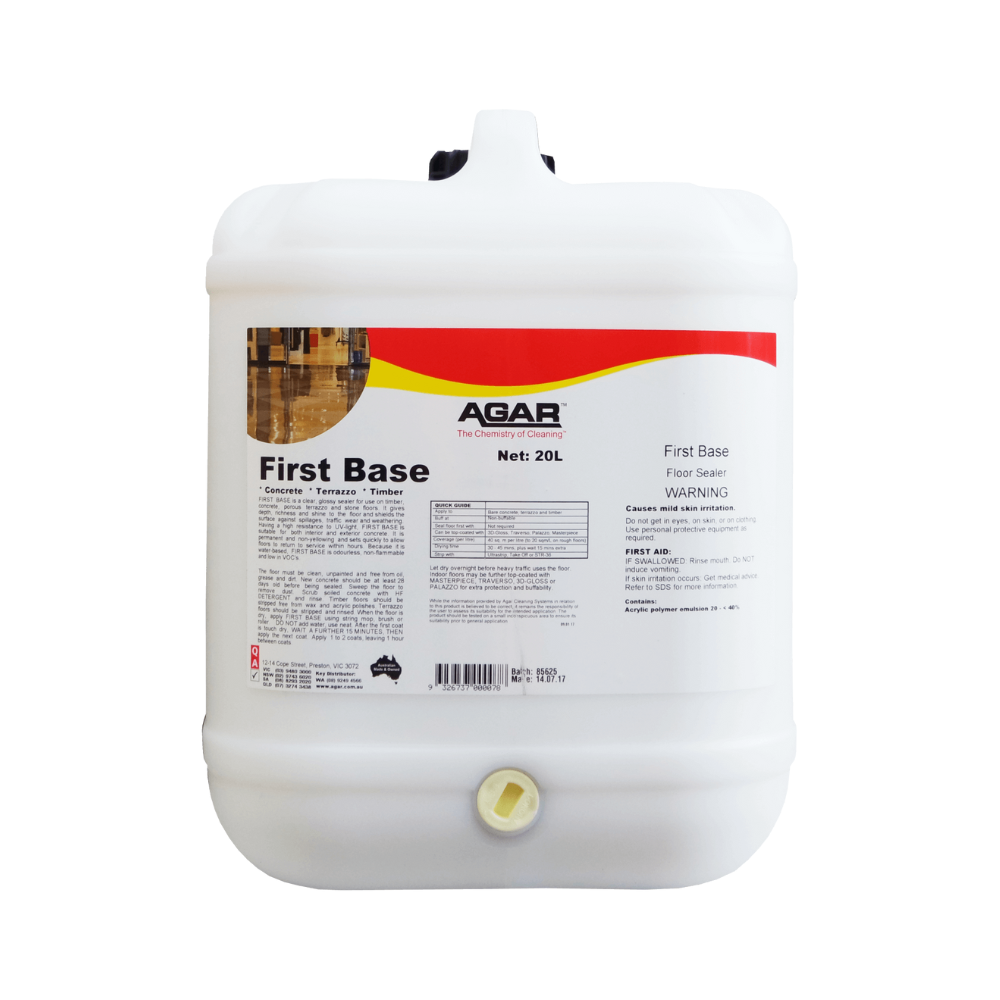
Freshway lists Agar First Base as a water-based, low-odour, non-flammable clear base-coat sealer in 5 L and 20 L packs (FIR5 and FIR20). The product page lists a pH of 7.5–9.5, coverage of 30–40 m² per litre depending on porosity, and 1 to 2 coats by mop, brush or roller on bare concrete, terrazzo, vinyl, timber and porous stone. It also states that the film dries fast enough to accept light foot traffic in 2 to 3 hours. Agar's own First Base product page describes it as a water-based base-coat that is only to be used directly on the bare floor, and says floors can return to service within hours.

Reading label windows
The useful number on a sealer job is the current label or product data sheet, not a remembered figure from another brand. Agar's how-to on how to strip and seal a floor tells you to let First Base become dry and tack-free — not sticky — then wait an extra 10 minutes after it is touch-dry before the next coat. On very porous floors it advises at least one hour for the first coat to dry properly. After the top sealer is down, it tells you to give the floor six hours or more to cure before buffing.
Those extra minutes are a buffer after the film is already dry to the touch. They are not a licence to recoat a still-soft floor at the ten-minute mark on a humid night. If touch-dry itself took forty minutes instead of twenty, the extra wait starts only then. Agar also warns against sealing floors below 9°C; if a cold floor cannot be avoided, it says to lay very thin coats at least one hour apart.
Freshway lists Agar 3D Gloss as a 5 L floor finish and sealer with a listed pH of 8.4–9.4 and coverage of 45–55 m² per litre. The page describes a milky white liquid that cures clear, notes a faint ammonia odour, and names it as a top coat for vinyl tiles, sealed timber, parquetry, sealed terrazzo, marble, linoleum and brick. At the midpoint of that coverage range (50 m² per litre), a 5 L drum covers about 250 m² per coat (5 × 50). Across the listed range the same drum covers about 225–275 m² per coat (5 × 45 to 5 × 55). The Freshway page also describes a fast-curing film that responds to high-speed burnishing.

Touch tests
Instruments help, but the field test Agar describes is still a clean hand on the floor. The coat must be dry and not sticky before another coat goes down. Check more than the first bay you sealed. Low spots, entries that drew extra product, and edges against cold glass often stay tacky after the centre of the room has flashed off.
A floor that looks shiny under night lighting can still be wet. Walk it in flat, closed shoes after the posted wait and feel for drag, fingerprinting or a cool film. If the print stays, wait. SafeWork NSW notes that cleaning products and methods are a common source of slips, trips and falls on the same level. A tacky or wet sealer aisle is a slip path, not a drying shortcut.
Avoiding trapped solvent
Recoating too early traps water or solvent under the next film. The usual results are milkiness, slow hardness, wrinkling, poor adhesion and a floor that scuffs as soon as it is opened. First Base and 3D Gloss are water-based systems on the Freshway pages; they still need a path for water to leave. Laying a heavy second coat on a humid, unventilated floor blocks that path.
Lay thin, even coats. Agar's how-to says never to leave pools, because pooled sealer takes a long time to cure, and to keep people off the floor until it is dry. Ventilate within the site rules, but do not point a heater at a wet film and call it cured. Leftover sealer, stripper slurry and contaminated rinse water are waste. Handle them under the site procedure and EPA NSW waste guidance.
Stripper choice belongs on the same job sheet when you are starting from a worn film rather than recoating a sound base. Browse Freshway floor strip, buff and sealers for the in-house stripper options, and keep sealer concentrates labelled. SafeWork NSW chemicals guidance applies to how those drums are stored and decanted on the trolley.
Coastal versus inland
Humidity is not the same from a Sydney harbour morning to a dry inland winter night. The Bureau's Sydney Observatory Hill record shows mean 3 pm relative humidity peaking at 64 percent in February and falling to 49 percent in August, with an annual 3 pm mean of 57 percent. Coastal summer nights often keep that moisture in the building after the air-conditioning shuts down. Inland sites can be drier, yet they can also be colder than Agar's 9°C warning.
Tropical Queensland jobs stretch the same physics further: warmer air can hold more water, so a film that dries promptly on a cool, dry night in western NSW may still feel tacky after the usual wait in a coastal wet season. Do not invent a shorter window to “catch up” a night shift. Extend the wait, thin the coats, and use the touch test in more than one bay.
Spec sealer systems
| Listed item | Agar First Base | Agar 3D Gloss |
|---|---|---|
| Role on the Freshway page | Clear base-coat sealer for the bare floor | Floor finish / top coat on already suitable surfaces |
| Pack sizes listed | 5 L and 20 L | 5 L |
| pH listed | 7.5–9.5 | 8.4–9.4 |
| Coverage listed | 30–40 m² per litre | 45–55 m² per litre |
| Freshway timing note | Light foot traffic in 2 to 3 hours | Fast-curing film; multiple coats in a single night shift when conditions allow |
| Agar how-to timing | Tack-free, then an extra 10 minutes; at least one hour for a first coat on very porous floors | Each coat dry before the next; six hours or more to cure before buffing |
The First Base page names 3D Gloss (and Tuff-Gloss) as topcoats that bond to it. Do not skip the base coat on porous concrete, terrazzo or stripped vinyl just to save a night. A 5 L drum of First Base at the listed 30–40 m² per litre covers about 150–200 m² per coat (5 × 30 to 5 × 40). That figure shrinks on a thirsty slab, which is exactly when the first coat needs the longer dry.
Actichem Instaseal is listed on Freshway as a water-based base coat with a pH of 7.5 and coverage of 50–80 m² per litre on porous masonry, and Instagloss as a high-gloss acrylic with a listed pH of 7.5. If you specify that system instead, use the current Actichem label for recoat timing rather than borrowing First Base minutes. Confirm burnishing plant in burnishers and polishers so the cure wait and the first buff are written as one sequence.
Logging conditions
A recoat window you cannot explain is not a window you can defend to a client. Log the floor type, product names, coat number, start time, room temperature if you measure it, a simple humidity note (sultry, dry, rain outside, HVAC off), the time the film became tack-free, and the time the next coat actually went down. That log tells the next crew why last Tuesday took longer than the card suggested.
Agar's floor-sealing systems guide also sets a longer maintenance rhythm once the film is in service: recoat high-traffic zones every 3 to 6 weeks with daily buffing, medium-traffic zones every 2 to 3 months, and low-traffic zones every 6 to 12 months. Humidity still governs each of those later coats. A scheduled six-week recoat laid on a wet coastal night without a touch test is the same early-recoat risk as a first installation.
Failures from early recoat
- Milky or cloudy patches where water was trapped under the next coat.
- Soft film that marks as soon as furniture goes back.
- Peeling or powdering because a coat was laid on a still-tacky base.
- Edge halo where extra product sat against skirting and never flashed off.
- Slippery residual film if the floor was opened while it was still wet.
WorkSafe Victoria slips, trips and falls pages apply on Victorian sites when you decide whether the aisle can reopen. If the film fingerprints, keep the barricades up. An early open does not make the sealer faster. It makes the complaint faster.
Frequently asked questions
Can we follow the label minutes exactly on a humid Australian night?
Use the label as the starting point, then wait until the coat is dry and tack-free. On humid nights that touch-dry point often arrives later than the printed window.
How do we know First Base is ready for the next coat?
Agar's how-to says the coat must be dry and not sticky. Test with a clean hand, then wait an extra 10 minutes after it is touch-dry, or at least one hour for the first coat on a very porous floor.
Does a shiny floor mean the sealer has cured?
No. Wet sealer looks shiny under night lighting. Check that it is not tacky and that low spots have flashed off before anyone walks or recoats it.
What if the floor is colder than 9°C?
Agar warns against sealing below 9°C. If you cannot wait for a warmer surface, it says to lay very thin coats at least one hour apart and to keep people off the floor until it is dry.
When can we buff 3D Gloss after the last coat?
Agar's how-to says to give the floor six hours or more to cure before buffing. Do not shorten that wait because the surface looks glossy while it is still soft.
Next steps with Freshway
Read the label window, then let tack-free time — not the shift clock — decide the next coat. Review base coats and finishes through the floor strip, buff and sealers collection, match daily cleaners in Agar floor cleaners, and check each product page for current pack sizes and coverage before you print the night card.