Basement Car-Park Epoxy: Scrubber Settings That Will Not Scar
Sweep grit and treat oil before the scrubber deck meets basement epoxy.
Shop now
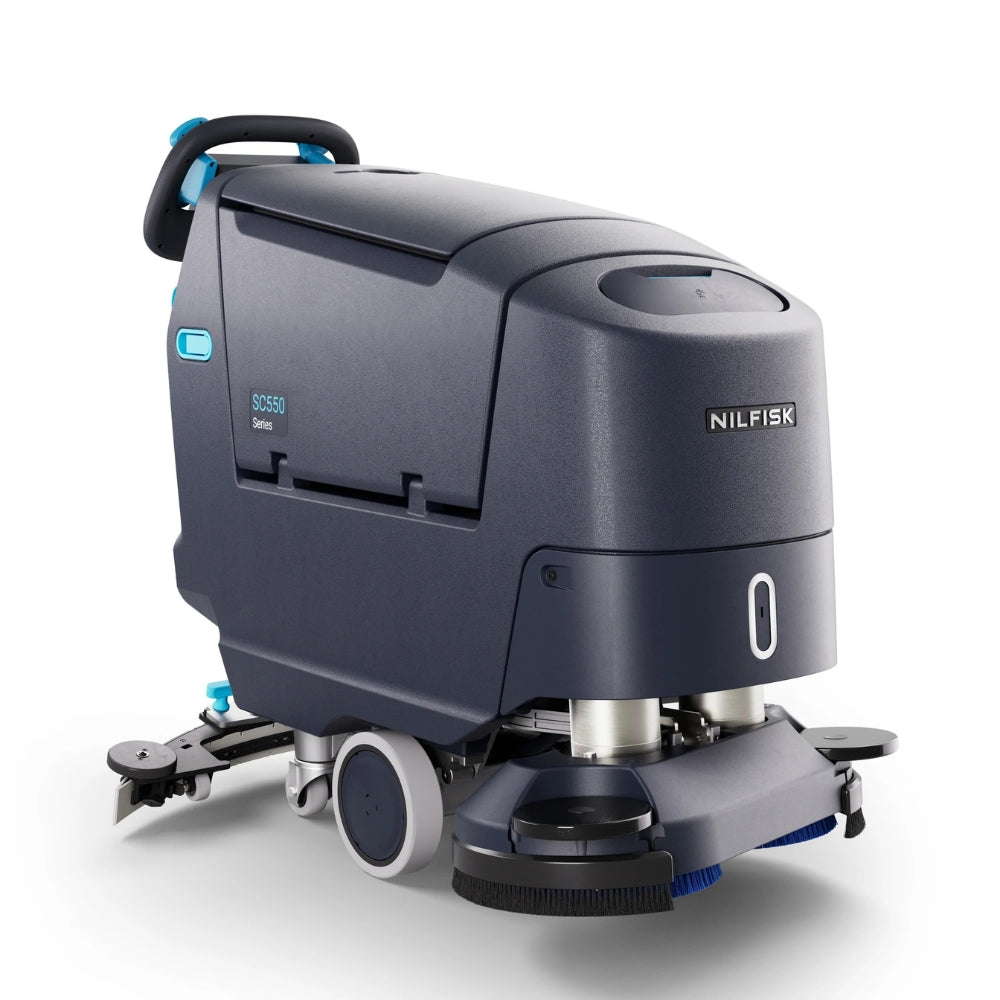
The Nilfisk SC550 disc deck is listed at 120 RPM across a 610 mm path. The cylindrical deck on the same platform is listed at 600 RPM across 508 mm. That five-fold difference in brush speed is the first setting choice on basement epoxy: more agitation is not automatically kinder to a coating that already lives with grit, tyre dust and oil.
Epoxy damage modes from basement scrubbers
Floor scrubber epoxy car park basement work fails when grit stays under the deck, when brush speed or pad choice is too aggressive, or when oil is smeared instead of pre-treated. Sweep first, treat hydrocarbons, then scrub and recover with a setting the coating can tolerate.
Basement epoxy is marked more often by what arrives with the machine than by the machine's name. Grit rolled under a deck acts as sandpaper. A high-speed cylindrical brush can chatter on a smooth coating. Oil that is not pre-treated becomes a brown film the squeegee just rearranges. Freshway already publishes a guide to scrubber settings on polished concrete and epoxy for general pressure, pad softness and pH discipline. This article stays on the basement car park: oil, grit, columns, ramps, exhaust and live vehicles.
A wet, glossy aisle is still a walking and driving surface. SafeWork NSW guidance on slips, trips and falls on the same level and WorkSafe Victoria's slips, trips and falls pages apply as soon as the first bay is wet.
Pressure and pad aggressiveness
Freshway lists the Nilfisk SC550 in two decks that share 50-litre solution and 50-litre recovery tanks, lithium-ion packages and a listed noise figure of 65 dB(A) in normal mode (59–61 dB(A) in silent mode). The page does not publish a contact-pressure figure, so do not invent one. What it does publish is brush speed and width, and those numbers are enough to choose a starting point on smooth coated concrete.

The SC550 D 61 uses dual 305 mm discs for a 610 mm path at 120 RPM and is described as optimised for smooth hard floors such as polished concrete and vinyl, with a listed theoretical productivity of 3,050 m²/h. The SC550 CYL 51 uses dual 508 mm cylindrical brushes at 600 RPM, with a 1.7-litre debris hopper, and is described as suited to textured floors, deep grout and safety flooring, at up to 2,550 m²/h. On a smooth epoxy basement the slower disc deck is the gentler listed starting point. Reserve the faster cylindrical deck for a test bay if the coating is textured or if the hopper's pre-sweep function is the reason you chose it — and stop if the coating marks.
Do not invent a colour ladder the pad pages do not list. Choose the brush or pad the machine page names for smooth hard floors, inspect it for embedded grit before the first pass, and replace it when it loads with sand or metal filings. Broader pad holders and utility pads sit in the scrubbing pads collection; keep steel wool and other cutting media away from a coating you are trying not to scar. Test an inconspicuous bay, then compare walk-behind options in the floor scrubbers collection if the site needs a different width.
Oil and hydrocarbon pre-treatment
Engine oil, transmission drips and plasticiser tracking from tyres do not belong in the first wet pass. If you drop a deck on an untreated puddle you spread a rainbow film down the aisle and then grind it in. Lift standing oil with absorbent where the site allows it, then pre-treat the remaining mark with a labelled degreaser and dwell as that label directs before the scrubber arrives.
Freshway lists Agar Dirt-Off as a high-alkaline detergent degreaser in 5-litre and 20-litre packs, written for mop-and-bucket, spray, pressure-washer and auto-scrubber use, and listed as suitable for stainless steel, painted metal in good condition, glass, aluminium, porcelain, vinyl and concrete. Agar's Australian Dirt-Off page likewise presents it as a degreaser for mops, autoscrubbers, steam cleaners and pressure washers. The Freshway page does not name epoxy. On a coated basement, test an inconspicuous bay, read the coating manufacturer's advice, and dilute according to the current Dirt-Off label rather than inventing a ratio. High-alkaline chemistry can be too aggressive for some coatings if it is used neat or left to dry.

Handle Dirt-Off under SafeWork NSW chemicals guidance. Other floor detergents in the floor cleaners and Agar degreasers collections may suit lighter soil once the coating and the label agree. Recovery water that carries oil is waste under EPA NSW waste guidance; empty it only where the site allows oily water to go.
Sweeping grit before scrubbing
Sand, concrete crumbs and metal filings left on epoxy will scar more surfaces in one wet pass than a month of tyres. Sweep or vacuum the aisle before the scrubber deck goes down. Freshway lists the Nilfisk SW250 as a manual push sweeper with a 480 mm main cylindrical broom, a side brush that brings the path to 720 mm, a 38-litre hopper, a listed theoretical productivity of 3,680 m²/h and a 20 kg body. Because it has no motor it adds no exhaust of its own in an enclosed basement, which matters when vehicle fumes are already part of the air.
Pay extra attention to ramp toes, column bases and the entry from the street, where grit concentrates. Empty the 38-litre hopper before it starts dropping collected sand back onto the coating. Other sweepers sit in the sweeper machines collection if the basement is large enough to justify a powered unit — and if you bring a powered sweeper into a poorly ventilated basement, treat its exhaust as part of the air plan, not as an afterthought.
Ventilation and fumes
A basement car park can hold vehicle exhaust, tyre dust and, once you start, degreaser vapour and wet-floor moisture. SafeWork NSW airborne contaminants guidance is the reason you do not run a chemical-heavy clean in a still, unventilated bay “to get it done before morning peak”. Use the building's ventilation if it can be placed in an appropriate mode, open designated doors only if the traffic plan allows it, and give dirty recovery and chemical decanting a point with moving air.
Edge work near columns
Columns, speed humps, wheel stops and drain falls are where a 610 mm deck leaves a halo of soil — and where operators then twist the machine harder, marking the coating. Do the main aisle with the agreed SC550 deck, then detail the column rings and wall edges with a smaller machine rather than forcing the large deck into a scrape.
Freshway lists the Nilfisk SC351 as a compact scrubber dryer with a 37 cm cleaning path, 11.5-litre solution and 11.5-litre recovery tanks, forward and reverse scrubbing and drying, a listed productivity of up to 1,360 m²/h, a 65 dB(A) noise figure and an 80 kg weight including the battery. The rotating deck and reverse dry are useful around columns and under low pipes if the site has checked clearances. Walk the edge first with a dry cloth or a hand pad so you are not driving unknown grit under that smaller deck either.
Spec width for ramp aisles
| Area | Listed machine and width | Why it belongs there |
|---|---|---|
| Open basement aisles on smooth epoxy | SC550 D 61, 610 mm disc path at 120 RPM | Slower disc speed on a smooth hard floor, 50 L tanks for a long run |
| Textured coating or a bay that needs a hopper pre-sweep | SC550 CYL 51, 508 mm at 600 RPM, 1.7 L hopper | Only after a test bay shows the coating can take the faster brush |
| Column rings, plant rooms and tight returns | SC351, 37 cm path, 11.5 L / 11.5 L | Forward and reverse drying without twisting a wide deck into the coating |
| Grit removal before any wet pass | SW250, 720 mm sweeping path, 38 L hopper | Collects sand and metal filings that would otherwise scar the epoxy |
Measure the ramp and the column grid before you choose a path. If the car park stays live, pick a width that leaves a clearly marked passing lane rather than filling the aisle with machine, lead and wet floor. WorkSafe Victoria's guidance on developing a traffic management plan is written around forklifts, but the same duty to separate vehicles and pedestrians applies when a scrubber is working among moving cars. Cone the wet bay, set a watcher on blind ramps, and do not scrub around a corner a driver cannot see.
Maintenance of coated floors
Write the basement as a repeatable cycle, not as a once-a-year rescue:
- Close or cone the aisle and check the traffic plan.
- Sweep grit with the SW250 or another listed sweeper; empty the hopper off the coating.
- Pre-treat oil marks with Dirt-Off or another labelled degreaser the coating can accept; dwell, then agitate only as the label allows.
- Scrub and recover with the agreed SC550 deck, starting conservatively on the disc setting for smooth epoxy.
- Detail columns and edges with the SC351 or by hand.
- Do not reopen the aisle until it is dry enough to walk and drive without tracking slurry up the ramp.
Inspect squeegee lips and pad or brush faces after each shift. If the coating shows new scratches, stop and find the grit source before you add speed or chemistry. Confirm current tank volumes, deck widths and listed dilutions on each product page before you reprint the basement card.
Frequently asked questions
Which SC550 deck is gentler on smooth basement epoxy?
Start with the disc deck. It is listed at 120 RPM across 610 mm and described as suited to smooth hard floors such as polished concrete and vinyl. The cylindrical deck runs at 600 RPM and should be proved on a test bay before you use it on a smooth coating.
Why sweep an epoxy car park before the scrubber?
Sand and metal filings under a rotating deck scratch the coating. A manual sweeper such as the SW250, listed with a 720 mm path and a 38-litre hopper, lifts that grit before water turns it into slurry.
Can we pour a heavy-duty degreaser straight into the scrubber for oil spots?
Pre-treat standing oil first and follow the current label. Dirt-Off is listed for auto-scrubber use on named washable hard surfaces, but the Freshway page does not name epoxy, so test a bay and do not run neat alkaline product as a shortcut.
How should we clean around columns without scarring the edge?
Do the open aisle with the agreed wide deck, then use a compact machine such as the SC351, listed with a 37 cm path and reverse drying, or detail by hand. Do not twist a 610 mm deck into the column to chase a halo.
When can we reopen a basement aisle after scrubbing?
Only when the recover pass has left the traffic line dry enough to walk and drive without picking up slurry. A wet shine under basement lighting is not a ready floor.
Next steps with Freshway
Measure the aisle and ramp, decide disc or cylindrical on a test bay, and pair a sweeper and a labelled degreaser with the scrubber so grit and oil never meet a dry deck. Use the floor-scrubber, sweeper and degreaser collections already linked above, and check each product page before the next overnight run.