
Floor Scrubber vs Floor Polisher: Do You Need One or Both?
Scrubber removes soil with liquid, agitation and recovery.
Polisher maintains or restores appearance on a compatible, already-clean floor.
Cleaning and appearance are different outcomes
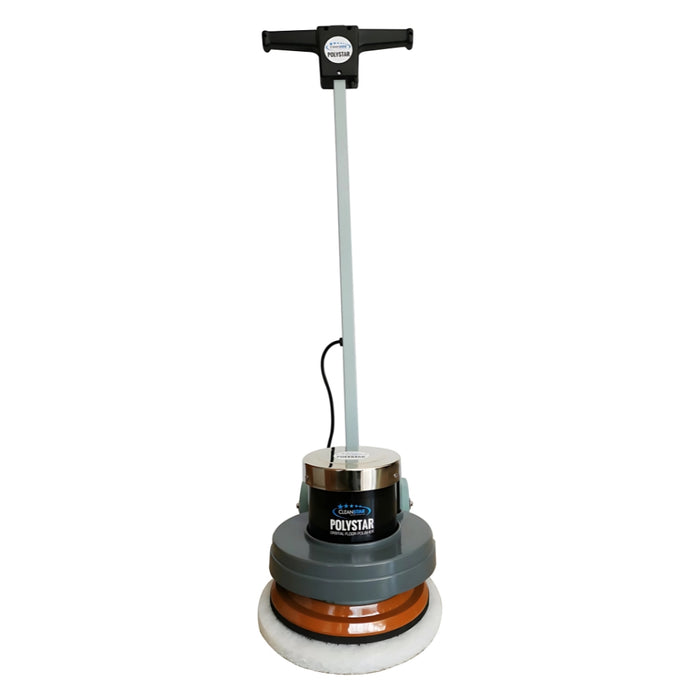
An automatic scrubber applies cleaning solution, agitates the floor and recovers dirty water through a vacuum squeegee system. Its main job is soil removal with controlled recovery. A low-speed rotary or orbital polisher drives a pad or brush and may scrub, strip, spray buff or polish when the machine, accessory and floor system permit. A high-speed burnisher primarily maintains gloss on a clean, compatible finished floor.
Product names overlap, so identify what the machine actually does. Ask whether it dispenses solution, recovers liquid, which speeds it operates at and which pads or brushes are approved. A unit described as a “scrubber polisher” may be a flexible single-disc machine, not an automatic scrubber-drier.
Use the floor condition to choose the process
| Observed condition | Likely process | What the machine cannot fix |
|---|---|---|
| Tracked soil and dirty wash water | Pre-sweep, scrub and recover | A scrubber cannot restore finish that has worn away |
| Clean floor looks dull but finish is serviceable | Manufacturer-approved polishing or burnishing | Gloss treatment cannot remove embedded soil safely |
| Finish is scratched, patchy or worn through | Assess scrub, strip, repair or recoat requirements | More pad speed cannot replace missing finish |
| Loose warehouse debris | Sweep or vacuum before wet work | A disc scrubber is not a substitute for suitable debris pickup |
| Textured or grouted floor | Trial a suitable brush or pad system | A flat pad may not reach recesses |
Floor material and finish set the boundary
Vinyl, rubber, sealed concrete, stone, timber and safety flooring do not share one cleaning or polishing process. Identify the substrate and any coating or finish before selecting chemistry, pad and speed. If the floor history is unknown, test a small area and inspect after drying.
Polishing terminology can also hide different goals. One site may want a clean satin appearance, while another specifies a high-gloss maintained finish. Translate “make it shine” into a measurable acceptance condition and confirm that the floor maker permits the proposed process.
Pad and brush choice can change the job
Pad colour is a useful family convention, but it is not a universal performance guarantee across every manufacturer. Match the exact pad or brush, machine speed, down pressure, chemical and floor system using the relevant instructions. A more aggressive pad can remove finish or mark a sensitive surface; a pad loaded with soil can redistribute contamination and create swirl marks.
Inspect pads during the task, not only at the end. Turn, rinse or replace them according to the process, and keep stripping or heavy-scrubbing pads separate from polishing stock. Check that the pad diameter fits the driver and machine. An incorrect size can expose the driver or interfere with safe operation.
Productivity depends on more than cleaning width
Theoretical coverage based on width and travel speed ignores turns, overlap, refilling, dumping, obstacles and edge work. Measure a representative area from setup to pack-down. For scrubbers, record solution use, recovery-tank stops and residual water at turns. For polishers, include dust control, cable management and pad changes.
Machine size should fit the narrowest doorway, lift, storage area and transport vehicle as well as the open floor. A wider machine may cover a warehouse aisle quickly but lose time in congested retail fixtures. A compact machine can be the better commercial choice when it completes more of the real route without manual rework.
When are both machines justified?
A finished-floor program may scrub routinely to remove soil and burnish only when inspection shows that a sound finish has lost its desired appearance. Separating the processes allows each machine to operate in its intended range. It also prevents a polishing step from being used to hide inadequate cleaning.
A multi-purpose low-speed or orbital machine can suit a smaller site if approved accessories cover its scrubbing and polishing needs and liquid recovery is handled safely. Larger sites may justify a dedicated scrubber-drier for routine cleaning and a separate burnisher for appearance maintenance. Compare labour, training, storage, service access and total annual use rather than counting machines alone.
Use a trial area to make the purchase decision
- Identify the floor and finish, then document the current defect or cleaning need.
- Pre-remove loose debris and divide a representative test area.
- Use the manufacturer-approved pad, brush, chemical and settings.
- Measure setup, cleaning, refilling, recovery, edge work and pack-down.
- Inspect immediately and again after the floor is dry under normal lighting.
- Record appearance, residual soil, slip concerns, marks, noise and operator effort.
Review Freshway’s floor scrubbers and verify each polisher’s approved applications, pads and floor combinations before purchase.
Frequently asked questions
Can a floor polisher remove dirt?
Some low-speed or orbital machines can scrub with an appropriate brush or pad. Polishing over soil, however, can spread contamination or damage appearance. Complete the cleaning process required by the floor system before gloss maintenance.
Does an automatic scrubber leave every floor dry?
No. Recovery reduces residual solution, but results depend on squeegee condition, floor texture, turns, settings and operator technique. Inspect the floor and control access until it is safe.
Can one pad be used for scrubbing and polishing?
Do not assume so. Those tasks normally require different levels of aggressiveness. Follow the pad and machine maker’s application guidance and keep contaminated pads out of finish work.