Diagnosing Filter Clogs and Suction Loss on Commercial Vacuums
Find the clog before you blame the motor on a dry backpack vacuum.
Shop now
A cleaner on a Sydney office floor felt the hose go light halfway down the corridor. The motor was still loud. Paper punch-outs were jammed in the wand knuckle, the bag was packed hard, and the cone filter was grey to the edges. The machine was not failing. The air path was blocked.
Symptoms that point to a clog versus a worn motor
A commercial vacuum losing suction diagnosis should start at the air path, not the motor. Check the floor tool, wand joints and hose, then the bag and pre-motor filter. On a Pacvac Superpro 700 the clear dome shows the 5-litre bag. Book service only after those checks fail.
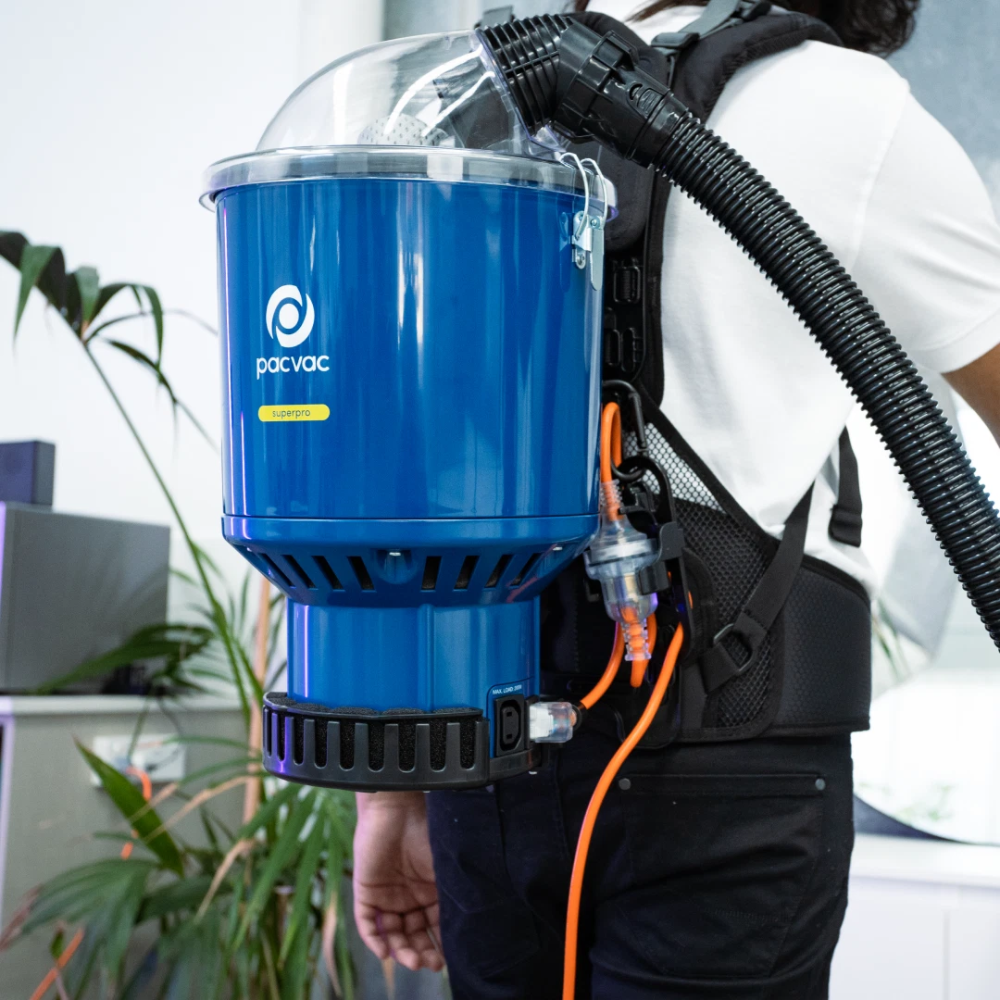
A clogged vacuum still sounds busy, yet pick-up at the tool fades, the hose may collapse, or dust leaks at a coupling. A motor problem more often brings burning smell, repeated thermal cut-out, unusual vibration, or a machine that will not start. Do not open the motor housing to “have a look”. Isolate the plug and treat the unit as electrical plant until a competent person inspects it, following SafeWork NSW electrical and power guidance.
The existing commercial vacuum filter maintenance guide covers dust type, sealed bag handling and what to log. This article is the on-floor sequence: where to look first, when fine dust has packed a filter, when wet soil has no place in a dry vacuum, and when to stop and send the machine to service.
Hose, wand and bag checkpoints in order
Work from the floor tool back toward the motor so you do not miss a simple blockage while staring at filters.
- Drop the floor tool and feel suction at the wand end. If suction returns, the tool is blocked or the brush strip is packed.
- Separate each wand section and the hose cuffs. Straighten the hose and look through it toward a light. Typical clogs are paper punch-outs, zip ties, bladder-wrack from entries, and a sock or wipe sucked up on a night shift.
- Read the bag through the lid, or open the canister on a clean sheet. Freshway lists the Pacvac Superpro 700 with a transparent dome lid, a 5-litre dust capacity, a reusable SMS bag and five paper bags in the standard kit. A bag that is packed, wet or torn will starve airflow long before the 1000 W single-stage motor is worn out.
- Only then inspect the pre-motor filter and the exhaust foam.

Freshway lists the Superpro 700 at 38 litres per second of airflow and 22 kPa of vacuum pressure, with a 5.4 kg body (excluding cord and hose), a 66 dBA noise figure and an 18-metre cord. Those figures describe a healthy air path. They do not survive a crushed hose or a bag pressed against the filter inlet. Browse backpack vacuums when you need to compare another body style, then stay with the same checkpoint order on every model.
HEPA packing from fine dust
Fine plaster, toner, concrete bloom and paper dust load filter media much faster than sand and crumbs. The bag may look half empty while the pre-motor filter is already blinded. Pick-up falls, the motor note rises, and another five minutes of “pushing through” cooks the remaining airflow.
Freshway lists the Pacvac Superpro pre-motor cone filter (FIL001) as a 196 mm snorkel-style cone for dry vacuuming only. It twist-locks into Superpro 700 and Superpro Duo 700 canisters, and the product page describes that cone path as the way the machine keeps airflow up as the bag fills. A grey, caked or distorted cone is not a cleaning suggestion. It is the next consumable in the path.

SafeWork NSW airborne contaminants guidance applies when the soil itself is a respiratory hazard. Do not tip a packed filter into an occupied lobby, and do not beat it against a loading-dock post. Change it in a controlled area, bag the used media, and use the PPE your SDS and site procedure name. WorkSafe Victoria’s hazardous manual handling advice still applies when someone is twisting out of a backpack to dump dust at waist height.
Wet soil in dry vacuums
The FIL001 page states the cone is for dry vacuuming only. A Superpro 700 is a dry backpack, not a wet-and-dry barrel. Water, mop slurry or a drink spill turned into mud will collapse paper bags, glaze foam and drive damp fines into the pre-motor media. The next sound is often a strained motor, not a restored hush.
If the tool suddenly feels heavy and the hose sweats, stop. Empty the path on a sheet, discard a wet bag, and do not restart until every section is dry. Spills belong with a wet pickup method or an absorbent, not with a dry commercial backpack. Repeat wet incidents are an operator briefing item, not a reason to keep “just finishing the floor”.
When to stop and book service
Stop unsupervised repair when you have cleared the tool, hose, bag and filters and suction is still poor, when there is a burning smell, when the machine trips a circuit, or when the casing, switch or cord is damaged. WorkSafe Victoria electrical and electrical safety pages make the same point as the NSW guidance: do not treat live or damaged equipment as a DIY task.
Australian workplaces commonly manage in-service inspection and tagging of portable electrical plant under procedures aligned with AS/NZS 3760. That is a reason to keep the covers on, not a licence to open them. Freshway’s Sydney service and repairs page is the path for diagnosis once the air-path checks are done. Describe the symptoms, the soil and the parts already changed so the bench is not repeating your first four steps.
Preventing repeat clogs by soil type
Office paper and punch-outs clog wands. School sand packs floor tools and then the bag. Plaster and toner blind filters. Kitchen or bathroom moisture ruins dry bags. Match the habit to the soil:
- Pick up large litter by hand before the tool does it for you.
- Change the bag on a schedule in high-soil zones, not only when pick-up dies.
- Keep a spare cone filter and exhaust foam on the trolley so a packed filter is a two-minute swap, not a reason to keep running.
- Assign one dry vacuum to dry floors. Do not share it with a wet spill kit.
For Thrift-series machines, Freshway lists Pacvac 5 L SMS sealed dust bags (DUB030) as a 10-pack with a sealed inlet collar, written for Pacvac Thrift and Thrift 650 backpacks. The sealed collar is there so dust does not bypass into the motor housing when the bag is pulled off. Use the bag the model page names; a bag that merely “fits” can leak around the inlet and look like a dying motor two weeks later.
Spec notes on bypass filtration
Bypass is unfiltered air sneaking around a bag cuff or a filter that is not locked. Freshway lists the Superpro 700 with a HEPA-rated Hypercone filtration system, and lists FIL001 with a twist-to-lock seal that is meant to sit airtight in the canister. Freshway also lists the Pacvac exhaust foam filter (FIL004 / PV259) as a washable grey foam final-stage filter for Superpro 700 and Thrift 650 series machines, sitting after the motor to catch carbon dust from the brushes.
A missing, flattened or poorly seated exhaust foam does not always feel like suction loss at the tool, but it does send dirty air back into the room you just cleaned. Refit it fully in the cage after washing and drying. Browse Pacvac filters and vacuum parts and accessories for the matching bag, cone, foam and hose parts rather than mixing series by guesswork.
| Checkpoint | What you usually find | What to do next |
|---|---|---|
| Floor tool and wand | Packed brush, paper or a wipe in the knuckle | Clear it and retest suction at the wand |
| Hose | A visible blockage or a hose that collapses under load | Clear or replace the hose, then retest |
| Bag | Packed, wet, torn, or the wrong cuff for the inlet | Fit the listed bag for that model and reseat the collar |
| Pre-motor filter | Grey, caked or unlocked media | Replace the listed cone or cartridge; do not run dry machines wet |
| Exhaust foam | Missing, soaked or crushed foam | Wash or replace, dry fully, and refit in the cage |
Operator checklist for shift end
End the shift with the same short list every night so the next operator does not inherit a hidden clog.
- Look through the Superpro dome lid and change the bag before it is packed against the filter.
- Wipe the floor tool and run a cable-tie pull through the hose if the building sheds paper or sand.
- Check that FIL001 is twist-locked and that the exhaust foam is present and dry.
- Coil the 18-metre cord without pinching it in a door, and park the backpack so the hose is not kinked under other gear.
- Note any burning smell, cut-out or missing suction on the job sheet before the machine goes back on the rack.
SafeWork NSW hazardous manual tasks guidance still applies when operators lift a loaded backpack, empty bags or carry several machines down a fire stair. The Superpro 700 is listed at 5.4 kg without cord and hose; a packed bag and a full hose add weight you should not swing off one shoulder.
Frequently asked questions
Does a loud motor mean the vacuum is still healthy?
No. A loud motor with weak pick-up usually means the air path is restricted. Clear the tool, hose, bag and filters before anyone talks about a replacement motor.
Can I wash the Superpro cone filter and keep using it indefinitely?
Treat FIL001 as a replaceable pre-motor part. If it is caked, distorted or no longer seals, fit a new listed cone rather than stretching a blinded filter through another week.
Should I keep vacuuming if the bag looks half empty?
Not when pick-up has already dropped. Fine dust can pack the pre-motor filter while the bag still has space. Stop and inspect the filter before the motor overheats.
When is suction loss a reason to book Freshway service?
Book service after the air-path checks fail, or sooner if you smell burning, see cord or switch damage, or the machine cuts out. Do not open the motor housing on site.
Next steps with Freshway
Walk the checkpoint order on the next machine that “feels weak”, then replace the listed bag and filter rather than guessing. Start with the Superpro 700 page for the body you already run, then pick matching parts from the Pacvac filters and vacuum parts collections linked above. If the air path is clear and the motor still misbehaves, use the Sydney service and repairs path instead of opening the electrics. Confirm current fitment on each product page before you order the next spare.