High-Rise Office Cleaning Trolley Setups That Actually Save Time
Measure the lift, load by colour, and keep waste lidded on every floor run.
Shop now
Two cleaners started the same Sydney tower at 18:30. One loaded a dual-bag housekeeping cart that would not turn into the service lift without unloading the mop bucket; the other used a compact cart that fitted the lift on the first try and finished two extra floors before midnight. The time was not lost to mopping. It was lost to a trolley that could not travel.
Why trolley layout is productivity
Office cleaning trolley setup high rise work succeeds when every floor run starts with a cart that fits the service lift, carries the night chemicals in colour order, and hides waste behind a lid. Measure door widths before you buy. A cart that cannot enter the lift costs more time than a missing spray bottle.
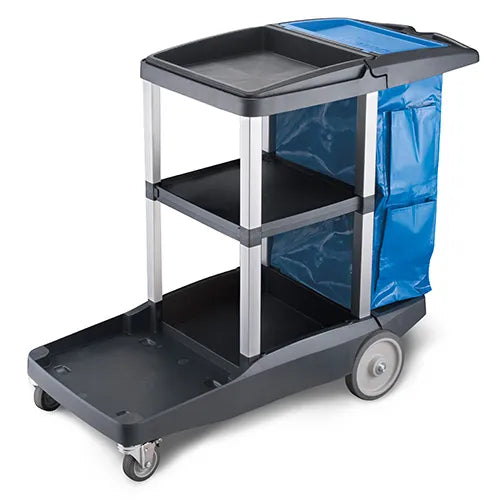
High-rise productivity is travel time: lift waits, door clearances, and how often the cleaner walks back to a slop sink because the cart was left on another floor. A well-laid trolley is a mobile storeroom for one or two floors, not a warehouse on wheels. For a general trolley packing method, use the existing commercial cleaning trolley setup guide. This article stays on the constraints that change once the workplace is a lift, a narrow floor lobby and a written colour-code.
Lift and door constraints
Measure the service-lift door, the car depth and the floor-lobby doors before you standardise a model. Freshway lists the Oates Platinum Compact Janitors Cart MKII (JC-3000ZX) with assembled dimensions of 1250 mm long, 558 mm wide and 996 mm high, in high-impact commercial plastic. The page describes a compact footprint for narrow corridors, tight elevators and busy aisles, plus a foldable handle and folding rear platform so the cart shortens for storage. Those millimetres are the buying data: if 558 mm plus your knuckles will not clear the lift door, pick another cart or change how it is loaded, rather than forcing the issue each night.

Freshway also lists the Oates Janitor Trolley with Lid (JC-175BL) as a compact, lightweight plastic cart with storage trays, accessory hooks and a grey laundry or rubbish bag concealed under a hygienic lid. Use that lid description when the trolley must cross a tenant lobby after hours: waste stays out of sight and odour is not on display beside the lift. If a floor needs more bag volume than a compact cart offers, Freshway lists the Edco Blue Janitors Cart (19040) with three storage shelves, tool holders for brooms and mops, an extra-thick base listed as supporting mop buckets and vacuums, non-marking castors and an 80-litre zippered waste bag. Confirm that longer body still turns in your lift before you make it the tower standard.

Stock lists by floor type
A tenancy floor, a wet-kitchen floor and a washroom-heavy podium do not need the same cart. Write a list per floor type: colour-coded spray bottles, cloths, a flat mop or dust-control mop and handle from the mops, heads and handles collection, bin liners in the sizes that match that floor's bins, spare toilet paper or towels only if that floor's washrooms are on the same run, and gloves plus any other listed PPE. Do not park a full unused carton of jumbo rolls on every office cart "just in case"; that weight belongs in the floor cupboard.
Daytime touch-up carts carry less: glass and bench bottles, cloths, a small liner bundle and a caddy that can leave the trolley at the lift. Night strip-out carts carry the mopping kit and the larger waste bag. The list is what stops two cleaners building incompatible carts from the same storeroom.
Weight and manual handling
Every extra full bottle, wet mop and bag of rubbish is a push, a turn and a lift. SafeWork NSW hazardous manual tasks and WorkSafe Victoria hazardous manual handling guidance are the control frame: reduce the load, use the trolley instead of carrying, keep heavy items between mid-thigh and shoulder height, and plan how a full waste bag comes off the cart. An 80-litre bag on the Edco 19040 should be changed before it is saturated; a overflowing bag that has to be hoisted from a low hook is a handling failure, not a badge of a busy shift.
Long vertical routes add fatigue even when the load is reasonable. SafeWork NSW fatigue guidance is the reason to design a floor block that can be finished inside the paid window, rather than a cart so heavy that the last floors are skipped. WorkSafe Victoria slips, trips and falls pages still apply around slop sinks and wet lift lobbies: a dripping mop should travel in its holder or bucket, not across the car floor.
Colour coding
Colour coding only saves time when the bottle, the cloth and the zone card match. Set the top of the trolley as a colour row, not a jumble. Freshway lists the Edco 28750 handy caddy at 280 mm wide and 400 mm deep, moulded from high-impact, chemical-resistant plastic to hold 500 ml to 1 L trigger bottles upright, with a central handle, and notes that it is designed to sit on the top shelves of most standard janitorial carts. That footprint is a practical way to keep washroom, glass and general-purpose bottles from sharing one cloth. SafeWork NSW chemicals guidance and WorkSafe Victoria chemicals pages apply to those bottles: labelled, capped, upright, with SDS available, and no decant into an unmarked spray container.
Browse cleaning chemicals when you print the colour card so the names on the trolley match SKUs the store actually stocks. Add gloves and other listed PPE to the same card: the pair lives in a dry pocket, not loose among wet cloths.
Spec trolley features
| Cart | Listed detail | High-rise note |
|---|---|---|
| Oates Platinum Compact MKII JC-3000ZX | 1250 × 558 × 996 mm; folding handle and rear platform; 4-compartment bottle holder; lid over the waste bag; Ergo Bucket footprint | Measure 558 mm width and 1250 mm length against the service lift |
| Oates JC-175BL with lid | Compact lightweight plastic; trays and hooks; bag concealed under a lid | Useful when the cart crosses tenant lobbies |
| Edco 19040 blue cart | Three shelves; mop and broom holders; thick base; non-marking castors; 80 L zippered bag | Higher bag volume; confirm turning circle in the lift |
| Edco 28750 handy caddy | 280 × 400 mm; holds 500 ml–1 L bottles; chemical-resistant plastic | Keeps colour-coded bottles upright on the top shelf |
Also look for quiet castors, a way to hang an A-frame sign, and a lid or cover if the cart will be seen by tenants. The JC-3000ZX page lists compatibility with Oates Platinum accessories, mop-holder brackets and hook clips for lobby pans and A-frame signs. Specify those extras on the same purchase order so crews do not improvise with unsecured handles. Review current models in the cleaning trolleys and carts collection before you lock a tower standard.
Night versus day setups
Day carts stay light and presentable: fewer bottles, a lid over waste, no dripping mop hanging at head height in a lift full of tenants. Night carts can carry the mopping kit, more liners and a larger bag because corridors are clearer and the lift is a service run. Do not leave the night cart staged in a public lobby at 07:30 with an open bag; swap to the day layout or park it in the cleaners' room. The same chassis can serve both shifts if the top caddy and the bag are reset, which is faster than maintaining two incompatible fleets.
Standard kit photo
Photograph one correctly loaded cart per shift and print it inside the storeroom door. The photo should show: bottle colours in order on the caddy, cloth colours in separate tubs, mop and handle in their holders, liners in a dry pocket, gloves in a dry pocket, lid closed over the bag, and nothing stacked so high that the cleaner cannot see over the load in a lift. The JC-3000ZX and Edco 19040 images above are the chassis references; the site photo is the loaded standard. If the photo and the floor list disagree, rewrite the list before the next induction.
Frequently asked questions
Is a larger trolley always faster in a high-rise?
No. A cart that cannot enter the service lift or the floor lobby costs trips and unloading time. Measure the listed dimensions against the doors first.
Do we need different carts for day and night?
Not always. Many towers reset the same chassis: a lighter, lidded layout by day and a mopping kit with a larger bag at night.
Where should full waste bags be emptied?
At the planned waste point before the bag is too heavy to lift safely. An 80 L bag on a cart such as the Edco 19040 should not be left to overflow on the last floors.
How do colour-coded bottles stay separated on a moving cart?
Use a compartmented top caddy, such as the Edco 28750 listed at 280 mm × 400 mm, and match each bottle to its cloth colour on the printed card.
Can we load spare jumbo rolls on every office trolley?
Only if that floor's washrooms are on the same run and the extra weight still lets the cart travel safely. Otherwise keep bulk paper in the floor cupboard.
Next steps with Freshway
Measure the service lift, write a stock list per floor type, then choose a chassis that fits those doors. Compare current models in cleaning trolleys and carts, match mopping tools in mops, heads and handles, and check bottle names against the cleaning chemicals collection before you photograph the standard kit.