Combining Sweeper and Scrubber on One Shift for Warehouses
Sweep first, scrub second, and size both machines to the shift you actually run.
Shop now
The night-shift scrubber operator in a Sydney distribution centre radios in at 2 am: the squeegee is leaving stripes, the recovery tank smells like a drain and the pads are already grey. Nobody swept aisle 14 after the evening pick, so the scrubber has been turning shrink-wrap offcuts, grit and pallet splinters into slurry for the last hour.
Should a warehouse sweep before it scrubs on the same shift?
Yes. On a warehouse shift, run the sweeper first and the scrubber second, in the same zone order. Sweeping removes loose grit, wrap and splinters that otherwise clog squeegees, block recovery hoses and grind into the floor finish. The scrubber then works on bonded soil only, so pads last longer and the floor dries cleaner.
That order is not a Freshway invention. Kennards Hire's guide to choosing a sweeper or a scrubber says that where there is loose dirt and rubbish you need to sweep before you scrub, or the loose dirt is spread along the surface and can scratch the floor, clog squeegees and brushes, or block the recovery system. This article looks at how to pair the two machines across one shift, with figures taken from the Freshway product pages.
Why grit kills scrubber results
A scrubber is a wet machine. Put dry, loose soil under it and the solution does the wrong job. RapidClean's floor preparation tips describe exactly this: solution mixes with dust and turns into mud that is spread around, the floor then has to be re-scrubbed, and small stones can be ground into the finish while also causing premature wear on the machine.
The symptoms show up in the recovery system first. Capital Equipment's list of floor scrubber quick fixes notes that a scrubber can pick up a large piece of debris, plastic or sludge that blocks the hose, and that the debris basket can clog during recovery if the area has not been swept or vacuumed first. In a warehouse that means stretch-film tails, strapping clips and timber splinters from damaged pallets. A ride-on scrubber with a blocked hose leaves water behind, and water behind a machine in a forklift aisle is a slip hazard, not just a cosmetic fault.
Sweeper first: the working rules
- Sweep the same zone the scrubber will cover next, not the whole building in one go. Grit settles back if the gap between passes is long.
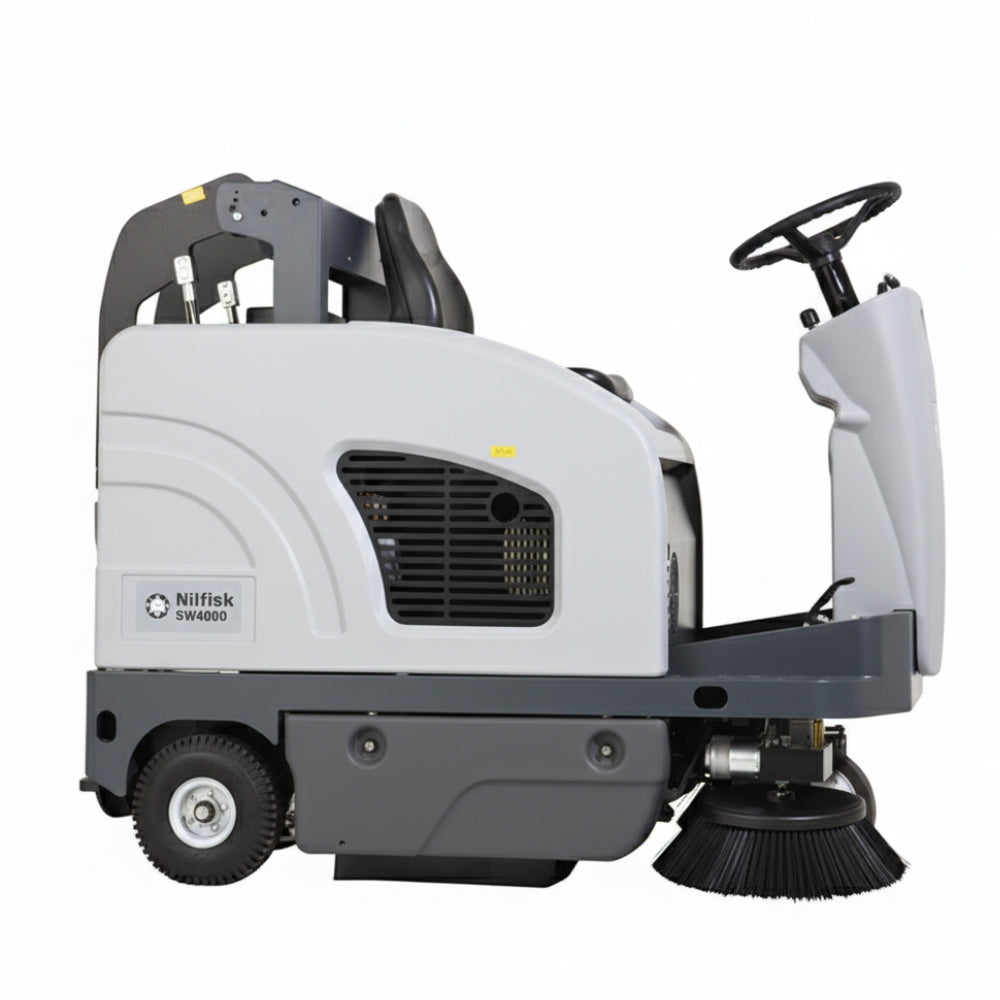
- Empty the sweeper hopper before it is full. The SW4000 page lists a 75 litre hopper with a hydraulic high dump, so the operator can tip into a skip without manual lifting.
- Pick up strapping and large wrap by hand before either machine passes. Neither machine is designed to digest metal clips.
- Leave mats, spill kits and pallet bays that are about to receive stock out of the scrub run.
One operator or two: working the numbers
Freshway lists the Nilfisk SW4000 battery ride-on sweeper at a theoretical 6,825 m²/h, a 1250 mm sweep path with the side broom, a 7 m² filter and up to 4 hours of runtime per charge. The Nilfisk SC6500 1100D battery ride-on scrubber dryer is listed at 9,000 m²/h theoretical and 6,300 m²/h actual, with a 1000 mm disc deck and 265 litre solution and recovery tanks.
Take a 20,000 m² open floor as an example. At the scrubber's listed actual rate, 20,000 ÷ 6,300 is about 3.2 hours. At the sweeper's listed theoretical rate, 20,000 ÷ 6,825 is about 2.9 hours, and real sweeping will take longer because the page gives no actual figure. One operator doing both in sequence is therefore looking at more than six hours of machine time before hopper dumps, tank changes and breaks. Two operators, with the sweeper one zone ahead, can finish the same floor in roughly the scrubber's time. Use this maths as a planning check, then log real minutes in the first fortnight.
| Shift model | What it needs | Trade-off |
|---|---|---|
| One operator, sweep then scrub | Machine time above six hours on a 20,000 m² floor at listed rates | Lower labour, but little margin for dumps, refills and forklift interruptions |
| Two operators, sweeper one zone ahead | Two trained operators and a zone map | Shorter window; needs clear radio calls and a traffic plan for two moving machines |
| Combination machine, single pass | One operator on a larger machine | One unit to train on, but more width and mass to manage in racking aisles |

Timing around forklift peaks
A sweeper and a scrubber are both mobile plant, and in a warehouse they share aisles with forklifts. SafeWork NSW's alert on working with or around mobile plant lists separating vehicles and pedestrians, or scheduling work so they are not operating in the same area at the same time, as ways to eliminate the risk. SafeWork NSW's forklift guidance says the same for forklift areas: where physical separation is not possible, schedule work so forklifts and people are not in the same place at once.
WorkSafe Victoria's page on developing a forklift traffic management plan explains why: a plan that separates forklifts from pedestrians reduces the risk of forklift-related deaths and injuries. Put the floor-care machines into that plan. In practice, sweep and scrub the dispatch zone after the last outbound wave, and the receiving dock after the morning inbound, so the cleaning pair is never threading between loaded forks.
Pad life and recovery-system wear
Pads and brushes are consumables, and grit is what wears them fastest. A pre-swept floor means the pad is working on bonded soil and tyre marks rather than loose sand, which is what the pads in the scrubbing pads range are designed to do. Change pads on condition: a pad that is loaded with grit or glazed does not clean evenly, however much solution goes down.
The same logic applies to squeegee blades. Capital Equipment points out that worn or wrong-material blades leave streaks and that the fix is to rotate or replace them. If you are rotating blades every week on a site that skips the sweep, the sweep is the cheaper fix.
When a combination machine makes sense
Some sites would rather run one machine. Freshway lists the Nilfisk CS7010 diesel hybrid as a combination machine designed to sweep and scrub in a single pass, with a 1540 mm sweeping path, a 1240 mm scrubbing path, a 1370 mm squeegee, 284 litre solution and recovery tanks and a 198 litre hopper. That is a lot of width. It suits wide, open floors and long runs; it is harder work in narrow racking aisles, and a diesel unit needs a separate conversation with the site about where it can operate indoors. Where aisles are tight or the site prefers battery power, a separate battery sweeper and scrubber pair is the more flexible answer.

Speccing both machines as a pair
Match the pair before you buy either. The sweeper's path should cover the scrubber's path with margin, so the scrubber never runs on an unswept strip; here the SW4000's 1250 mm sweep path covers the SC6500's 1000 mm deck. Check that both machines can turn at the end of the narrowest aisle you intend to clean, and that the floor, ramps and dock plates are rated for the mass: about 1200 kg for the SW4000 and 1460 kg for the SC6500 1100D, both including battery. Plan charging so both machines are full at the start of the shift. The full range sits in the sweeper machines and Nilfisk sweepers collections.
Sweeper and scrubber pairs for warehouses in Sydney, Melbourne and Brisbane
The checklist below works for any warehouse, but the pairing decision usually turns on shift length and aisle width. If the site runs one night shift with a single cleaner, the combined machine-time maths above decides whether a pair is realistic. If it runs a skeleton crew across two shifts, sweeping on the evening shift and scrubbing overnight can also work, provided the gap is short enough that dust does not resettle.
Shift checklist:
- Confirm the zone order and the forklift-free window with the shift supervisor.
- Hand-pick strapping, clips and large wrap.
- Sweep the zone; dump the hopper before it is full.
- Scrub the swept zone; check the debris basket and squeegee at every tank change.
- Keep wet-floor signs at aisle ends until the floor is dry. SafeWork NSW lists slippery floors among common hazards on its slips, trips and falls page.
- Charge both machines and record runtime used.
Frequently asked questions
Can we skip the sweep if the floor looks clean?
Not on a working warehouse floor. Fine grit you cannot see still turns to slurry under the scrubber.
Should the sweeper and scrubber run at the same time?
Yes, if you have two operators. Keep the sweeper one zone ahead and both inside the traffic plan.
Does pre-sweeping save scrubber pads?
It removes the loose grit that wears pads fastest, so pads work on bonded soil instead.
Is a combination machine always faster?
No. It covers wide floors in one pass, but its width is harder to manage in narrow racking aisles.
Next steps with Freshway
Map the zones, time one sweep and one scrub, and spec the pair from real minutes rather than brochure rates. Freshway supplies sweepers and floor scrubbers to businesses in Sydney NSW, Melbourne VIC and Brisbane QLD. Same-day delivery is available in Sydney, with fast delivery to Melbourne and Brisbane. Call 1300 567 002 for a delivered quote, or browse the floor scrubbers collection.