Air Watts vs Water Lift: Reading Commercial Vacuum Spec Sheets in Australia
Convert suction and airflow to one set of units before you compare any vacuum.
Shop now
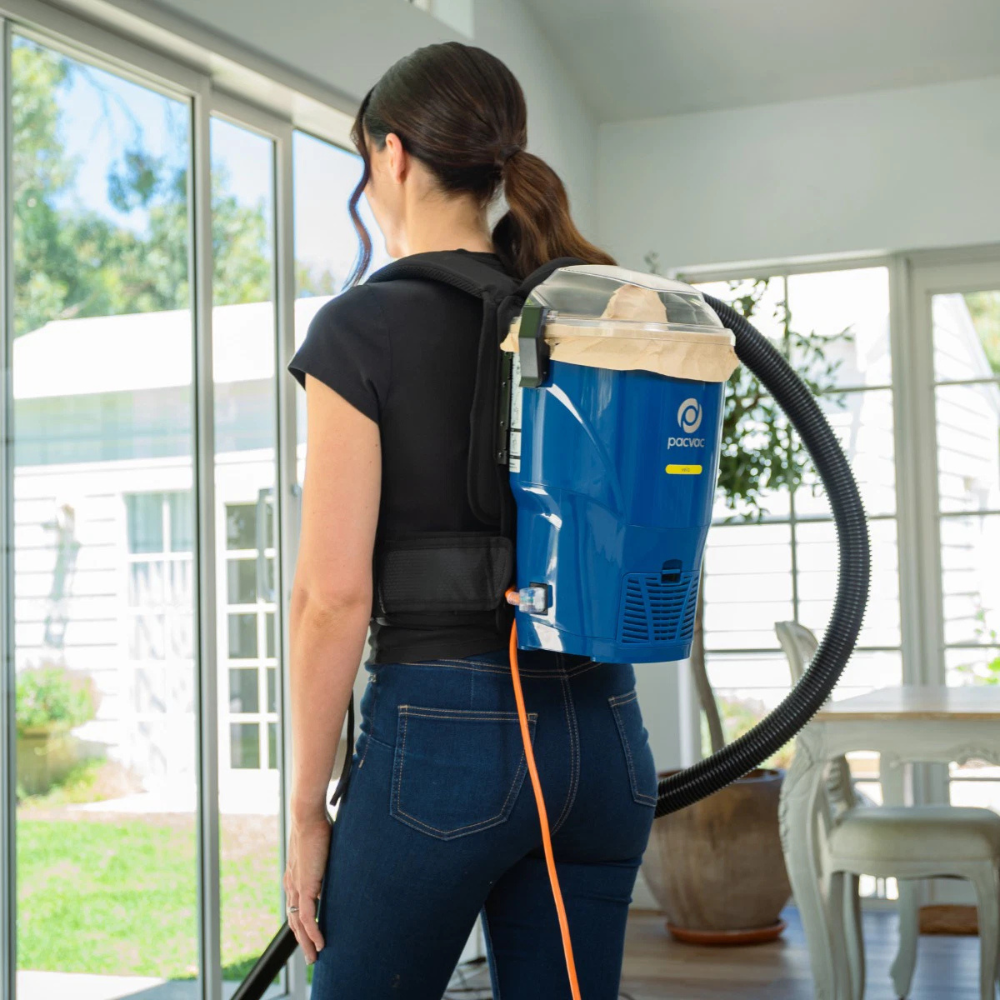
900 watts in, 192 watts of suction out. That is how Freshway's listing for the Pacvac VELO corded backpack reads: a 900 W motor and a 192 W suction-power figure on the same specification block. About 21 per cent of the wattage on the box shows up as air power, and that ratio is the reason two vacuums with the same motor rating can clean very differently.
Air watts vs water lift: what each number tells you
Air watts vs water lift comes down to what each figure measures. Water lift, also printed as sealed suction in mm, mbar or kPa, shows how hard the motor can pull. Airflow in L/s shows how much air it moves. Air watts combine both at one working point. Compare all three, never motor watts.
The Freshway guide to common commercial vacuum spec sheet mistakes already explains why watts mislead and lists other traps such as capacity and noise claims. This article goes one level deeper for engineers and supervisors: converting the units Australian spec sheets actually use, doing the air-power maths honestly, and testing the result on site.
Why wattage misleads buyers
Motor watts describe electrical input. Some of that power becomes air movement, and the rest becomes heat, noise and losses in the fan and motor. The VELO numbers make the point: 192 ÷ 900 = 0.213, so roughly a fifth of the input is listed as suction power. Two machines with identical input ratings can have different fans, seals and air paths, so their air power will differ even when the box says the same number.
Air watts, water lift and airflow explained
Three figures describe the motor-fan unit:
- Sealed suction (water lift). The pressure difference the unit can create with the inlet blocked. Australian listings print it as mm of water, mbar or kPa.
- Airflow. The volume of air moved with the inlet open, printed as L/s, L/min, m³/h or CFM.
- Air power (air watts). Airflow multiplied by pressure at the same operating point. In SI units, watts = m³/s × Pa.
The trap is multiplying the two maximums. Maximum suction happens with the inlet sealed, when airflow is zero. Maximum airflow happens with the inlet open, when suction is close to zero. Their product is not a real operating point. For the VELO: 28.2 L/s is 0.0282 m³/s, and 18.6 kPa is 18,600 Pa, so 0.0282 × 18,600 = 524.5 W. The listed suction-power figure is 192 W, about 37 per cent of that product. Treat the product of maxima as a ceiling, not a rating.
Building a fair comparison table
Before comparing machines, convert everything to the same units. The conversions are fixed:
- 1 mm of water ≈ 9.81 Pa, so 2,500 mm ≈ 24.5 kPa.
- 1 mbar = 0.1 kPa, so 240 mbar = 24.0 kPa.
- 1 L/min = 1/60 L/s, so 5,200 L/min ≈ 86.7 L/s.
- 1 CFM ≈ 0.472 L/s.
Applied to six machines as Freshway lists them:
| Machine (Freshway listing) | Motor input | Airflow as listed | Suction as listed | Airflow, L/s | Suction, kPa |
|---|---|---|---|---|---|
| Pacvac VELO corded backpack | 900 W | 28.2 L/s | 18.6 kPa | 28.2 | 18.6 |
| Numatic WV380-2 | 1060 W | 49 L/s | 2400 mm | 49 | 23.5 |
| Ghibli ASL7P | 1300 W | 55 L/s | 240 mbar | 55 | 24.0 |
| Karcher NT 20/1 Me Classic | 1,500 W | 59 L/s | 227 mbar | 59 | 22.7 |
| Nilfisk VHS 120 LC | 2000 W | 5200 L/min | 21 kPa | 86.7 | 21.0 |
| Numatic WVD570 | 2400 W | 80 L/s | 2500 mm | 80 | 24.5 |
Once converted, a pattern appears. Across the wet and dry machines, from 1060 W to 2400 W, listed suction sits in a narrow band of about 21 to 24.5 kPa. What rises with motor input is mostly airflow. That tells a buyer what extra watts usually buy: more air volume, which helps on bulky debris and wide tools, rather than much more lift.

What each metric predicts on carpet vs hard floor
Suction helps where soil is held: grit deep in carpet pile, water in grout lines, debris in crevices and long hose runs. Airflow helps where soil is loose and plentiful: hard floors, open warehouses and wide floor tools that need a lot of moving air across the nozzle. The floor tool matters as much as the motor. A well-sealed carpet tool converts suction into pickup; a wide hard-floor tool needs airflow to carry debris along its width.
Spec sheet inconsistencies across brands
Australian listings mix units even within one category: mm of water, mbar and kPa for suction; L/s, L/min and CFM for airflow; and sometimes a "suction power" in watts. Some print only one of the three. When a figure is missing, do not estimate it from motor watts. Ask the supplier, or compare only the fields both machines publish. Where figures disagree between sources, confirm the number on the Freshway product page before you rely on it.
When filtration reduces effective suction
Every layer between the nozzle and the fan adds resistance: bags, cartridges, HEPA stages and a full container. Fine filtration is often required, for example SafeWork NSW's guidance on clean-up of silica dust calls for an M- or H-class rated vacuum. The listed airflow and suction are measured on the unit, so expect less at the floor tool as filters load. A clean filter and an empty bag restore much of the gap; the Freshway guide to diagnosing filter clogs and suction loss walks through the checks.
Field tests you can run on site
Spec sheets narrow the list; a trial decides. Simple tests that any supervisor can repeat:
- Same tool, same floor. Fit comparable floor tools and vacuum a measured carpet area seeded with the same amount of fine grit. Weigh the bag or container gain.
- Hard-floor sweep. Time how long each machine takes to clear a marked strip of loose debris.
- Filter loading. Repeat after a week of normal use without changing bags, and note how much pickup drops.
- Operator comfort. Ask operators to rate weight and handling; SafeWork NSW treats sustained awkward posture as a hazardous manual task. WorkSafe Victoria's guidance on safer vacuuming recommends training workers to select appropriate vacuum equipment for the surface type and area.
Buying mistakes from vanity metrics
- Choosing on motor watts alone, then finding airflow or suction is lower than a smaller machine.
- Multiplying maximum airflow by maximum suction and calling the result air watts.
- Comparing mm of water with mbar without converting.
- Ignoring filter class and tool design, which often matter more than a few kPa.
- Skipping the electrical check on trial machines. Plug-in equipment on commercial sites is commonly inspected and tagged under AS/NZS 3760, as SafeWork NSW explains on its electrical inspection and testing page.
- Forgetting the safety side. AS/NZS 60335.2.69, listed in the Standards Australia store, covers safety requirements for wet and dry vacuum cleaners for commercial use; it is a safety standard, not a performance ranking.

Frequently asked questions
Is higher water lift always better?
No. It helps on carpet and wet pickup, but airflow and tool design decide pickup on hard floors.
Can I calculate air watts from a spec sheet?
Not from the two maximums. Their product overstates real air power.
Why do some listings show suction in watts?
That is an air-power figure, an output, not the motor input.
Do more watts mean more suction?
Often not. In the table above, extra watts mostly bought airflow.
What is 2,500 mm of water in kPa?
About 24.5 kPa, because 1 mm of water is about 9.81 Pa.
Next steps with Freshway
Convert the figures for the machines on your shortlist, check filter class and tools, then run a short trial. Compare listed specs across the vacuum cleaner, backpack vacuum and wet and dry vacuum ranges, confirm each figure on the product page, and contact Freshway if a listing is missing the number you need.