Warehouse and Logistics Scrubbers: Productivity First
Plan on real square metres per hour, not the theoretical figure on the brochure.
Shop now
Nine thousand square metres an hour. That is the theoretical productivity printed on the Freshway product page for the Nilfisk SC6500 1100D ride-on scrubber. The same page lists 6,300 m² an hour as the actual figure, which is 70% of theory. That gap is the most useful number in warehouse scrubber planning, because it decides whether the floor gets done in one shift or spills into the next.
This guide is written for industrial facilities managers and the buyers who work with them. It starts with the soil and the site rules, then works through battery shifts, detergent, forklift traffic and a simple hours-based return sketch.
Warehouse floor scrubber: the short answer
Choose a warehouse floor scrubber on real productivity, not brochure width. Start from the floor area cleaned per shift, apply a realistic share of theoretical output, then check that runtime, tanks and brush pressure cover it. Long-aisle logistics sites usually end up with a battery ride-on, scheduled away from forklift traffic.
Freshway's floor scrubber collection runs from compact walk-behinds to micro riders and full ride-on machines, and the wider commercial cleaning machines range adds sweepers and combination units. If you need the broader equipment picture first, read the warehouse cleaning equipment guide; this article stays on the scrubber.
Dust and tyre marks
Warehouse soil is mostly two things: loose dust and grit from pallets and dock doors, and bonded marks from forklift tyres. They need different answers.
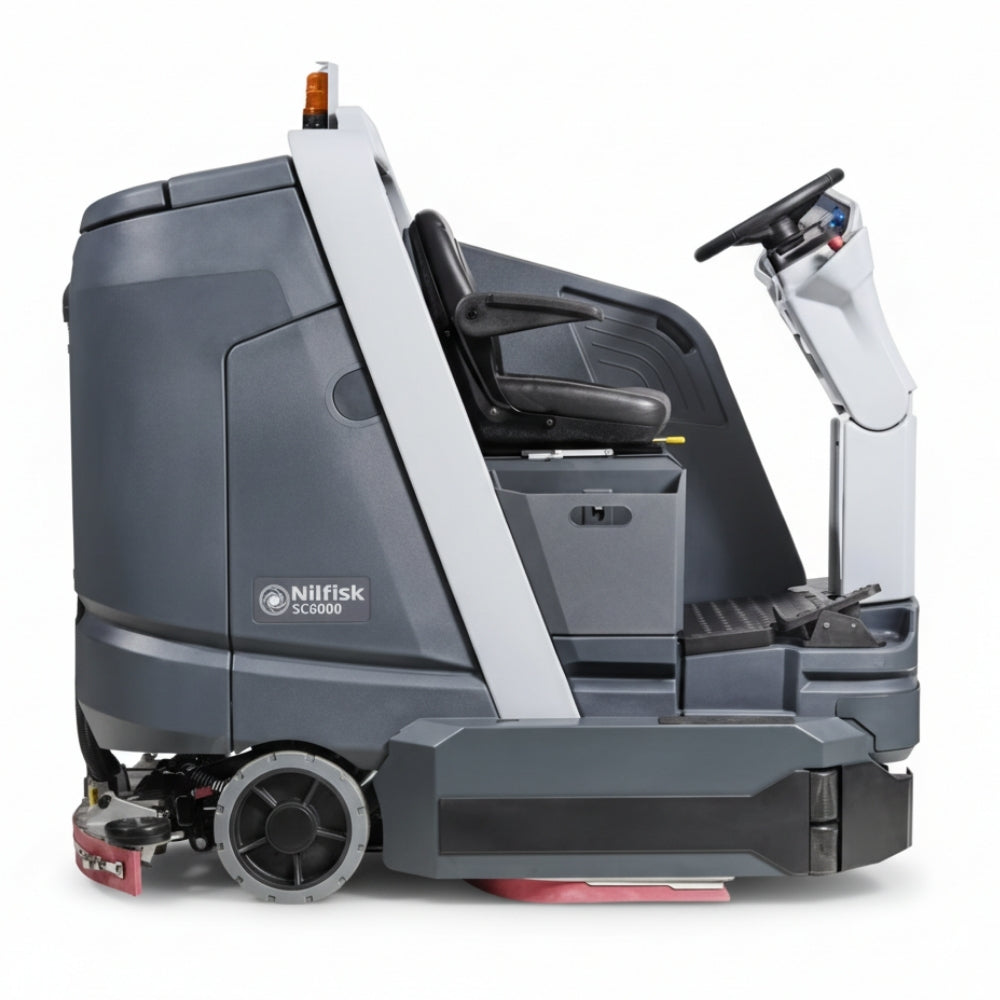
Loose debris decides the deck type. Tennant Australia's brush guide explains that disc brushes run at about 250 to 300 RPM and have no way to collect debris, so floors must be swept first, while counter-rotating cylindrical brushes at 600 to 800 RPM throw loose dirt into a tray. It names warehouses and parking facilities as natural candidates for cylindrical heads. The Nilfisk SC6000 910C on Freshway's site is a cylindrical ride-on that lists scrubbing and sweeping in one pass.
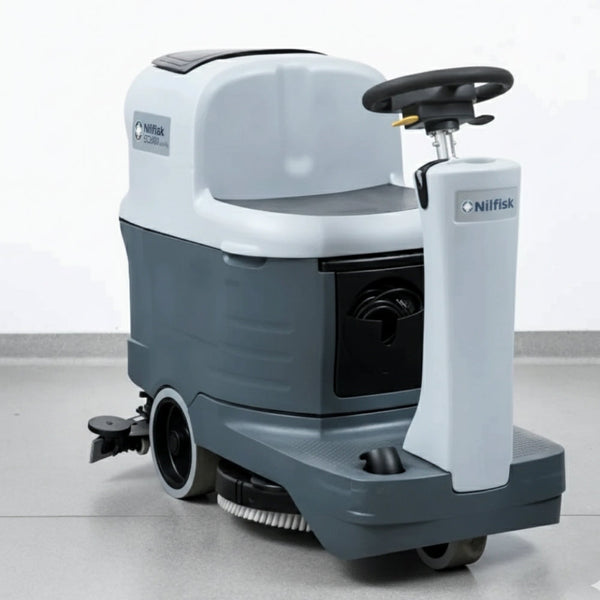
Tyre marks are a down-pressure problem. Freshway's page for the Nilfisk BR855 names forklift tyre marks on sealed concrete and lists adjustable brush pressure of 40, 65 or 96 kg. The SC4000 860D page lists up to 100 kg. Tennant notes that disc machines can apply more down pressure for thick build-up, so a disc rider with high pressure is the usual tool where marks matter more than grit.

Ride-on triggers
A walk-behind becomes the wrong machine when any of these is true:
- The floor area per shift needs more hours than the operator or the battery can give.
- Aisles are long and straight, so a wider deck turns into fewer passes rather than harder turns.
- Tank stops eat the shift, because every dump means a drive back to the drain.
- The cleaning window is short, such as between a late pick wave and an early dispatch.
Tennant Australia puts industrial and logistics facilities with long aisles and heavy soil in ride-on territory, and walk-behinds where congestion and tight turns dominate. Many distribution centres need both: a rider for the main aisles and a walk-behind for amenities, offices and tight pick faces.
Battery shift planning
Runtime is a hard ceiling. On Freshway's product pages the SC2000 53B micro rider lists up to 2.5 hours per charge and the SC6000 910C lists up to 270 minutes. Those are maximums; plan on less.
Charging needs a place, not just a socket. Choose a charging bay away from forklift routes and pedestrian walkways, with room to open the battery compartment. If the machine uses lithium-ion batteries, SafeWork NSW asks for chargers designed for the battery type and voltage, storage away from heat and flammable materials, and no unattended or prolonged charging. Plug-in chargers and leads also fall under SafeWork NSW's inspection and testing requirements where the environment is likely to damage them, with AS/NZS 3760 setting out methods and frequency.
Detergent choice
Warehouse slabs are usually sealed or bare concrete, and the soil is dust, rubber and some oil near docks and charging bays. Use a detergent formulated for auto-scrubbers, at the dilution on the label, and resist the urge to add more. Excess chemical leaves residue that attracts dust and can make the floor slippery.
Two compliance points travel with every drum. SafeWork NSW requires a current safety data sheet before a hazardous chemical is used, a register of hazardous chemicals kept on site, and labels on any container a chemical is decanted into. Freshway's cleaning chemicals range is the place to compare options, and its B2B page offers help with SDS documents for account customers.
Safety around forklifts
A scrubber in a warehouse is another vehicle among forklifts and pedestrians. SafeWork NSW's forklift guidance says the safest workplaces physically separate people from moving forklifts, and where that is not possible, work should be scheduled so forklifts and people are not in the same area at the same time.
Apply the same logic to the scrubber: clean aisles in blocks that are closed to forklift traffic, agree the sequence with the shift supervisor, and keep the scrubber operator out of loading zones while trucks are working. A wet floor behind the machine is a slip risk for people and a traction risk for forklifts, so the squeegee must leave the floor dry and the route should be signed.
SafeWork NSW's slips, trips and falls guidance lists slippery floors from cleaning products or methods, and spills of water, grease, oil or dust, among the hazards to control. Nilfisk Australia's ride-on scrubber page adds a practical point: squeegees and blades need regular inspection, or the machine will not pick up dirty water properly.
Spec-sheet fields to check
Compare machines on the same fields. These figures come from Freshway product pages; where a field is blank, the page does not list it.
| Machine | Deck | Width | Solution / recovery | Listed productivity | Runtime |
|---|---|---|---|---|---|
| Nilfisk SC2000 53B | Micro ride-on | 53 cm | 70 L / 70 L | 3,180 m²/h theoretical | Up to 2.5 h |
| Nilfisk BR855 | Disc ride-on | 860 mm | 106 L / 106 L | 5,360 m²/h theoretical | Not listed |
| Nilfisk SC4000 860D | Disc rider | 860 mm | 125 L / 125 L | 6,020 m²/h theoretical | Not listed |
| Nilfisk SC6000 910C | Cylindrical ride-on | 91 cm | 190 L / 190 L | 5,730 m²/h theoretical | Up to 270 min |
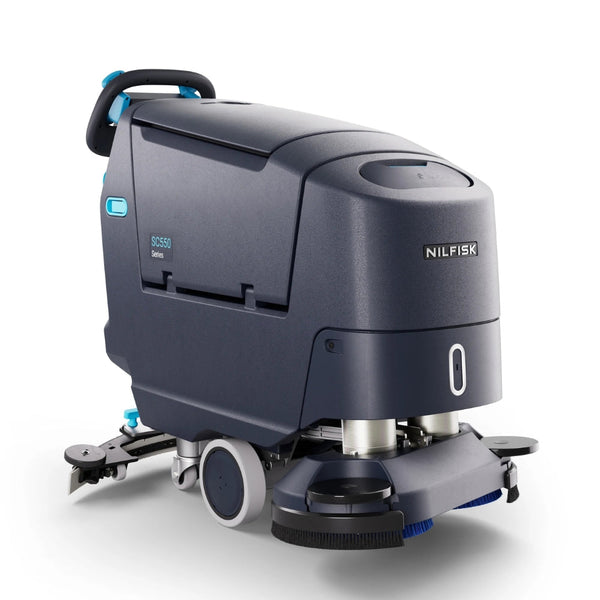
| Nilfisk SC6500 1100D | Disc ride-on | 1,000 mm | 265 L / 265 L | 9,000 theoretical, 6,300 actual m²/h | Not listed |
Also ask for brush pressure, squeegee width, battery type and capacity, charger type, transport speed and turning space. The SC4000 page, for example, lists a 1,055 mm squeegee and 7 km/h transport speed, which matter on long travel runs between zones.
ROI sketch in labour hours
Price the machine on its product page; the return shows up in hours. Take a 20,000 m² area of open aisles cleaned each night. Only the SC6500 page lists an actual figure, so the sketch applies the same 70% of theoretical to the other machines as a planning assumption.
| Machine | Planning rate | Hours for 20,000 m² | Fits listed runtime? |
|---|---|---|---|
| SC2000 53B | 2,226 m²/h | 8.98 h | No, about 3.6 charges at 2.5 h |
| SC6000 910C | 4,011 m²/h | 4.99 h | Just over 4.5 h; split or add a charge |
| SC4000 860D | 4,214 m²/h | 4.75 h | Runtime not listed; ask |
| SC6500 1100D | 6,300 m²/h (listed actual) | 3.17 h | Runtime not listed; ask |
The point is not the decimals. A micro rider is a good machine in the wrong job here, while the larger riders finish within one shift. Real output also drops with tank stops, turns and forklift hold-ups, so trial on your own floor before committing.

Common mistakes to avoid
Buying on theoretical productivity alone is the first. The second is choosing a disc deck for a dusty dock area and then paying someone to sweep ahead of it every night.
Third, forgetting where the machine will charge and dump. Fourth, overdosing detergent. Fifth, ignoring service access: Freshway's service and repairs page covers scrubbers with drive faults, battery issues and water recovery problems, and offers pick-up and delivery for commercial clients in Sydney. Nilfisk Australia also notes that combustion-engine machines suit large outdoor or well-ventilated indoor spaces, so an enclosed warehouse normally stays battery-powered.
Frequently asked questions
What size floor scrubber does a distribution centre need?
Divide the area cleaned per shift by a realistic hourly rate, not the theoretical one. If the result is more hours than one charge or one operator can give, step up to a wider ride-on or split the area across shifts.
Do I need a sweeper as well as a scrubber in a warehouse?
Not always. A cylindrical-deck scrubber collects light debris while it scrubs, which removes the pre-sweep in many aisles. Heavy debris, pallet wrap and broken timber still call for a sweeper or manual pick-up first.
Can a battery scrubber run a full night shift?
Only if its listed runtime, less a safety margin, covers the hours your floor needs. If it does not, plan a mid-shift charge, a second battery set or a split cleaning schedule.
How do I stop scrubbers and forklifts sharing the same aisle?
Agree a block-by-block cleaning sequence with the warehouse supervisor so aisles are closed to forklifts while the scrubber works, and sign the wet area until the floor is dry.
Next steps with Freshway
Measure the floor area you clean each shift, note the soil type and the cleaning window, and shortlist two machines from the table above. Freshway can help compare runtime, consumables and delivery lead times for heavy machines, which its shipping policy says need special handling. Check each product page for current pricing.