Building a Mixed Vacuum Fleet: Backpack + Canister + Wet-Dry
Give every vacuum format a fixed job, then standardise models within each one.
Shop now
Standardising on one vacuum model across every site sounds like the tidy option. In practice it usually creates more exceptions, not fewer: the backpack that suits a four-level office gets dragged into a food court, and the canister bought for open retail floors ends up on a fire stair. The tidy fleet is the one where each format has a fixed job.
This guide is for operations managers who buy for several sites at once. It treats the fleet as a system: which formats to run, how many of each, where they live, which consumables they use and which workplace safety rules shape the plan.
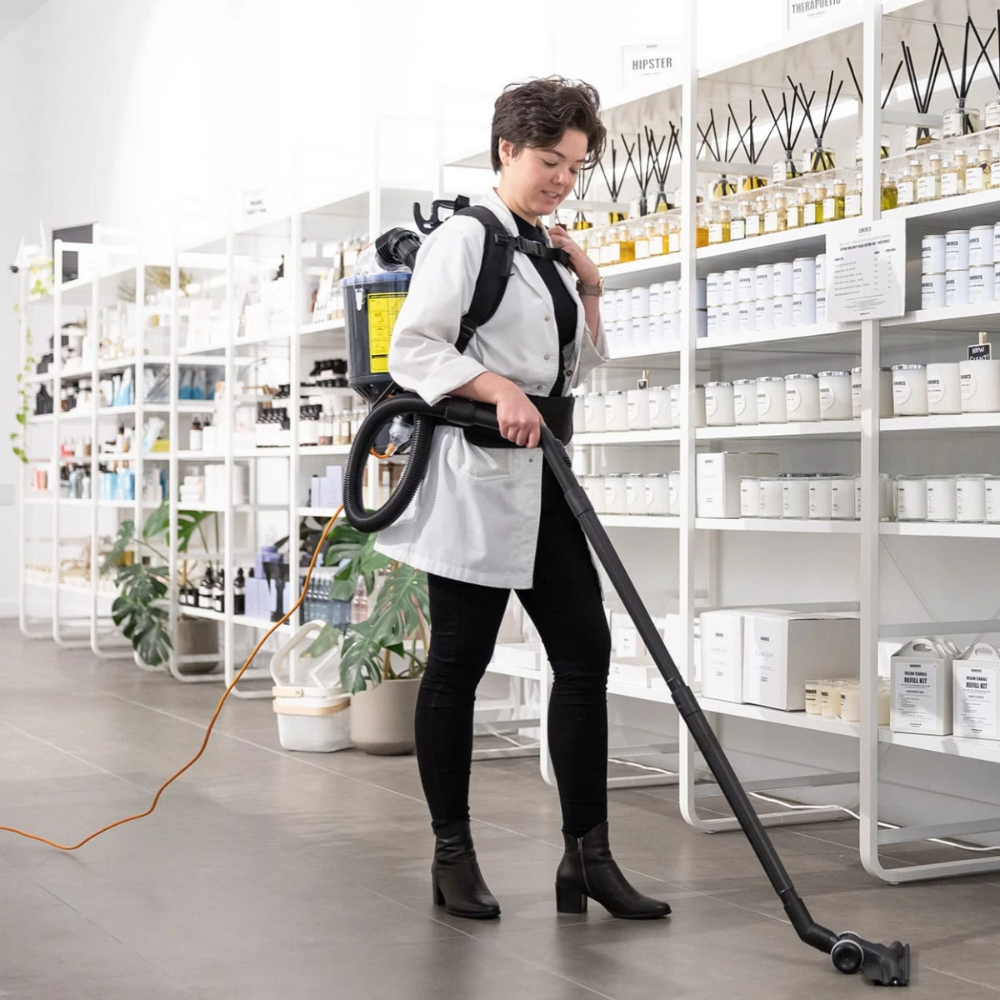
Mixed commercial vacuum fleet: the short answer
A mixed commercial vacuum fleet works when each format has a fixed job: backpacks for stairs, desks and tight routes, canisters for open floors and long shifts, and a wet-dry machine for spills and scrubber support. Size backpacks per operator, canisters per zone and wet-dry units per site, then standardise models within each format.
That last step matters most. Mixing formats is sensible; mixing five brands of backpack is not. Every extra model adds a bag, a filter, a hose cuff and a spare-parts line to manage. Freshway's backpack vacuum, canister and barrel vacuum and wet and dry vacuum collections cover all three roles, so a fleet can be built from a short list.
Why single-format fleets fail
A single format fails at the edges of the contract. Tennant's Australian guide to commercial vacuum types points backpacks at cubicles, stairways and tight quarters, canisters at facilities with several floor types, and wet-dry machines at moisture and soiled floors. No single machine covers all three.
The cost of forcing one format shows up as workarounds. Operators carry canisters up stairs. Backpacks fill too often on long open runs. Somebody uses a dry machine on a wet spill and the motor pays for it.
There is also a safety angle. SafeWork NSW's hazardous manual tasks guidance treats forceful pushing, pulling and lifting, repetitive movement and sustained posture as risk factors, and it defines sustained posture as holding a position for more than 30 seconds at a time. A canister lugged between levels every night, or a backpack worn on a route it was never chosen for, adds exactly those factors.
Ratio rules of thumb: how many backpacks per site
There is no published industry ratio, so build one from the roster rather than the floor plan. These starting points are planning assumptions to test, not benchmarks:
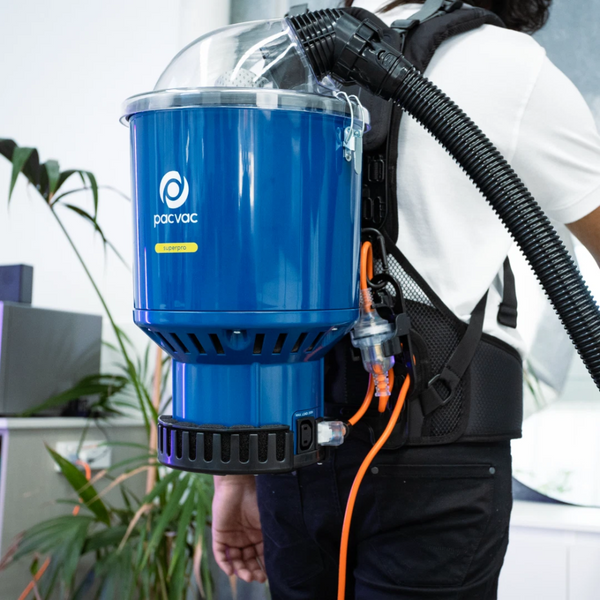
- Backpacks: one per operator who vacuums stair, desk or tight-room routes on the busiest shift. A backpack is worn, so harness fit makes it personal kit.
- Canisters: one per open-floor zone that is vacuumed at the same time, shared across shifts.
- Wet-dry: one per site where spills, wet mopping or scrubber support happen weekly; otherwise one shared across nearby sites.
- Float spares: at least one spare per format per depot, adjusted once you have repair turnaround data.
So the answer to "how many backpacks per site" is the number of people vacuuming tight routes at the same time, plus cover. A site with three night cleaners on desk-heavy floors and one on a ground-floor foyer needs three backpacks and one canister before spares, not four of either.
Site audit worksheet
Run the same audit on every site before ordering. It takes about one walk-through per building and stops the fleet from being designed around the loudest site manager.
| Audit field | What to record | Points toward |
|---|---|---|
| Levels and stairs | Number of floors, fire stairs, lifts available after hours | Backpack |
| Desk density | Workstations or furniture per floor | Backpack |
| Open floor runs | Long corridors, foyers, retail floor, function rooms | Canister |
| Liquids | Spills, wet mopping, scrubber pick-up, wash bays | Wet-dry |
| Power points | Distance between sockets on each route | Cord length or cordless |
| Cleaning window | Day cleaning around occupants or night only | Noise and cordless options |
| Storage | Lockable cleaner's room, charging point, drain for emptying | Dedicated or shared machines |
The power-point row is often skipped and often decisive. The Pacvac Thrift 650 backpack lists an 18 m cord, while the Nilfisk VP300C canister and Nilfisk VL500 wet-dry list 10 m, so a site with sparse sockets may favour the longer lead regardless of format.

Shared stores vs dedicated machines
Dedicated machines stay on one site. Shared machines live in a depot or van and move to where they are needed. Most multi-site fleets need both.
Backpacks and the main canister on each site should stay dedicated, because they are used every shift and moving them daily invites damage and lost parts. Wet-dry machines are the natural shared asset: they are bulky, used less often, and a 35 L tank like the VL500's is wasted sitting in a cupboard that floods once a quarter. The trade-off is response time, so map which sites can wait a few hours for a shared machine and which cannot.
Consumables SKU control
Consumables are where a mixed fleet quietly gets expensive to manage. Each model carries its own bags and filters. On the Freshway product pages, the Pacvac Thrift 650 ships with SMS bags, the Pacvac Glide 300 with DUB031 disposable dust bags, the Numatic Charles CVC370 with HepaFlo bags, and the Nilfisk VL500 runs a washable PET filter instead of bags.
| Role | Machine | Capacity | Listed weight | Cord | Noise |
|---|---|---|---|---|---|
| Corded backpack | Pacvac Thrift 650 | 5 L | 4.8 kg | 18 m | 66 dB(A) |
| Cordless backpack | Makita VC008G | 2 L | 4.7 kg with battery | Battery | Not listed |
| Canister | Pacvac Glide 300 | 15 L | 5.8 kg | 18 m | 64 dB(A) |
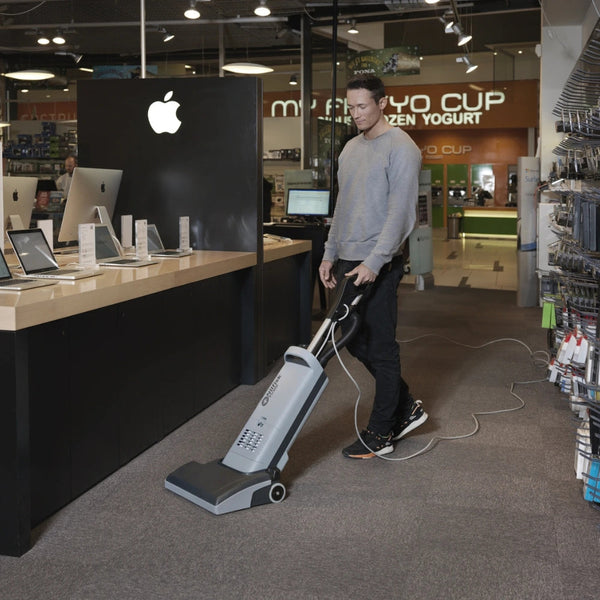
| Canister | Nilfisk VP300C | 10 L | 5 kg | 10 m | 69 dB(A) |
| Wet-dry | Numatic Charles CVC370 | 15 L dry, 9 L wet | 7.1 kg | Not listed | 61 dB |
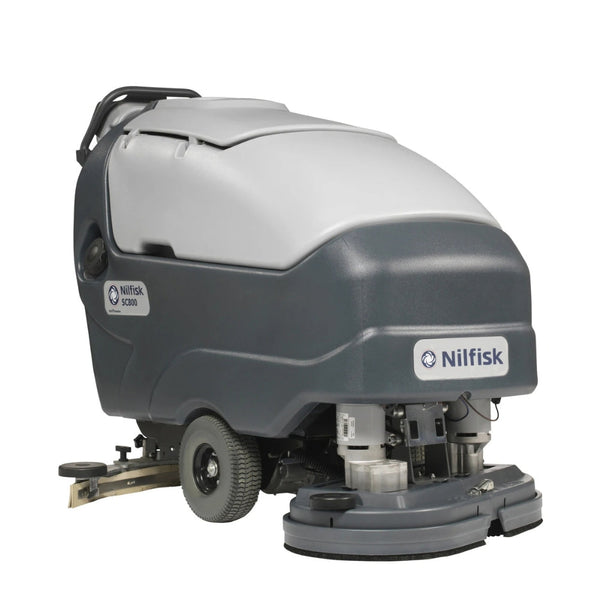
| Wet-dry | Nilfisk VL500 | 35 L | 11.5 kg | 10 m | 81 dB(A) |
Six machines, at least five different bag or filter lines. Pick one model per role, and keep a written list of the bag, filter and hose part each one uses, so a site supervisor can reorder without guessing. Before adding a second model to any role, check whether it shares consumables with the first.
Service intervals and test and tag
Corded vacuums are plug-in electrical equipment, and cleaning is hard on cords. SafeWork NSW says plug-in equipment used where conditions are likely to cause damage, such as moisture, dust or mechanical damage, must be regularly inspected and tested by a competent person, with AS/NZS 3760 setting out methods and frequency. A record must be kept until the next test, and a tag can serve as that record.
Put every machine's test date in the same register as its service history. Wet-dry machines deserve the closest attention because they meet water by design. Cordless machines swap cords for batteries: SafeWork NSW's lithium-ion battery guidance asks for chargers matched to the battery, storage in a cool, dry place and no unattended or prolonged charging, which shapes where a cordless backpack lives overnight.
For repairs, Freshway's service and repairs page lists repairs to backpack vacuums from Pacvac, Numatic, Nilfisk and Karcher, plus wet and dry vacuums, from its Sydney workshop, with pick-up and delivery for commercial clients.
Capex phasing and wholesale ordering
Few fleets are replaced in one purchase. Phase it by role:
- Replace the format causing the most workarounds first, usually backpacks on stair-heavy sites.
- Add shared wet-dry machines next, because one unit can serve several sites.
- Replace canisters as existing machines fail, moving to the chosen standard model each time.
- Retire orphan models whose bags and filters are used nowhere else.
For ongoing ordering, Freshway's B2B page describes a credit account application for businesses with an ABN or ACN, covering invoice-based purchasing with purchase order references and support for recurring supply and SDS documents. Its shipping policy says most orders are dispatched within 1–2 business days and that heavy machinery needs special handling, so allow extra lead time for wet-dry units and multi-machine orders. Check each product page for current pricing.

Case-style examples
These are illustrative scenarios, not client records.
Six suburban offices, night cleaning. Each building has two to four levels and dense desks. The fleet becomes one backpack per night cleaner, one canister per building for foyers and meeting rooms, and two wet-dry machines in the supervisor's van. Bag lines drop to three.
A shopping centre plus two medical clinics. The centre runs canisters on long open floors and keeps a wet-dry on site for food court spills. The clinics run quiet backpacks for daytime work around patients. The wet-dry is dedicated at the centre because spills cannot wait for a van.
A school cluster. Classrooms suit canisters with larger bags; stairwells and libraries suit backpacks. One wet-dry per campus covers wet-weather entries and canteen spills.
KPIs and risks to track
Measure the fleet, not just the machines. Useful numbers:
- Bag or tank changes per shift, by format and site.
- Machines out of service each month and average repair turnaround.
- Share of machines with a current test tag.
- Number of distinct consumable lines held.
- Operator feedback on weight and fatigue after a full shift.
Watch the noise column too. The SafeWork NSW noise code of practice sets the workplace exposure standard at 85 dB(A) averaged over eight hours. A machine listing 81 dB(A) is not automatically a problem, but it is the one to check when operators run it for long stretches. WorkSafe Victoria's cleaning injury hotspots page also suggests buying the quietest machines available, with vacuum cleaners and scrubbers given as examples, and names backpack vacuums among the mechanical aids it recommends for cleaning work.
The main risks are drift and orphans: sites buying their own one-off machines, and old models lingering with consumables nobody else uses.
Frequently asked questions
How many backpacks per site?
One for each operator vacuuming stair, desk or tight-room routes on the busiest shift, plus a spare per depot.
Should a wet and dry vacuum be part of every site's kit?
Only where spills or wet work happen weekly. Otherwise share one across nearby sites.
Is it worth standardising on one brand?
Standardise within each format first. One brand across all formats helps only if consumables actually overlap.
Do cordless backpacks belong in a mixed fleet?
Yes, for day cleaning or sparse power points, provided battery charging and storage are planned per site.
Next steps with Freshway
Run the audit worksheet on each site, total the backpacks, canisters and wet-dry units it points to, and shortlist one model per role. Send that list to Freshway if you want help checking consumables overlap or lead times before you commit to a phased order.