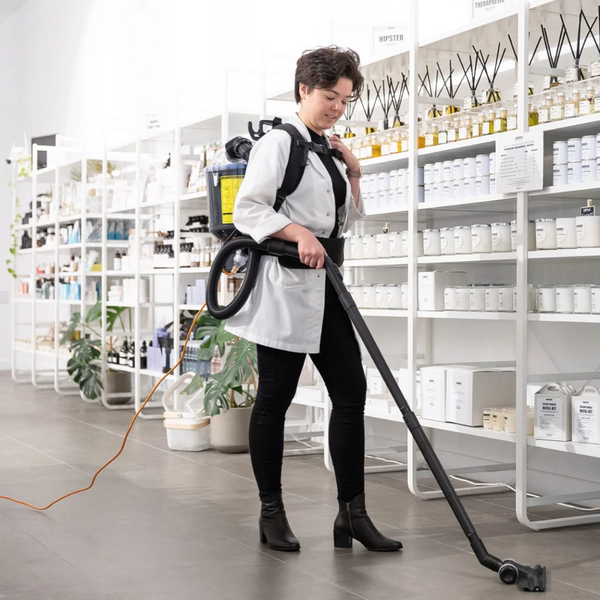
Canister and Barrel Vacuums for Large Commercial Floors
Plan cable reach, filter class and weight before buying for big floors.
Shop now
Picture a cleaner halfway down a long corridor on a large office floor when the vacuum suddenly stops pulling. The cord has run out, the plug has been yanked from the wall, and the nearest power point is another few metres away. Nothing is broken. The machine was simply chosen without anyone working out how far it can reach from one outlet.
That scene is why large floors are a different buying problem from small ones. On a big floor the limits are cable length, power supply and handling rather than suction alone. This guide works through it in order, with the arithmetic shown, so you can check any canister or barrel vacuum against your own floor plan before you buy.

Canister and barrel vacuums for large commercial floors: the short answer
A canister or barrel vacuum suits large commercial floors when you can map the power points and the machine's cable covers the gaps between them. Work out reach per outlet, current draw, filtration class and weight, in that order. Add a backpack only for stairs and tight spaces.
The six steps below follow that order. Freshway's own guide to barrel and canister vacuums covers the product types in general. This article is about sizing them to a floor.
Step 1: Measure the floor and mark the power points
Walk the route you clean, not the floor plan. Note where each power point is, how long the longest uninterrupted run is, and where doorways, corners and fire doors force the cord to bend. A cord rarely runs in a straight line, so every turn takes length off the usable reach.
Also note what is on the floor. Carpet, vinyl and sealed concrete all call for different tools, and a floor with a lot of fine dust or construction fallout changes the filtration question in Step 4. Write all of it down before you open a catalogue.
Step 2: Work out how far one outlet reaches
The simplest ceiling on reach is the cable. If you plug in at the middle of a straight corridor, the machine can travel one cable length each way, so the corridor length covered from one outlet is at most twice the cable. The real figure is lower because of corners and doorways, and the hose and wand add a little extra on the working end.
Using the cable lengths listed on Freshway's product pages, the table shows the maximum corridor length per outlet and how many outlets a 120 m corridor needs. For example, 120 ÷ 36 is 3.3, which rounds up to 4.
| Machine | Listed cable | Corridor per outlet (2 × cable) | Outlets for 120 m |
|---|---|---|---|
| Pacvac Glide 300 | 18 m | 36 m | 4 |
| Kärcher T 15/1 | 15 m | 30 m | 4 |
| Nilfisk GD930 PRO HEPA S2 | 15 m | 30 m | 4 |
| Kärcher T 10/1 Adv | 12 m | 24 m | 5 |
| Numatic Henry HVR200 | 10 m | 20 m | 6 |
The gap between 4 and 6 outlets is the number of times someone stops, unplugs and walks to the next point. On a long corridor that adds up over a shift, so cable length is worth a line in the buying brief. The Numatic WVD570 is not in the table because its page does not list a cable length.

Step 3: Check the current and the circuit
Current in amps is power in watts divided by voltage. At 240 V, a 1,300 W machine draws about 5.4 A (1,300 ÷ 240), an 800 W machine about 3.3 A, and a 620 W machine about 2.6 A. A standard 10 A power point supplies up to 2,400 W, so a single canister vacuum is well inside it. Two machines or a vacuum plus a floor machine on the same circuit may not be.
The one to watch is the Numatic WVD570. Its page lists 2,400 W total from twin motors, which is 10.0 A at 240 V (2,400 ÷ 240) and uses the whole rating of a standard outlet. The product pages list wattage but not plug rating, so confirm the plug and the circuit on the machine's data plate before you plan a route around it.
Plug-in equipment that works in damaging conditions needs regular checking. SafeWork NSW says it must be inspected and tested by a competent person, using AS/NZS 3760 for the methods and tagging, with a record that includes the date of the next test. A cord that is dragged across thresholds all night is the kind of equipment that guidance has in mind.
Step 4: Choose filtration for the dust you actually have
For ordinary office and retail dust, a filtered commercial canister is the normal choice. For hazardous dust, the class of the machine matters more than the filter on it. WorkSafe Queensland's guidance on industrial vacuum cleaners and hazardous dust sorts machines into L, M and H classes under AS/NZS 60335.2.69, and notes that HEPA does not mean H-class.
The same document says domestic-rated vacuums, even with HEPA filtration, are not guaranteed to give suitable protection, and that an L-class machine cannot be upgraded to M or H by fitting a better filter. It also states an H-class vacuum is required for respirable crystalline silica in the stone benchtop industry, and that both M and H-class machines are accepted for construction dust containing it.
So a vacuum listed with a HEPA filter, such as the Nilfisk GD930 PRO HEPA S2, is a filtration product, not automatically a hazardous-dust product. If your floors carry silica, lead or similar dust, look at Freshway's hazardous dust vacuums and check the class marking rather than the filter name.
Step 5: Decide where wet pickup fits
Most large sites eventually need one machine that handles liquid. Tennant Australia describes wet-dry vacuums as machines that can pick up wet and dry messes and help speed floor stripping and refinishing. In a fleet, that role usually goes to one heavier machine rather than every canister.
The Numatic WVD570 is an example: it lists a 23 L dry capacity, a 15 L wet capacity, 80 L/s airflow and 15.8 kg. That weight is the trade-off. Freshway's wet and dry vacuums range shows the alternatives.

Step 6: Weight, noise and handling
The listed weights for the dry canisters run from 5.8 kg (Pacvac Glide 300) to 8.1 kg (Kärcher T 15/1 and Numatic Henry HVR200). The wet and dry WVD570 is 15.8 kg. SafeWork NSW counts carrying, pushing and pulling, and repetitive movement among the causes of hazardous manual tasks, so stairs and long drags are where the heavier machines need a plan.
Noise matters for day cleaning. The listed levels range from 52/48 dB(A) on the Nilfisk GD930's two speeds to 72 dB on the Henry HVR200. All the listed levels are below the 85 dB(A) eight-hour exposure standard described in SafeWork NSW's noise code of practice, though lower numbers are easier on occupants.
SafeWork NSW's slips, trips and falls guidance lists enough power outlets to keep cords off floors as a design control, and loose cords and cables as a cause. If the outlet count is the problem, flag it rather than live with a cord across the corridor.
Six Freshway-listed machines side by side
The table collects the figures from each product page. Check each page for current pricing. Amps are calculated from the listed watts at 240 V. "Not listed" means the product page does not give the figure.
| Machine | Listed power | Current at 240 V | Capacity | Airflow | Weight | Noise |
|---|---|---|---|---|---|---|
| Pacvac Glide 300 | 1,300 W | 5.4 A | 15 L | 38 L/s | 5.8 kg | 64 dB(A) |
| Kärcher T 15/1 | 800 W | 3.3 A | 15 L | 61 L/s | 8.1 kg | 62 dB(A) |
| Nilfisk GD930 PRO HEPA S2 | 760 W | 3.2 A | 15 L | not listed | 8 kg | 52/48 dB(A) |
| Kärcher T 10/1 Adv | 1,100 W | 4.6 A | 10 L | 61 L/s | 6.5 kg | 59 dB(A) |
| Numatic Henry HVR200 | 620 W | 2.6 A | 9 L | 42 L/s | 8.1 kg | 72 dB |
| Numatic WVD570 (wet and dry) | 2,400 W | 10.0 A | 23 L dry, 15 L wet | 80 L/s | 15.8 kg | not listed |
Airflow figures are the makers' own listings and are not directly comparable across brands without the same test method, so use them to compare within a brand rather than across.
When to add a backpack, or something wider, to the fleet
Tennant Australia's vacuum selection guide says backpack models suit tight quarters such as cubicles, stairways and under furniture, while canister vacuums on wheels suit facilities with multiple floor types and can get under desks. It describes wide-area vacuums as the machines for large spacious areas such as airports, ballrooms and broad hallways.
The practical reading for a big site is a mix. Use canisters for mixed floor types, a backpack from Freshway's backpack vacuum range for stairs and congested rooms, and check whether the largest open areas justify a wider machine. If most of your floor is open and carpeted, a canister may not be the productivity answer at all.
Frequently asked questions
How long should the cable be on a commercial canister vacuum?
Long enough to cover the gaps between your power points. A corridor length per outlet of twice the cable is the ceiling, so an 18 m cable covers up to 36 m and a 10 m cable covers up to 20 m. Subtract allowance for corners and doorways.
Is a HEPA filter enough for construction dust?
Not by itself. WorkSafe Queensland says HEPA does not mean H-class, and that an L-class machine cannot be upgraded to M or H by adding a better filter. For silica or other hazardous dust, check the class marking on the machine.
Can I run a canister vacuum on a standard 10 A outlet?
Usually yes. A standard outlet supplies up to 2,400 W at 240 V, and most canisters listed here draw between 2.6 A and 5.4 A. The Numatic WVD570 at 2,400 W is the exception, as it uses the full 10 A, so check its plug and circuit.
Do commercial vacuums need testing and tagging?
Often, yes. SafeWork NSW says plug-in equipment used where it can be damaged must be inspected and tested by a competent person using AS/NZS 3760. Frequency depends on your workplace, so check with your regulator or electrician.
Next steps with Freshway
Take the floor plan, the route and the power points, run the three numbers in this guide, and shortlist two or three machines from the canister and barrel vacuums range. Send the shortlist to Freshway for a second look. Businesses that buy regularly can also ask about a trade account on the B2B dealer page.