Upright and Stick Vacuums vs Backpack and Canister in Commercial Sites
Carpet runs want a brush, broken-up floors want a backpack, sticks only spot clean.
Shop now
Halfway along the second-floor corridor of a 60-room hotel, the stick vacuum starts to beep. Its dust capsule has already been emptied twice, and the corridor carpet still looks flat and grey where the brush has only skimmed it. The cleaner has four floors to go and one battery. Nothing is broken; the machine is simply doing a commercial job it was never sized for.
That is the real question behind upright, stick, backpack and canister comparisons on commercial sites. This guide works through each format as a buyer's checklist, using specifications from Freshway product pages, so you can decide which one leads on each site and which ones support it.
Upright vs backpack commercial vacuum: the short answer
Choose an upright where wide runs of wall-to-wall carpet need a powered brush to lift soil and groom the pile. Choose a backpack where stairs, desks and tight rooms dominate. Use canisters for mixed floors and larger dust loads, and keep stick vacuums for quick spot cleans, not full commercial routes.
Freshway groups these formats in separate ranges: upright and stick vacuums, backpack vacuums and canister and barrel vacuums. The table below compares representative machines from each.
| Machine | Format | Width or tool | Capacity | Listed weight | Power | Noise |
|---|---|---|---|---|---|---|
| Nilfisk VU500 15 inch | Corded upright | 380 mm brush | about 3.5 L | Not listed | 1,000 W, 10 m detachable cable | Not listed |
| Karcher CV 38/2 Adv | Corded upright | 380 mm brush | 5.5 L | 9.5 kg | 850 W suction plus 150 W brush, 12 m cable | Not listed |
| Karcher CV 30/2 BP | Cordless upright | 300 mm brush | 3 L | 6.5 kg | 36 V, up to 67 min in eco mode with 7.5 Ah battery | 64 dB(A) |
| Makita CL003G | Cordless stick | Floor nozzle | 440 mL | 1.9 kg with BL4025 | 40V Max | 65 dB |
| Pacvac VELO corded | Backpack | Floor tool | 2.5 L | 3.9 kg | 900 W, 18 m cord | 65.3 dB(A) |
| Karcher T 10/1 Adv | Canister | Floor tool | 10 L | 6.5 kg | 1,100 W, 12 m cable | 59 dB(A) |
Where an upright still fits
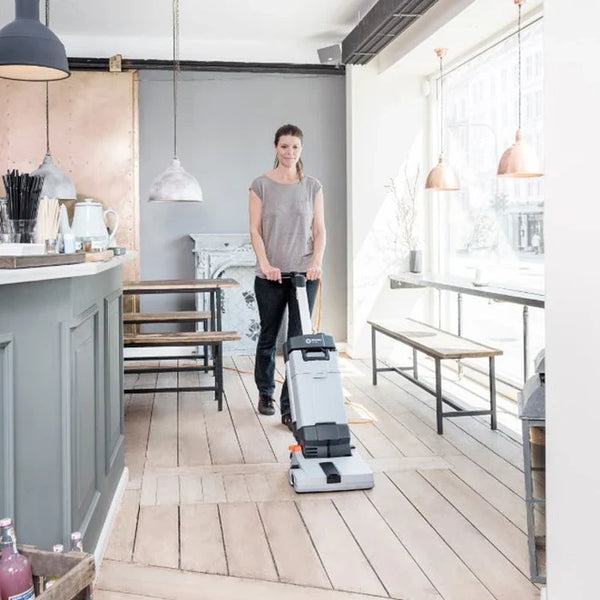
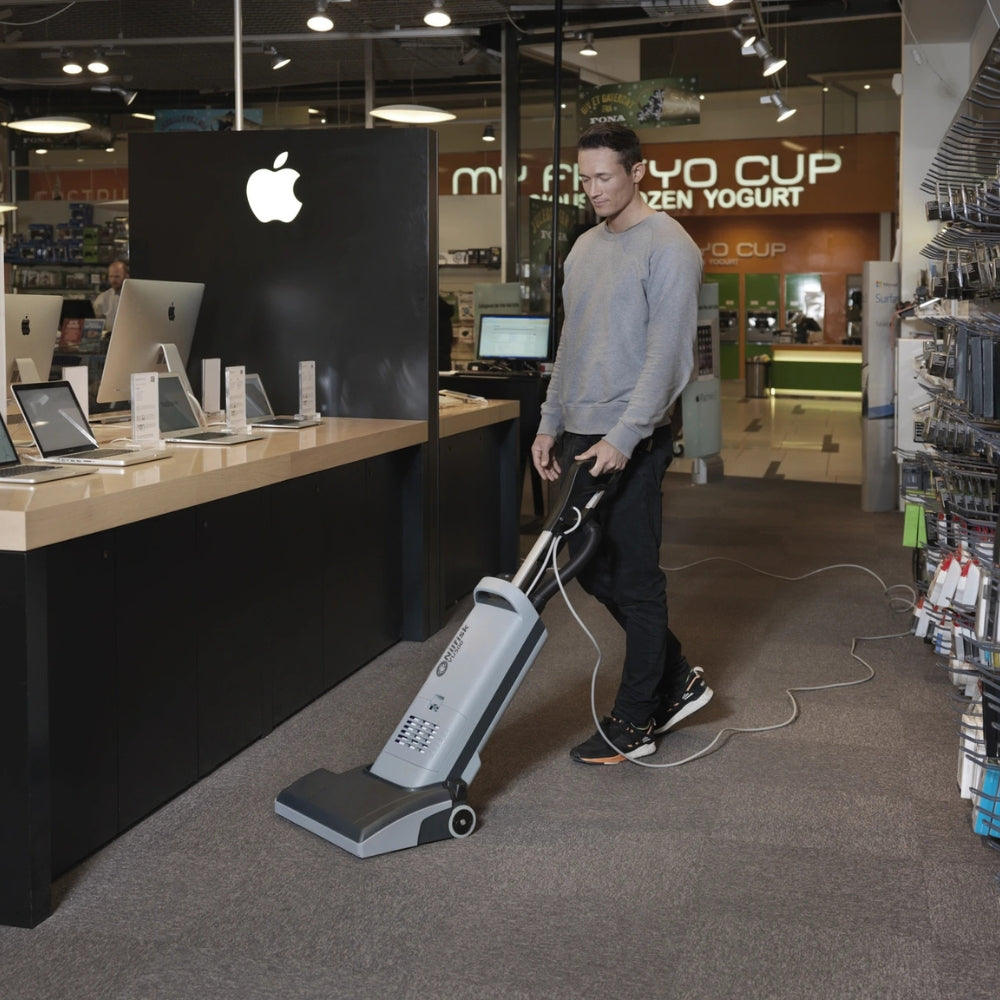
Uprights earn their place on carpet. Nilfisk Australia describes its commercial uprights as built for medium and low-cut carpets, with an electric rotating brush for a deeper clean, and points them at hotel lobbies and hospitals. Tennant Australia places single-motor uprights in classrooms, reception areas, offices and hotel rooms, and dual-motor uprights in high-traffic lobbies where the machine both extracts dirt and grooms the carpet.
Check these before choosing an upright:
- Most of the route is wall-to-wall carpet, not mixed floors.
- Rooms are open enough to push a 300 to 380 mm head in long passes.
- Stairs are few, or a second machine covers them.
- Brush maintenance is planned; the VU500 page lists tool-free brush removal and a detachable cable that can be swapped on site.

Stick vacuum limits on commercial sites
A stick vacuum fails commercially for three predictable reasons: capacity, runtime and brush. The Makita CL003G lists a 440 mL capsule, and the Karcher VC 6 Premium on Freshway's site lists 0.8 L and is described as a Home and Garden Series machine. Compare that with 2.5 L in a backpack or 10 L in a canister, and a full route means repeated stops.
Runtime is the second limit. Battery figures are maximums, usually in eco mode, and they fall on carpet. The third is the head: many sticks carry a narrow nozzle, so the route takes more passes.
Sticks are still useful. A commercial-grade stick such as the Nilfisk VU200, listed at 2.97 kg with up to 60 minutes of runtime, is a good spot-clean tool for reception desks, lift lobbies and daytime touch-ups. Just do not make it the main machine on a full night route.
Backpack strengths
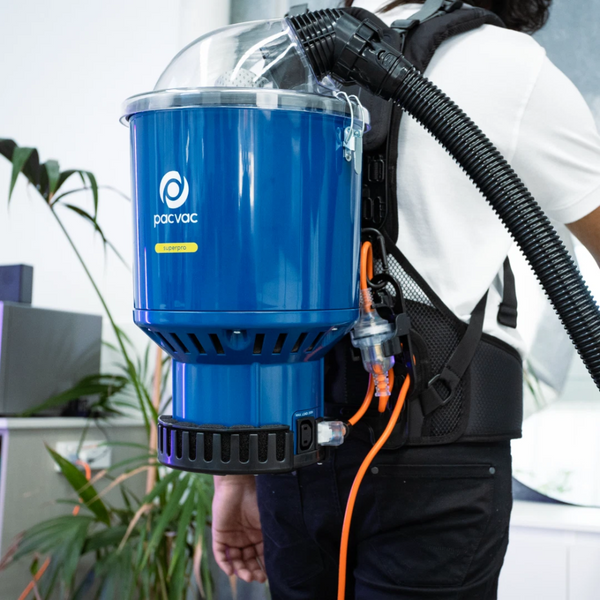
Backpacks win where the route is broken up. Tennant notes that a backpack removes the repetitive back-and-forth motion of an upright and handles cubicles, stairways and tight quarters, but adds that with only a floor nozzle it may not remove carpet soil as well as an upright's revolving brushes.
That trade-off is the whole comparison. SafeWork NSW counts a movement as repetitive when it is performed more than twice a minute, which describes upright pushing on a long carpet route. A backpack shifts the load to the hips and shoulders instead, so harness fit and listed weight matter. WorkSafe Victoria's cleaning injury hotspots page lists backpack vacuum cleaners among the mechanical aids it recommends.

Canister strengths
Canisters suit mixed floors and heavier dust loads. Tennant describes them as useful in facilities with several floor types, able to clean under desks with small heads, and usually quieter than uprights. The Karcher T 10/1 Adv in the table lists 59 dB(A) and a 10 L container, the lowest noise figure and the largest capacity among the six machines in the table.
The cost is towing. A canister has to be pulled around corners and carried between levels, which is why it rarely leads on stair-heavy sites.
Hybrid sites: running more than one format
Most commercial sites are hybrids. A hotel has carpeted corridors, tiled lobbies and stairwells. An office floor has open carpet, a kitchen and a fire stair. Work through these steps:
- Map each area by floor type: carpet, hard floor or mixed.
- Mark stairs, desk clusters and tight rooms.
- Give the largest carpet area to an upright and the broken-up areas to a backpack.
- Use a canister where floors change often or dust loads are high.
- Add a stick only for daytime spot cleaning.
For more on individual formats, Freshway's vacuum cleaner guide hub collects the related buying guides.
Spec traps on vacuum spec sheets
Read every spec sheet against this checklist:
- Watts are not cleaning. The CV 38/2 splits 850 W of suction from 150 W for the brush; compare airflow and brush width, not total watts.
- Runtime is a maximum. The CV 30/2 BP figure of up to 67 minutes is quoted in eco mode with a 7.5 Ah battery.
- Weight may exclude the battery. Makita lists the CL003G at 1.1 kg skin-only and 1.9 kg with a battery.
- Noise units vary. Some pages give dB(A), others plain dB, so compare with care.
- HEPA is a filter, not a machine class. Ask for test documentation if a site specification names a class.
Cost notes
Check each product page for current pricing; the running costs are where formats differ. Uprights add brush rolls and sometimes belts. Cordless machines add batteries, chargers and charging space; SafeWork NSW asks for chargers designed for the battery and no unattended charging. Corded machines need regular inspection and testing as plug-in equipment, which SafeWork NSW links to AS/NZS 3760. Every format adds bags and filters, so fewer models means fewer consumable lines.
Repairs count too. Freshway's service and repairs page lists vacuum cleaner and backpack vacuum repairs at its Sydney workshop, with pick-up and delivery for commercial clients.
Decision table: which option fits which site
| Site | Lead format | Support format | Why |
|---|---|---|---|
| Hotel corridors and rooms | Upright | Backpack for stairs | Long carpet runs need a powered brush |
| Multi-level offices | Backpack | Upright for open carpet | Desks, stairs and tight rooms |
| Schools and classrooms | Canister or upright | Backpack for stairwells | Mixed floors and larger dust loads |
| Retail and lobbies, day cleaning | Cordless upright | Stick for spot cleans | No cords across public walkways |
| Clinics and aged care | Quiet canister | Backpack | Noise and mixed floors |
One last check on noise. The SafeWork NSW noise code of practice sets the workplace exposure standard at 85 dB(A) averaged over eight hours. The machines in the table list well below that, but day-cleaning sites usually care about the occupants' comfort long before the limit.
Frequently asked questions
Is an upright or a backpack better for office carpet?
Upright for large open carpet; backpack where desks and stairs break up the route.
When does a stick vacuum fail on a commercial site?
When the route needs more capacity, runtime or brush width than it has.
Can one vacuum cover a whole hotel?
Rarely well. Corridors suit an upright and stairs suit a backpack, so plan for two formats.
Are cordless uprights worth it for day cleaning?
Often, because they remove cords from walkways. Plan batteries for the full route.
Next steps with Freshway
Map your site by floor type, stairs and cleaning window, choose a lead format from the decision table, then shortlist one machine for each role. Freshway can help compare consumables and battery options across the models you shortlist before you order.