Retail and Cinema Vacuuming: Format Choice for Soft Floors
Backpacks for steps and seating, canisters for corridors, cords off public walkways.
Shop now
The last session has finished. The aisle carpet between the seat rows is a crunch of popcorn, the foyer tiles are tacky near the candy bar, and the canister the crew brought in has already caught on the step edges of the tiered seating twice. Next door, in the shopping centre, a backpack operator is working the carpeted fashion tenancies after close, with the cord running back across a tiled mall walkway that security staff still use. Neither crew has a bad machine. Both have the right machine in the wrong place.
This guide treats retail and cinema vacuuming as an implementation job, looked at from the engineering side: where soil lands, how each format handles floor transitions, what public hours allow, how to keep cords and machines safe in public areas, and how to roll out a fleet that centre management, tenancies and cinemas can share.
Retail cinema commercial vacuum: the short answer
For retail and cinema soft floors, use backpack vacuums for steps, tiered seating, fitting rooms and tight fixtures, and canisters for long carpeted corridors, foyers and back-of-house areas where capacity matters. Pick quiet machines for trading hours, keep cords off public walkways, and share machines across the site through a simple booking system.
Foot traffic patterns: where soil actually lands
Retail and cinema floors do not soil evenly. Grit and moisture come in on shoes and drop where people first step from hard floors onto carpet: mall-to-tenancy thresholds, cinema entries and the first stretch of each corridor. Food debris collects in queue lines, around candy bars and along the seat rows themselves, where it is trodden into the pile between sessions.
From an engineering point of view, that turns the site into zones with different duty cycles rather than one big floor:
- High-frequency zones: entrances, thresholds, queue lines and cinema aisles. Short, repeated passes, often in limited windows.
- Medium-frequency zones: tenancy sales floors and foyers. Larger areas, cleaned daily.
- Low-frequency zones: offices, staff rooms and back-of-house corridors.
Each zone gets a format. Tight, stepped or cluttered zones suit a backpack because the machine travels with the operator. Open zones with heavier debris suit a canister, which can stay put while the hose does the reaching and holds more before emptying.
Carpet vs hard transition
Retail floors change surface constantly: tiles to carpet, carpet to vinyl, entry matting to polished concrete. SafeWork NSW lists changes in flooring or traction type, such as concrete to carpet, along with loose cords and cables, among common sources of slip and trip risk. Those same transitions are where vacuums snag.
The floor tool is the first fix. WorkSafe Victoria's vacuuming guidance matches heads to surfaces: bristles extended for low carpets or hard floors, smooth heads for thick carpets, and combined heads for both. A combination head saves tool changes on mixed floors, while a smooth head is worth carrying for cinemas with thicker pile.
The format matters at each threshold too. A backpack operator simply lifts the floor tool over the edge. A canister has to roll across, so the same guidance recommends lightweight vacuum cleaners with functional castors; a machine that tips at every door strip will be dragged by the hose instead.
Working around public hours
Shopping centres typically split vacuuming into before opening, after close and spot cleaning during trading. Cinemas add short turnarounds between sessions, where an aisle and its seat rows must be cleared before the next audience walks in. Those short windows favour the format that moves fastest through stepped rows, which is usually a backpack.
Trading-hours work also brings noise into the selection. WorkSafe Victoria's cleaning injury hotspots page advises buying the quietest tools and machinery available and names vacuum cleaners as an example. Freshway lists the Nilfisk VP300 HEPA TC canister at 57 dB(A), the Nilfisk GD5 HEPA backpack at 62 dB(A) and the Pacvac Thrift 650 backpack at 66 dB(A). Freshway's guide to quiet commercial vacuums for day cleaning covers how to weigh those figures against filtration and reach.

Machine visibility and cords in public areas
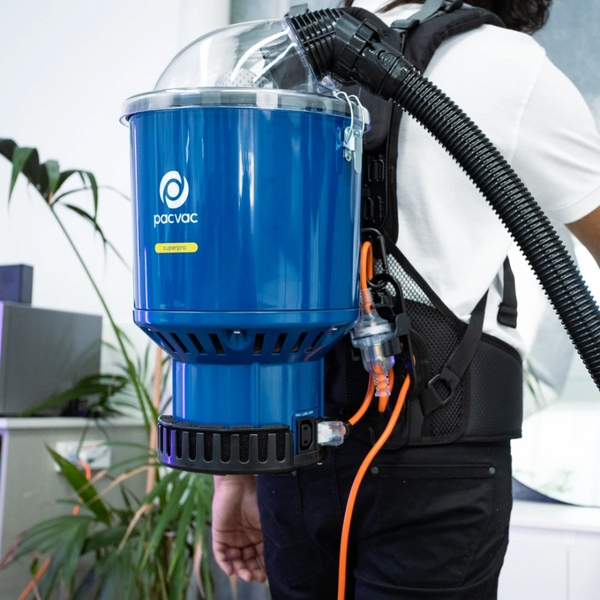
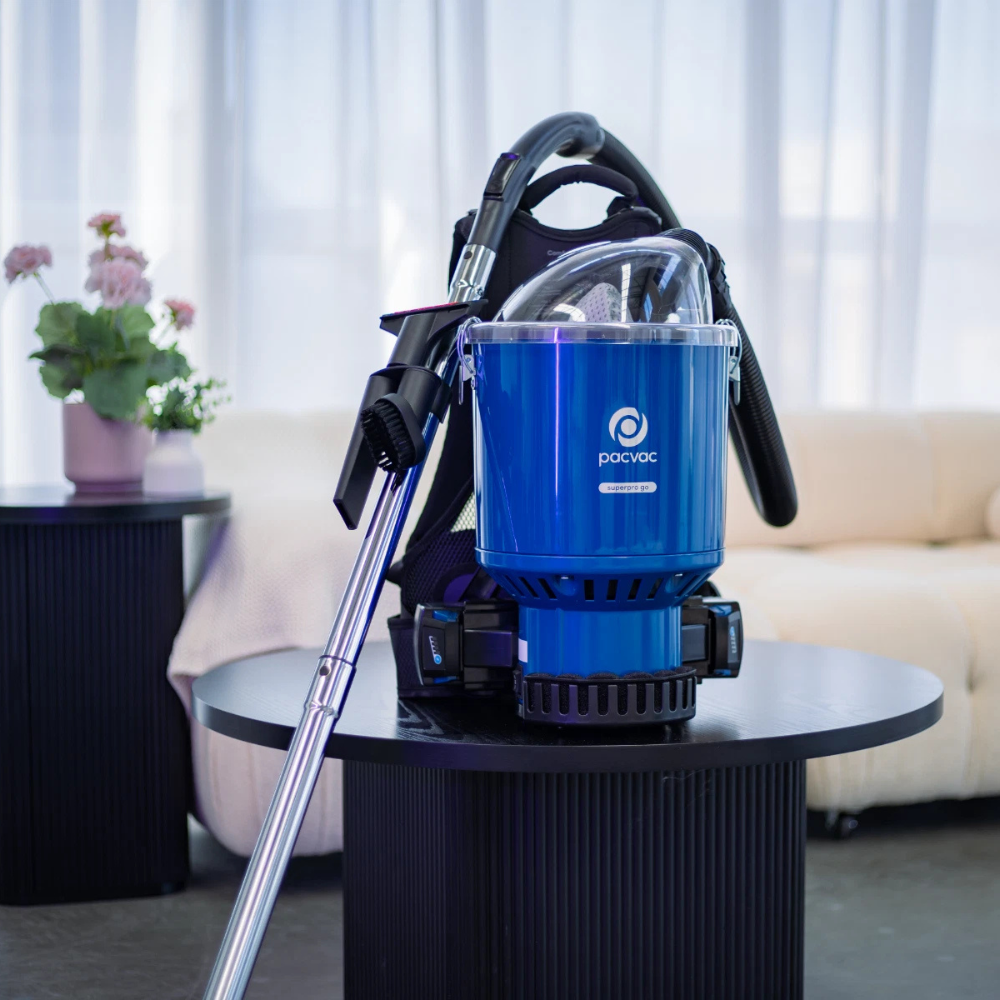
During trading hours, the cord is the hazard customers notice last. WorkSafe Victoria's hotspots guidance suggests installing more power points to eliminate long power leads, and where that is not possible the practical answers are shorter runs, cords kept behind the operator, or no cord at all. Freshway's listing pitches the Pacvac Superpro Go as removing cord trip hazards, and lists standard and boost suction modes plus an Ecoharness with three height settings.
Where corded machines stay in service, make them easy to see and easy to fix. Freshway lists the VP300 HEPA TC with a highly visible orange cable that is detachable, so a damaged lead can be swapped. Keep the electrical side current as well: SafeWork NSW requires plug-in equipment to be regularly inspected and tested by a competent person where its normal use is likely to damage it, with AS/NZS 3760 setting out the methods and frequency. Cords dragged across mall floors and shut in doors are a good reason to keep tags current.
Machine visibility is also about appearance. A compact machine, worn or parked close to the operator, looks like routine maintenance; a canister and long lead stretched across a shopfront looks like an obstacle.
Fleet sharing between centre, tenancies and cinema
Large retail precincts often have several cleaning teams working the same building. Sharing machines cuts duplication, but only with some structure:
- A machine on each level. WorkSafe Victoria suggests a vacuum cleaner on each level of a multi-level building, or in each area to be vacuumed, rather than carrying one between floors.
- Fewer models. Standardising on a small number of machines keeps bags, filters and tools interchangeable within each model.
- A sign-out sheet. Record who has each machine, its zone and any faults reported.
- A charging point for cordless backpacks, with batteries rotated so one is always charged.
Lifting deserves attention in the shared plan. SafeWork NSW lists lifting or moving heavy objects, and slips and trips, among the common causes of injury in retail, and its hazardous manual tasks guidance gives replacing heavy items with lighter ones as a control. Store machines where they are used, not in a basement cage two lifts away. Freshway's shop by industry page groups supplies for office and retail sites.
Spec tips for soft-floor machines
Read spec sheets for the fields that matter in public soft-floor areas. The examples are taken from Freshway's own listings.
| Spec field | Why it matters in retail and cinema | Example from Freshway listings |
|---|---|---|
| Power source | Cords crossing public walkways | Pacvac Superpro Go: cordless, standard and boost modes |
| Noise, dB(A) | Work during trading hours | Nilfisk VP300 HEPA TC: 57 dB(A); Pacvac Thrift 650: 66 dB(A) |
| Capacity | Popcorn and foyer debris volumes | VP300 HEPA TC: 10 L dust bag; Superpro Go: 5 L |
| Cord length and type | Reach from power points, damaged leads | Nilfisk GD5 HEPA: 15 m detachable; Pacvac Superpro 700: 18 m |
| Filtration | Dust released into occupied spaces | VP300 HEPA TC and GD5 HEPA: H13 HEPA filter |
| Weight | Stairs and tiered seating | GD5 HEPA: 4.4 kg; VP300 HEPA TC: 5 kg |

Mistakes that undo the format choice
- Pulling a canister up tiered seating. WorkSafe Victoria flags carrying vacuums upstairs and suggests light backpacks with lumbar support for stairways.
- One machine for the whole centre. It ends up carried between levels and fought over by teams.
- Cords across open walkways in trading hours. Re-plan the route or use a cordless machine.
- Using a dry vacuum on spilled drinks. Freshway lists the VP300 HEPA TC as a dry machine; liquids need a wet-rated machine.
- Letting bags fill up. WorkSafe Victoria advises emptying vacuums frequently to reduce weight.
Rollout checklist
- Walk the site with the cleaning lead and mark high-, medium- and low-frequency zones.
- Assign a format to each zone: backpack for stepped and cluttered areas, canister for open runs and back-of-house.
- Map power points and cord routes, and flag zones that need a cordless machine.
- Short-list machines against the spec table and trial them in a live area.
- Confirm test and tag status, then induct each operator on the machines they will use.
- Set up the sign-out sheet, storage on each level and a charging point.
- Review after the first month with operator feedback, and adjust zones or machines.
Common objections, answered
Can one canister cover a whole shopping centre?
It can reach a lot of floor, but it has to be carried between levels and pulled up steps. WorkSafe Victoria suggests a vacuum on each level and light backpacks for stairways.
Is a backpack too noisy for trading hours?
Not necessarily. Freshway lists the Nilfisk GD5 HEPA backpack at 62 dB(A). Check the listed figure for each machine and trial it in the space before committing.
Why not use cordless machines for everything?
Battery machines take cords off public walkways, but runtime and bin size limit them on large foyers. Many sites pair cordless backpacks with corded canisters for long runs.
Does test and tag apply to vacuums in shops?
SafeWork NSW requires regular inspection and testing of plug-in equipment where normal use is likely to damage it. AS/NZS 3760 sets out the methods and frequency.
Next steps with Freshway
Zone the site first, then choose machines for each zone. Compare cordless and corded options in the backpack vacuum range, capacity and noise figures in the canister and barrel vacuum range, or browse all commercial vacuum cleaners. Check each product page for current pricing, stock and Australia-wide delivery details.