Office and Strata Cleaning Supplies: What Buildings Actually Reorder
Liners and paper are what buildings actually reorder. Get the gauge right once.
Shop now
Office and strata cleaning runs on consumables, not on machines. The recurring spend is paper, soap, liners and cloths, and the decisions that control it are dispenser capacity and cleaning frequency rather than product choice.
Consumables carry the cost, so spec them first
In offices and strata buildings the cost is dominated by consumables, so specify dispensers and consumable capacity first and cleaning equipment second. A machine is bought once; paper, soap and liners are bought every month for the life of the contract, and their capacity determines the recurring spend.
That is the reverse of how most specifications are written, and it is why buildings end up with expensive equipment and unpredictable consumable spend.
Prices are Freshway catalogue prices as at 16 September 2026 and are subject to change. Confirm the current price, and whether GST applies, before quoting.

What makes office and strata cleaning different
- Occupied during cleaning. Most work happens in business hours, around people.
- Consumable-dominated cost. Paper, soap and liners outweigh equipment spend over a contract term.
- Shared facilities. Strata buildings have common areas with no single owner of the cleaning standard.
- Appearance is the metric. Unlike healthcare or food premises, the audit is visual.
The chemical kit
| Product | Use | Price |
|---|---|---|
| Neutral floor cleaner, 5 L concentrate | All routine floor cleaning | From A$42.00 |
| Multipurpose surface cleaner | Desks, partitions and general surfaces | From A$74.00 |
| Glass cleaner, 5 L concentrate | Glazed partitions, windows and doors | From A$42.00 |
| Agar toilet and bathroom cleaner spray, 750 mL | Washrooms | A$7.50 |
| Stainless steel cleaner | Lift doors, fittings and kitchenettes | From A$90.00 |
Glazed partitions are the office-specific consumable driver. An open-plan office with extensive internal glazing uses far more glass cleaner than the floor area alone suggests, and that should be counted before pricing a contract.
Equipment
| Equipment | Why it suits offices | Price |
|---|---|---|
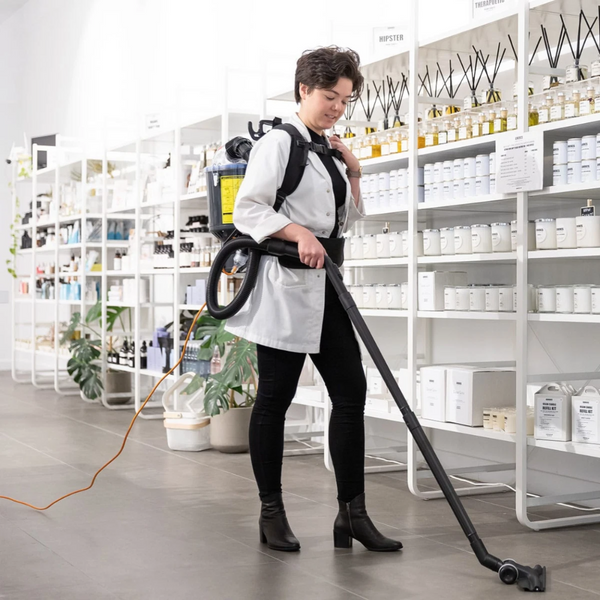
| Quiet backpack or canister vacuum | Daytime cleaning without disturbing occupants | From A$339.00 |
| Flat microfibre mop | Fast, low-moisture coverage of open floors | From A$10.00 per refill |
| Cordless stick vacuum | Spot work between scheduled cleans | From A$169.00 |
| Cleaning trolley with lockable compartments | Keeps equipment supervised in shared space | From A$30.54 |
| Wet floor signage | Wet floors in occupied circulation areas | From A$20.00 |

Washrooms: where the recurring cost sits
Office washrooms are lower traffic than public facilities, so the cost driver is refill labour rather than paper volume. Mini jumbo and centre-pull systems are the usual answer, because they reduce the number of interventions per washroom per week without requiring a full jumbo dispenser.
Where a building has multiple tenancies, standardise the dispensers across all floors. Mixed systems mean mixed consumables, and that is where stockholding and confusion both increase.
Strata common areas
Strata cleaning differs from office cleaning because the space is shared and the standard is agreed between owners rather than set by an occupier. Two practical consequences:
- Write the specification by area — lobby, lifts, corridors, stairwells, bin rooms, car park — rather than as one blanket standard.
- Bin rooms and car parks need their own equipment, because they are high-soil areas and should not share tools with the lobby.
Our waste management range covers the bin room side.
Pricing the recurring spend
- Consumables per occupant per week — the figure that makes a contract defensible.
- Refills per washroom per week — the labour driver.
- Glass and partition area, which is often omitted and then absorbed by the contractor.
- Periodic carpet extraction, priced separately from the daily round.
Sustainability and waste
Office and strata contracts increasingly include waste and sustainability requirements, which affect supplies in two ways: liner specifications change if the building separates waste streams, and dispenser choice affects the volume of packaging waste. Both are worth agreeing at tender rather than after.
Frequently asked questions
- What cleaning supplies do I need for my office?
- A neutral floor cleaner, a multipurpose surface cleaner, a glass cleaner and a washroom cleaner and descaler, plus the consumables: paper, hand soap, liners, cloths and mop heads. Consumables dominate the recurring cost, so dispensers should be specified before equipment.
- Where can I buy bulk cleaning supplies?
- From a commercial supplier on a trade account rather than a retail store, because bulk pricing, delivery frequency and continuity of the same product matter more than the headline unit price. We supply across Australia, with trade accounts for sites ordering on a cycle.
- What is a strata cleaner?
- A strata cleaner is a cleaning contractor engaged by an owners corporation to look after common property: lobbies, stairwells, lifts, bin rooms and car parks. This article covers the supplies that work consumes. Engaging the contractor is a services decision rather than a supply one.
- How should strata cleaning be specified?
- By area rather than as a single standard, because a lobby, a stairwell and a bin room need different frequencies and equipment. Bin rooms and car parks should have their own tools.
- Do I need different products for glazed partitions?
- A standard glass cleaner is suitable, but the quantity required is often underestimated in open-plan offices with extensive internal glazing. Count the glazed area before pricing a contract.
References
- SafeWork NSW — chemicals and other substances: labelling, storage and safety data sheets.
- NSW Environment Protection Authority — chemicals, including storage and disposal.
Specifying for a building?
Send us the floor areas, occupant count and washroom numbers, and we will build a supply list with a consumable forecast per occupant. See office supplies or ask our team.
This article is one section of the cleaning by industry guide, which covers what each kind of site actually buys.