Monthly Auto-Dose Calibration on Commercial Floor Scrubbers
Measure the water, measure the detergent, and check the ratio against the label.
Shop now
The night supervisor signs off a clean foyer. By mid-morning the tenant's facilities officer is on the phone: the tiles feel tacky, footprints are showing, and the recovery tank was full of foam again. The chemical has not changed and neither has the operator. What changed, slowly and without anyone noticing, is how much detergent the scrubber's dosing system is actually delivering.
How do you calibrate a floor scrubber auto-dose system each month?
Once a month, run a timed catch test: measure how much water and how much detergent the machine uses over a set period, divide one by the other, and compare the result with the label dilution. Clean filters first, adjust only through the approved control, retest, and record the before and after figures.
Freshway's existing guide to solution flow and chemical dosing on commercial scrubbers explains how gravity, pump and speed-linked systems work and what to check before buying. This article is the follow-on for buyers and supervisors who already own machines: a monthly check that proves the dose is still right.
Why dosing drifts
- Filters and lines partly block. Capital Equipment's floor scrubber quick fixes notes that a blocked solution filter can restrict water flow to the brush.
- Settings get changed. A dial turned up "for a dirty night" often stays there.
- The chemical changes. A new product or a thicker concentrate draws differently through the same system.
- Pumps and valves wear. Small changes in delivery add up over hundreds of tank-fulls.
- Operators top up by eye. On premix machines, a glug instead of a measured dose undoes any calibration.
Tools for a monthly check
- A graduated measuring cylinder or jug marked in millilitres.
- A marked bucket or the machine's tank graduations for water volume.
- A timer and a clipboard or phone form.
- The product label and current safety data sheet for the detergent.
- Gloves and eye protection as the SDS requires.
WorkSafe Victoria's page on safety data sheets says employers must hold an up-to-date SDS for hazardous products and make it available to workers. Keep a copy with the calibration kit, because the person measuring concentrate is the one most exposed to it.
Matching label dilution
Start from the label, not from habit. Freshway's listing for Agar Superforce describes a low-foam detergent suitable for autoscrubbers, with a dilution of 1:160 for light soil to 1:50 for heavy soil. For a 40 litre solution tank, that is about 250 mL of concentrate for light soil (40,000 ÷ 160 = 250) and roughly 800 mL for heavy soil (40,000 ÷ 50 = 800). Recompute for your own tank size and product.

On machines that dose from a separate detergent container, the same ratio applies to what the system draws. If a timed run uses 20 litres of water and 125 mL of detergent, the ratio is 20,000 ÷ 125 = 160, or 1:160. If it draws 250 mL for the same water, the ratio is 1:80: double the light-soil dose.
Running the catch test
- Clean the solution filter and check lines for kinks before measuring.
- Fill the solution tank to a marked level and, on separate-container systems, fill the detergent container to a marked level.
- Set the machine to the site's standard flow and dose settings and note them.
- Scrub a normal test area for a fixed time, such as ten minutes.
- Measure the water used by refilling to the mark from a measured bucket.
- Measure detergent used by refilling its container to the mark from the measuring cylinder.
- Divide water used by detergent used and compare with the label ratio.
- If it is outside tolerance, adjust through the approved control only, then repeat the test.
On premix machines without on-board dosing, the "test" is checking that operators measure the dose into each tank. Watch a fill, measure what goes in and compare it with the label.
Sticky floor and residue clues
Capital Equipment notes that overdosing creates excess foam that can fill the recovery tank and let moisture into the vacuum motor, leaves streaks even with good squeegee blades, and leaves floors sticky so they attract more soil. SafeWork NSW's page on slips, trips and falls lists slippery floor surfaces resulting from cleaning products or methods among common sources of risk. Treat complaints about tacky floors or foam as a prompt to run the catch test early.
Recording calibrations
| Field | Example entry |
|---|---|
| Machine and asset number | Walk-behind scrubber, unit 3 |
| Product and label ratio | Low-foam detergent, 1:160 light soil |
| Settings before test | Flow 2, dose 2 |
| Water and detergent used | 20 L and 125 mL in 10 minutes |
| Measured ratio | 1:160 |
| Action taken | None, or adjusted and retested |
| Tested by and date | Name, signature, date |
Keep the sheet with the machine's service log. Over a few months it shows whether a system is drifting steadily, which points to wear, or jumping, which points to settings being changed.
Pump wear symptoms
- The measured ratio drifts in the same direction month after month.
- Delivery is uneven: strong at the start of a tank, weak at the end.
- The pump runs but the detergent level barely moves.
- Visible leaks or crusted concentrate around fittings.
Those are service jobs rather than dial adjustments. Freshway's service and repairs team in Sydney works on floor scrubbers.
Training who may adjust dials
Limit adjustment to trained people and record every change. WorkSafe Victoria's injury hotspots for cleaning calls for scrubbing machines to be used properly and maintained in line with the equipment maker's specifications, and for employees to be trained in selecting and using mechanical equipment. A short sign-off for each operator should cover the label ratio, the catch test and who to call when it fails.
Labels also carry hazard information. SafeWork NSW's summary of chemicals and the GHS explains the classification and labelling system used for hazardous chemicals, so include pictograms and PPE in the same training.
Spec notes on dose systems
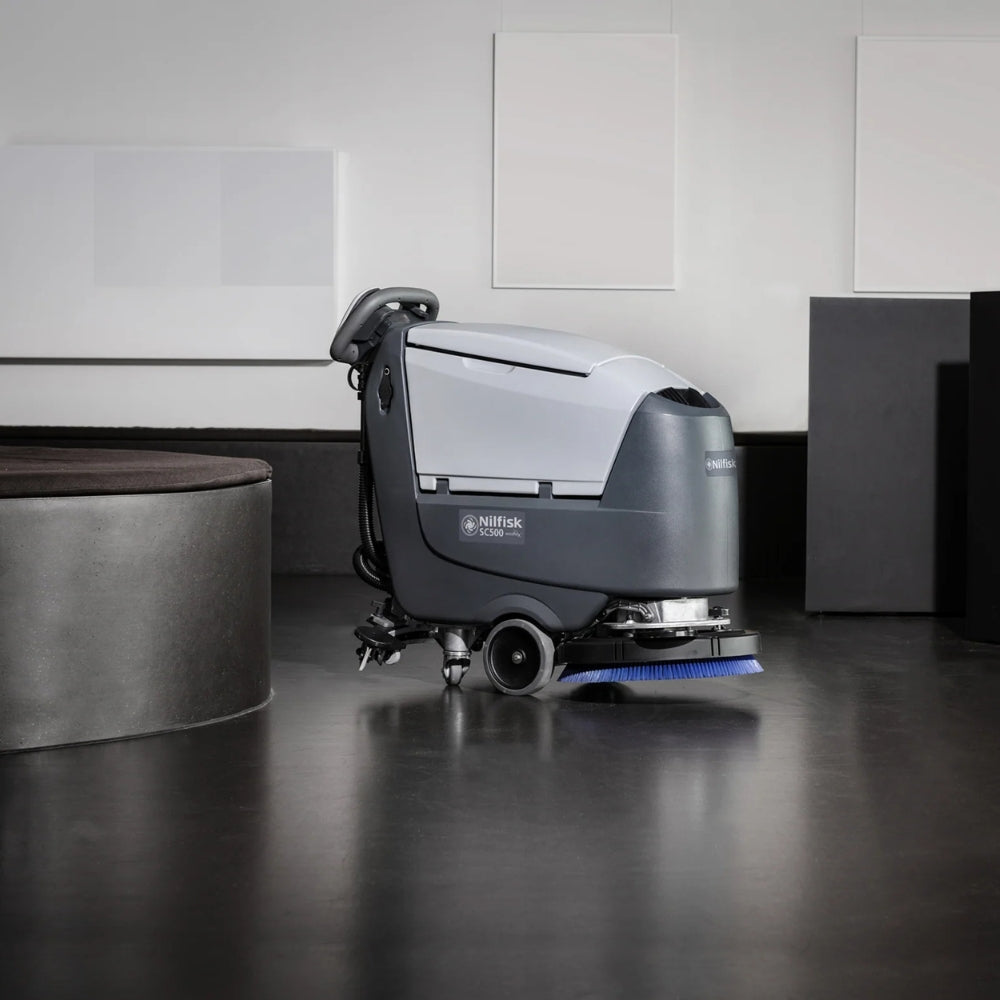
Dosing features differ by machine. Freshway's listing for the Nilfisk SC500 describes an automatic chemical dosing system on a 24 V battery walk-behind with a 510 mm scrubbing width, 40 litre solution and recovery tanks, up to four hours of runtime and a 75 kg net weight. The listing for the Nilfisk SC2000 53B describes SmartFlow, which adjusts water and detergent flow to the machine's speed. Speed-linked systems need the catch test run at normal working speed, not standing still.

When choosing chemistry for dosing systems, look for low-foam products labelled for autoscrubbers in Freshway's Agar floor cleaners and Freshway floor cleaners, and compare machines in the floor scrubbers range.
Frequently asked questions
Is an automatic dosing system set and forget?
No. Filters block, settings change and pumps wear, so the delivered dose can drift without anyone noticing. A monthly catch test confirms it.
Surely a bit more detergent cleans better?
Not on a scrubber. Overdosing can cause foam in the recovery tank, streaks and sticky floors that attract soil faster.
Can any operator fix the dose if it looks wrong?
Better not. Limit adjustments to trained staff, use only the approved control, retest and record the change.
Does a speed-linked system need testing too?
Yes. Run the test at normal working speed, because the delivered amount changes with how fast the machine moves.
Next steps with Freshway
Put a measuring cylinder and record sheet with each machine and run the first catch test this month. If the measured ratio keeps drifting, book a service; Freshway can also help match low-foam chemistry to your scrubbers.