When to Add a Second Commercial Vacuum Instead of Paying Overtime
Time the vacuuming first: if crews queue for one machine, overtime is an equipment cost.
Shop now
Under the Cleaning Services Award 2020, time a part-time or casual cleaner works beyond 7.6 hours a day, five days a week or 38 hours a week is overtime. Many cleaning businesses track that line closely on the roster and much less closely on the equipment list. When two cleaners queue for one vacuum, the queue becomes overtime.
When does a second commercial vacuum beat paying overtime?
A second commercial vacuum beats paying overtime when the extra hours come from cleaners waiting for, sharing or carrying one machine rather than from a genuine increase in floor area. If vacuuming is the bottleneck on most shifts, a second unit usually pays its way; if overtime is occasional, a spare or hire is enough.
This is a business case for owners of cleaning companies. It does not compare vacuum formats in detail; for that, Freshway's guide to measuring productivity in square metres per hour covers how to time backpack and canister work. Here the question is narrower: is your overtime really a labour problem, or a machine problem?
Labour time vs machine time
Every shift has two clocks. Labour time is the hours your cleaners are paid. Machine time is the hours each vacuum is actually running. When there is one vacuum per cleaner, the clocks move together. When two or three cleaners share a machine, vacuuming becomes serial: one person waits, or does other tasks out of order, while the other vacuums.
The award itself links overtime to safety. Clause 19 of the Cleaning Services Award 2020 says that when deciding whether overtime is reasonable, any risk to employee health and safety from the extra hours must be taken into account, along with personal circumstances and the needs of the workplace. Overtime caused by a missing machine is hard to justify on any of those grounds.
Simple capacity maths without inventing wages
You do not need wage figures to see the bottleneck; you need minutes. Time a normal shift and record how many minutes of vacuuming each cleaner needs. Then compare total vacuuming minutes with the minutes each machine is available.
| Example shift (illustrative) | One shared vacuum | Two vacuums |
|---|---|---|
| Shift length | 5 hours | 5 hours |
| Vacuuming needed: cleaner A + cleaner B | 3 h + 3 h = 6 machine-hours | 3 h + 3 h = 6 machine-hours |
| Machine-hours available | 5 | 10 |
| Shortfall | 1 hour every shift | None |
| What the shortfall becomes | Overtime, rushed work or missed areas | Spare capacity for growth |
Recompute it with your own times. If the shortfall shows up most nights, convert it to cost with your own payroll data: overtime hours per week, multiplied by your overtime rate from the award tables, multiplied by the weeks the contract runs. Compare that with the price on the product page for a suitable machine plus bags and filters. Keep the calculation in a spreadsheet so you can rerun it when contracts change.
Failure and downtime buffers
One vacuum per crew has no slack. A torn hose, a full bag with no spare or a motor fault turns into a lost shift or a late finish. A second unit is also your breakdown cover. Plug-in equipment that is moved between sites wears faster, and SafeWork NSW's page on electrical inspection and testing explains that such equipment must be regularly inspected and tested by a competent person, with a record or tag kept. A machine out for testing or repair is a machine you do not have that night.

Mixed fleet vs two identical units
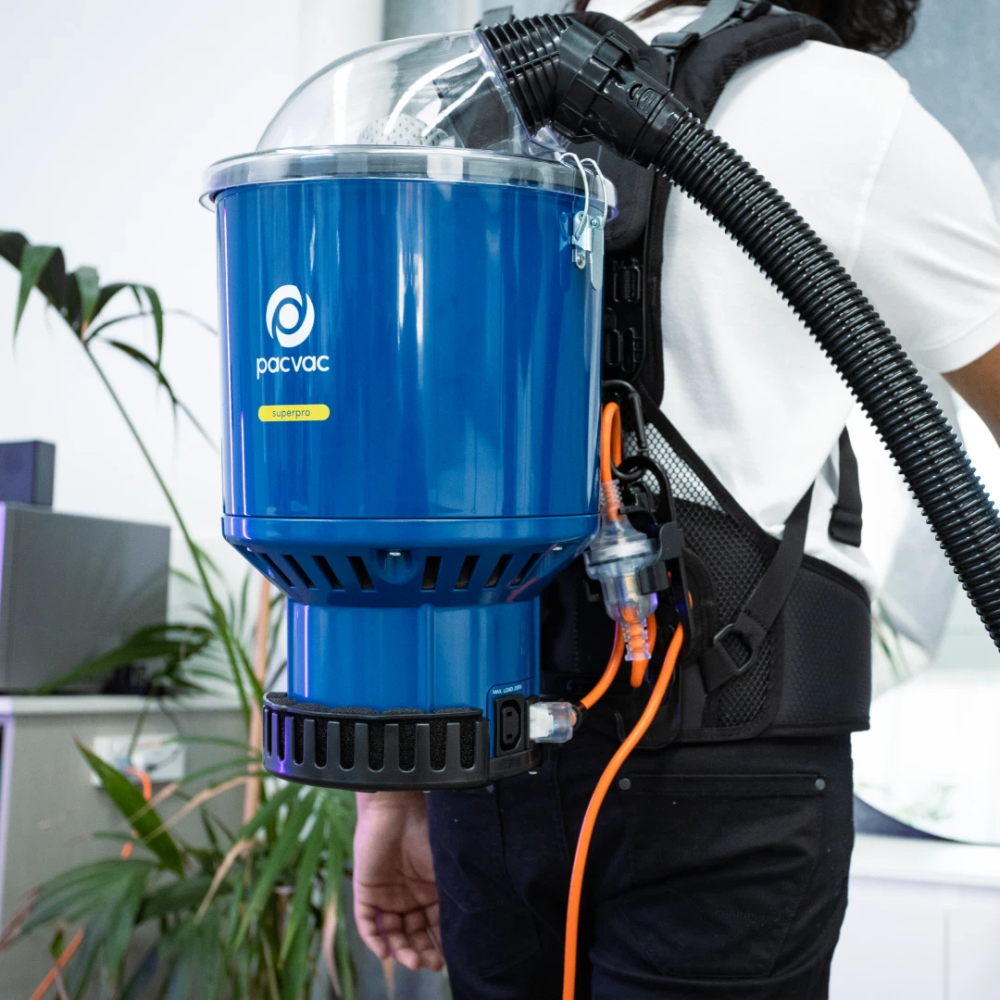
Two identical machines share bags, filters, hoses and training, so either can cover for the other. A mixed pair suits crews whose work splits into different tasks. Freshway lists the Pacvac Superpro 700 at 1000 W, 38 litres per second airflow, 22 kPa vacuum pressure, HEPA-rated filtration and 5.4 kg; the Pacvac Thrift 650 at 1300 W, 55 litres per second, an 18 metre cord and 4.8 kg; and the cordless Pacvac Velo Go with two 18 V lithium-ion batteries, a 2.5 litre capacity and 4.5 kg including batteries. A corded unit for open floors plus a cordless unit for stairs and lifts can remove both the queue and the time spent moving leads.

Browse the full backpack vacuums range and the Pacvac backpack vacuums collection, or the barrel and canister vacuums if your second unit is for wet pick-up or long corridors.
Site distance and van loading
On multi-site runs across Sydney, travel time eats into the shift before any vacuuming starts. Carrying one machine between floors or buildings adds more. WorkSafe Victoria's safer way to clean: vacuuming sheet suggests providing a vacuum cleaner on each level of a multi-level building, or in each area to be vacuumed, to reduce lifting and carrying. A second unit left on a large site, rather than carried in and out each night, can save both time and backs.
Long days compound the effect. SafeWork NSW's page on fatigue lists physically demanding or monotonous work, shift and night work and long commuting times among its causes, so routes that already include driving are the worst place to add overtime.
Trial week before buying
- Pick the site with the most recurring overtime.
- Record vacuuming start and finish times for each cleaner for one week with the current setup.
- Add a second machine, borrowed, hired or from another crew, for the following week.
- Record the same times, plus finish time and any missed areas.
- Compare overtime hours, finish times and complaints between the two weeks.
- Decide on a purchase only if the difference repeats across most shifts.
Signs you are under-equipped
- Cleaners do tasks out of sequence while waiting for the vacuum.
- Finish times vary widely depending on who got the machine first.
- Bags are changed mid-shift because there is no time to empty between areas.
- A single breakdown cancels a night's vacuuming.
- Overtime clusters on the same sites every week.
WorkSafe Victoria's injury hotspots for cleaning lists backpack vacuum cleaners among the mechanical aids that reduce lifting and handling, and recommends job rotation so workers are not on repetitive tasks for long periods. Rotation only works when there are enough machines to rotate.
Decision checklist for owners
- Is the overtime recurring and tied to vacuuming, not to extra scope?
- Does the trial week show a repeatable drop in overtime or finish time?
- Will the second unit share consumables with the first?
- Can it stay on a large site instead of travelling?
- Is there a plan for testing, tagging and servicing both units?
If most answers are yes, buy. If not, a spare kept at the depot may be enough. Trade customers can set up purchasing through Freshway's B2B and trade account page.
Frequently asked questions
Quick check: is overtime always a staffing problem?
No. If cleaners are waiting for one shared machine, the bottleneck is equipment, not people.
Quick check: identical units or a mixed pair?
Identical units share parts and training. A mixed pair suits crews with clearly different tasks, such as open floors and stairs.
Quick check: how long should a trial run?
At least one normal week with the current setup and one with the second machine, timed the same way.
Quick check: do I need wage figures to decide?
Not to find the bottleneck. Use timed minutes first, then apply your own payroll rates to the overtime hours.
Next steps with Freshway
Time one site for a week, find the machine-hour shortfall and then choose the second unit to match the work. Freshway's team can help compare backpack and canister models and the consumables they share; contact the team with your crew size and site mix.