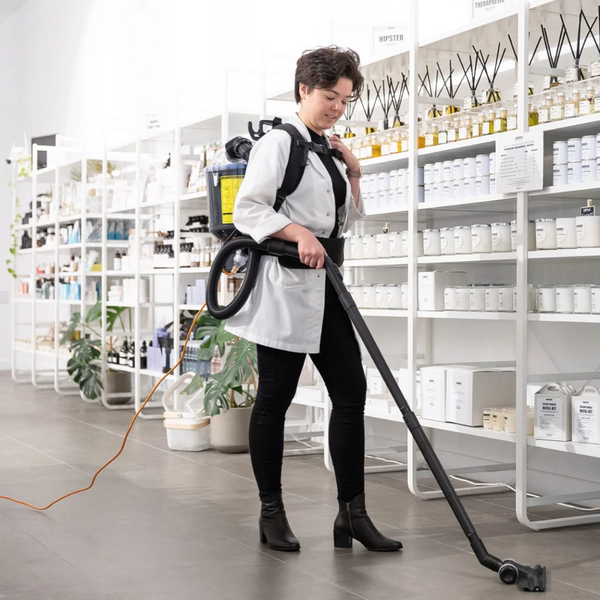
A carpet that is still damp when the doors open is an operational problem, not a cosmetic one. Damp pile re-soils faster, traffic lanes grey out again within a day, and moisture held in the backing keeps slip complaints, odour and mould risk alive long after the machine is packed away. Knowing how to reduce carpet drying time starts with how much water you put into the carpet, how much you take back out at the wand, and how quickly moving air reaches the full width of the area rather than the strip you happen to be standing on.
How to reduce carpet drying time: what keeps a commercial carpet wet?
The backing and underlay hold the moisture, not the pile.

The pile dries first and looks finished while the backing and underlay stay damp underneath, so recovery at the wand and airflow across the whole area decide the real drying time.
In spray extraction, water travels through the pile, into the backing, and back out through the wand head. The pile releases water quickly because air can reach it. The backing and underlay release it slowly, and they sit on a subfloor that cannot absorb it. If the wand leaves the backing saturated, more blowers will not fix it, because the water is no longer where the airflow is.
Two site conditions stretch drying time further. Wicking draws moisture up from the backing with dissolved soil, so a carpet that looked even while wet dries with brown patches along joins. Restricted airflow does the same in windowless rooms, corridors with closed fire doors and areas where ceilings or service voids trap humid air.
Match the process to fibre, backing and soil
Fibre type changes how much water a carpet accepts, how fast it releases it and how much agitation it tolerates. Solution-dyed and synthetic loop piles are the most forgiving on commercial sites. Wool and wool blends hold more moisture, release it more slowly, and are more sensitive to pH and aggressive agitation. Cut pile shows wand marks and pile distortion more readily than a tight loop, and carpet with a jute or other natural backing needs a far more controlled approach than one with a synthetic backing.
Soil load is the other half. A lightly soiled, day-cleaned office needs a light prespray and a rinse, not a heavy detergent build-up. A food service or entry area with grease and tracked-in grit needs the soil suspended before extraction, or the passes that follow spread it. The practical method is a documented process per carpet type: prespray, dwell, agitate where the fibre allows, extract with overlapping passes, then dry, with a test patch first wherever the carpet or backing is unknown.
Control moisture, recovery and drying time
Recovery is the part operators control most directly, and it is where most drying time is won or lost. Extraction works because the wand head seals against the carpet, the vacuum lifts water into the recovery tank, and the operator moves at a speed that lets the vacuum do that work before the head moves on. Rushing the wand leaves water behind; moving too slowly lets the head stall and the tank fill without lifting more water from the backing.
Four habits tighten recovery on commercial work:
- Overlap each pass by half a wand width so no strip is missed and the return pass lifts what the first pass loosened.
- Follow every wet pass with dry passes over the same line to pull leftover water out of the pile without adding more.
- Empty the recovery tank before the vacuum starts losing lift, rather than after the water carries over.
- Watch the wand head angle so the front and rear lips stay in contact across the head.
Drying then depends on air movement. Air movers create a fast-moving boundary layer over the carpet; spaced around the area, that layer carries humid air away and the carpet dries evenly. Aimed at one spot, the carpet under the blower dries first while the edges of the room stay damp, and the area cannot be released.
Chemistry, residue and test patches
Residue is the quiet cause of callbacks. Detergent left in the pile is sticky, it attracts soil from the first foot traffic, and the carpet looks tired again within days. The cleaner approach on commercial work is to separate the two jobs chemistry actually does: a prespray that breaks down and suspends soil, and a rinse that flushes the loosened soil and chemical out of the fibre. Treating one product as both usually means overdosing.
Dose to the label and to the soil load rather than to habit. Dilution stronger than specified does not clean proportionally better, and on wool it can dull the pile as well as leave more residue behind. Acidic, neutral and alkaline products suit different soils and fibres, and the safety data sheet for each product carries the dilution, contact time and personal protective equipment the label expects. Where a site stores chemicals, keep the SDS library current so the dilution in use matches the sheet the operator holds. The Carpet and Rug Institute guidance on carpet cleaning sets out the same principle from the manufacturer side: use the chemistry as specified, and remove it again.
Test patches are not a formality. They confirm colourfastness, show whether the fibre distorts under agitation, and show how the carpet dries in that specific location. Run the patch through the full process, chemistry included, then inspect it before the crew builds a method around it.

Wands, hoses and operator ergonomics
A wand head that is too wide for the machine's airflow produces a weak seal at the edges, so the outer centimetres of every pass come up wetter than the middle, while a head that is too narrow is simply slower across long corridors and open plan floors.
Hoses work the same way: every extra metre and every added bend costs airflow, and worn cuffs or stretched couplings leak vacuum and reduce recovery across the whole job. Ergonomics follow the same logic. A tired operator shortens strokes, skips dry passes and leaves the head at the wrong angle, which is how moisture stays in the backing, so splitting long areas into manageable sections protects the standard of the last hour of the shift.
Which electrical and slip controls are needed before the machine goes on?
Supply capacity, lead management and wet-area control.
Confirm a circuit that can carry the extractor and the air movers, keep leads and connections out of the wet path, and cordon and sign every damp area until the carpet is dry to touch, not just dry in the middle.
Spray extraction and drying equipment both draw real current, and adding air movers to the same circuit as the extractor is a common way to trip a board halfway through a floor. Check what else is on the circuit, use the shortest lead that reaches the work, keep the lead run out of standing water, and protect the supply with an appropriate residual current device. Australian work health and safety duties require the risks of the task to be managed, and the Work Health and Safety Regulations 2011 set out the framework that site procedures sit inside.
Wet carpet is a slip hazard, and the risk does not stop at the edge of the cleaned area. Signage and barriers need to cover entry points, lift lobbies and any route leading onto the damp surface, and they stay in place until drying is complete. WorkSafe Victoria's guidance on slips, trips and falls is a useful reference when writing the site method, and SafeWork NSW publishes general hazard management material through the SafeWork NSW regulator site. Leaving signage in place until the area is genuinely dry protects both the public and the crew.
How do you measure the result after the carpet dries?
Inspect the dried carpet, not the damp one.
Walk the area once the pile is dry to touch and look for wicking, brown-out along seams, standing pile and odour, because soil or moisture that reappears after drying was never fully removed in the first place.
A wet carpet hides almost everything. Freshly extracted pile looks uniform, seams disappear, and light reflects evenly off the surface. The inspection that matters happens after drying, when wicking shows as browning along joins, wand marks appear as bands across the pile, and over-wetting shows as a crinkled backing or a rippled edge against the skirting.
Build the check into the job rather than leaving it to a complaint. Note the areas cleaned, the method used, the drying equipment deployed and the time the area was released, then inspect the same areas after drying. Where a patch has wicked or the pile has distorted, the cause is usually one of four things: too much water at the wand, too little recovery, inadequate airflow in that specific area, or chemistry too aggressive for the fibre. The IICRC S500 standard for water damage restoration sets out the underlying principle: moisture decisions should be based on measurement and observation, not on appearance.
How to Reduce Carpet Drying Time Across Australian Sites and Seasons
Airflow, room conditions and access decide the schedule.
The same machine and method can dry one area quickly and leave another damp for hours, because humidity, air conditioning and how long the area can stay closed vary between sites and between seasons.
Humid summer conditions slow evaporation, particularly in coastal locations, while air-conditioned buildings can dry a carpet faster during the day than in the evening when the plant shuts down. Rooms with no external wall, internal corridors, basements and areas above a cold slab all behave differently from a glazed foyer. Sealed rooms need air movement and moisture removal; spaces with constant foot traffic need the work sequenced around that traffic, or the carpet is being re-soiled as it dries.
That is why a single drying routine rarely transfers between buildings. Plan the sequence as part of the quote: which areas close, for how long, where the air movers go, whether a dehumidifier is needed for enclosed rooms, and who releases the area back to normal use. Where a building cannot close an area, working in smaller sections and drying each one is usually better than cleaning the whole floor and hoping the airflow keeps up. Air mover manufacturers publish placement and airflow guidance for their own equipment, including XPOWER's technical product information, and this guide to sizing and running air movers and carpet dryers covers the site side of the same decision. If you are still weighing methods, this comparison of extraction, encapsulation and dry cleaning sets out where each one fits.

What to settle before ordering equipment
Once the method is agreed, the equipment list follows from it, so work through the site conditions first and let them set the specification.
- Access. Stairs, lifts, door widths and turning space decide the practical machine size and whether portable units are needed alongside a larger machine.
- Water and tank capacity. Where a tap is not close to the work, capacity and the number of refills per floor matter more than a headline specification.
- Drying equipment. Match air movers and any dehumidifiers to the areas that cannot be opened to outside air.
- Chemistry. Choose the prespray and rinse to suit the fibre and the soil, and keep the matching safety data sheets on site and current.
- Consumables and spares. Wands, cuffs, hoses, filters and brushes are the parts that fail mid-job, so plan how quickly replacements can be obtained.
- Service and support. Confirm how repairs, parts and technical advice are handled, and whether trade terms are available for repeat purchasing.
Freshway Supplies supports commercial cleaning teams across Australia from Arncliffe in Sydney, with extraction machines, air movers, chemistry and parts from the one account, and approved business customers can apply for a trade credit account with 30-day terms.
Questions we get asked most
- How long should a commercial carpet take to dry after extraction?
- There is no fixed number, because drying time depends on how much moisture is left in the backing and how fast moving air reaches the area. The practical target is a carpet that is dry to touch before normal traffic returns. Keep wand passes tight, use dry strokes to recover more water, and place air movers so air crosses the full width of the carpet rather than one patch.
- Does more detergent make a carpet dry faster?
- No. Extra detergent leaves residue in the pile, and residue attracts soil, so the carpet looks dirty again soon after it dries. Dose the chemical to the label and to the soil load, use the rinse step to flush what the prespray lifted, and confirm the dilution on the safety data sheet before the job starts. Less residue usually means a cleaner result that stays clean longer.
- Is an air mover or a dehumidifier better for drying carpet?
- They do different jobs, so most commercial sites benefit from both. Air movers keep the boundary layer of humid air moving off the carpet, which speeds surface drying. A dehumidifier removes the moisture from the room so the carpet is not drying into already saturated air. In closed rooms with no fresh airflow, the dehumidifier matters more than another blower.
- Do I still need to cordon off the area if the carpet looks dry?
- Yes. A carpet can look dry on the surface while the backing and underlay still hold moisture, and damp backing is where odour, wicking and slip complaints begin. Keep wet floor signage and barriers in place until the carpet is dry to touch across the whole area, not just along the main walking route. Record when the area is released so cleaning and building staff share the same expectation.
Conclusion
Faster carpet drying comes from four controls, in this order: put in less water, recover more of it at the wand, move air across the whole area, and inspect the result after the carpet has dried rather than while it is still wet. A site that rushes extraction and then adds more blowers is buying drying time, not removing moisture, and the re-soiling that follows is the cost. The decision for most commercial teams is therefore method first and machines second: decide how the area will be dried and released, confirm the chemistry suits the fibre, and keep parts and support close enough that a mid-job failure does not leave a floor wet overnight.
Compare spray extraction machines, spot extractors and the accessories that recover more water per pass in the Freshway carpet care range, or talk to the team about the method for your site.