Most residue problems on commercial carpet start with a product doing two jobs badly. A single detergent is applied as a prespray, left to dwell, worked into the pile and then used again as the rinse, and the result is a carpet that looks clean while holding a film of chemical that attracts soil from the first hour of traffic. The carpet prespray vs extraction detergent decision is really a decision about separating two tasks that a single product cannot do equally well.
This guide explains what each product is designed to do, how the two work together in one process, how to dose and dwell them properly, and how to check the result after the carpet dries rather than while it is still wet.
Carpet Prespray vs Extraction Detergent: Two Different Jobs
A prespray is a soil-suspension product. It is applied to the carpet before extraction, given dwell time to break the bond between soil and fibre, and agitated where the fibre allows it. Its job is to make the soil removable. An extraction detergent, sometimes called a rinse or an emulsifier, is designed to be metered into the machine's solution and flushed through the pile during extraction. Its job is to hold what the prespray loosened in suspension so the wand can recover it, and to leave as little residue as possible behind.
The difference matters because the two products are dosed differently, dwell differently and are judged by different outcomes. A prespray is dosed for the soil load and works on contact time. An extraction detergent is dosed for the volume of water the machine will pass through the carpet, and it is judged on how cleanly it rinses out. Using one product for both roles usually means over-dosing the fibre and under-performing on one of the two tasks.
Match the Process to Fibre, Backing and Soil
Fibre sets the chemistry. Wool and wool blends are protein fibres and are sensitive to high pH, so a wool-safe prespray and a neutral or mildly acidic rinse are the correct pairing. Solution-dyed and synthetic loop piles are more tolerant and can take stronger products where the soil requires it. Stain-resistant treatments on newer carpet add a further consideration, because overly alkaline products can strip the treatment and leave the carpet soiling more readily than before.
Backing and underlay set the moisture limits. Carpet with a waterproof or cushion backing does not release water into the underlay, which keeps the job drier; carpet glued directly to a slab or laid over porous underlay holds moisture where it is hardest to remove, so the volume of solution has to come down. The same principle applies to the rinse: better to pass less water through the pile and recover more of it than to flood the carpet and hope the wand catches up.
Soil sets the sequence. Lightly soiled, day-cleaned carpet in an office usually needs a light prespray and a thorough rinse, because the soil is fine and easily suspended. Food service, entry matting and traffic lanes with grease and tracked-in grit need a heavier prespray with real dwell time, mechanical agitation where the fibre allows, and a rinse that removes both the suspended soil and the prespray. Where soil is heavily built up, one pass will not fix it; it usually takes a second application at a lighter dose rather than one aggressive pass that leaves residue everywhere.
Which Product Should Do Which Job?
Prespray lifts the soil; the rinse removes it.
The prespray is chosen for the soil and the fibre, dosed to the label for the soil load, and given the dwell time to work; the rinse is metered into the machine for the volume of water being used, and its main qualification is that it flushes out cleanly.
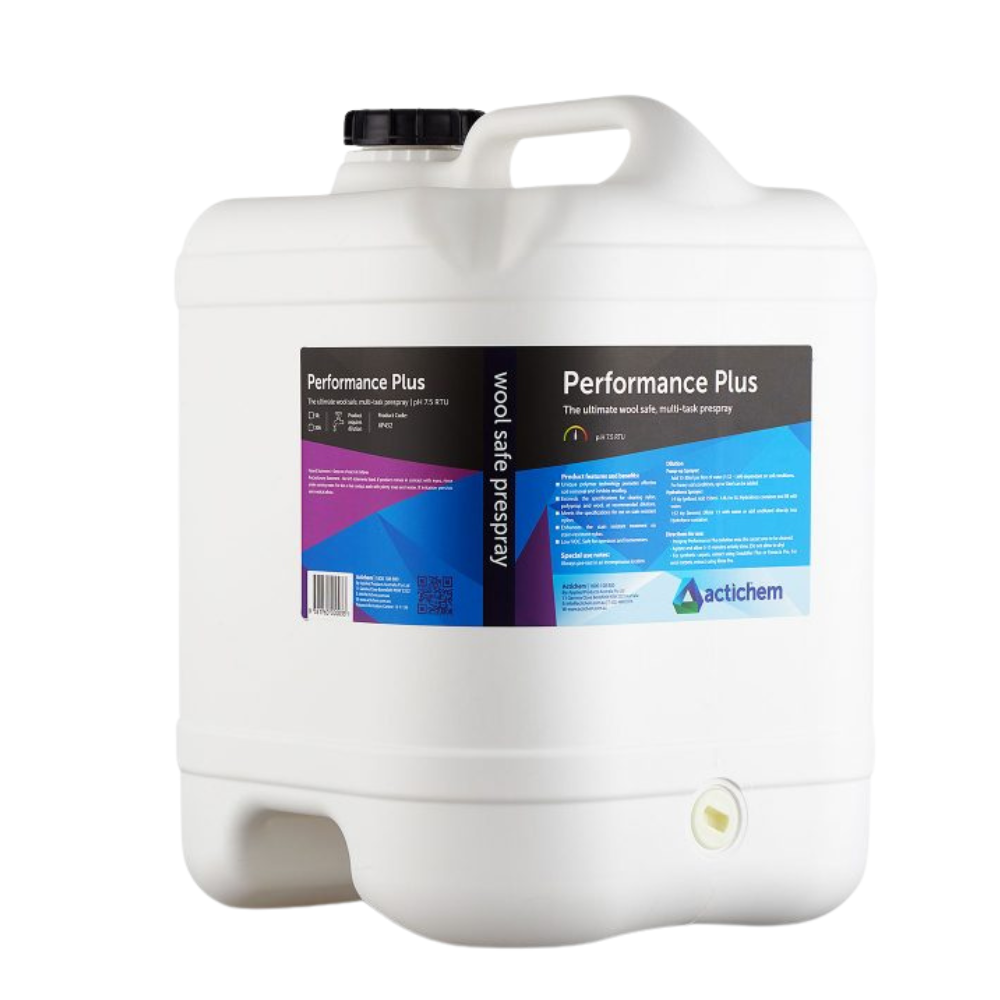
Choosing the prespray comes first, because it does the cleaning. A general multi-task prespray suits most commercial carpet and can be used across mixed fibre with the dilution adjusted. A wool-safe product is the correct choice where wool or wool blends are present, and it also suits sites where fibre composition varies from area to area and cannot be confirmed. Specialist presprays exist for olefin, for encapsulation cleaning and for heavy grease, and they are worth using where the soil genuinely calls for them rather than as a default upgrade.
Choosing the rinse is more straightforward than it is often made to feel. The requirements are that it suits the fibre, that it is neutral or mildly acidic where wool or stain-resistant treatments are involved, that it does not foam excessively in the recovery tank, and that it is dosed to the water volume rather than guessed. A neutralising rinse also helps on carpet where previous cleaning has left an alkaline residue, because it brings the fibre back towards neutral and reduces the soil attraction that comes with high pH.
What the pair should not do is double up. Where a rinse detergent is also a strong cleaning agent, the temptation is to reduce or skip the prespray, which shifts all the work onto the rinse and into the fibre. The cleanest commercial results usually come from a moderate prespray used well and a light rinse detergent used properly, not from one aggressive product used twice.

Dilution, Dwell Time and Mechanical Action
Dilution is the variable most often set by memory. Both products have a labelled dose range, and the correct point in that range depends on the soil load rather than on the operator's preference. Where a site fills a sprayer or a solution tank by eye, the dose drifts, and drift is what produces the two opposite complaints: carpets that stay dirty, and carpets that go dirty again quickly because of residue.
Dwell time is the second control. A prespray needs enough time on the fibre to break the soil bond, and that time is stated on the label. Working behind a prespray immediately, or letting it dry completely before extraction, both reduce its effectiveness, which is why the practical routine is to work in sections sized to the dwell time rather than to spray an entire floor before starting the machine. On commercial sites that means the operator leapfrogs sections, applying prespray to one area while extracting the previous one.
Residue, Rinsing and Test Patches
Residue is the reason the two-product method exists. Any chemistry left in the pile continues to work after the job is finished: it attracts soil, it can stiffen the fibre and change its appearance, and on wool it can affect the colour. Rinsing is therefore not an optional second pass; it is the step that removes the product that did the cleaning.
The practical controls are straightforward. Rinse with clean water through the machine rather than with a stronger mix, use a rinse detergent only at its labelled dose, and make enough dry passes to recover the water the rinse added. Where a site has previously used heavy detergents, an acid or neutral rinse helps reset the fibre and remove the residue left by earlier cleaning.
Test patches matter here as much as anywhere in carpet care. Run the full process - prespray, dwell, agitation where appropriate, extraction and rinse - on an inconspicuous area, then inspect it dry. What to look for is colourfastness, any change in pile texture and, most importantly, whether the patch looks even and does not re-soil faster than the surrounding carpet in the following days. On commercial contracts with identical areas, the patch also establishes the dose and dwell that should be written into the method.
Control Moisture, Recovery and Drying
The rinse step adds water, so the moisture controls that apply to any extraction job apply here: apply less than the carpet can hold, recover more than is applied, and dry the area with air movement rather than relying on time. Where a rinse is used, that means passing clean water through the pile and then making dry passes until the wand stops pulling visible water.
Drying then depends on airflow and room conditions. Air movers placed so air crosses the whole area dry the pile and the backing more evenly, and enclosed rooms benefit from a dehumidifier because the carpet cannot dry into air that is already saturated. Where the sequence includes a rinse, allowing a realistic drying window before the area is released is part of the process rather than an inconvenience at the end of it.

Measure the Result After the Carpet Dries
Inspect the dried carpet, in the areas the client actually sees. Damp pile hides residue, wicking and uneven pass marks, and the failures that matter - a greying traffic lane that reappears, a brown line along a seam, a patch that soaks up soil first - all appear after drying.
Three checks are worth building into the routine. First, evenness: compare the cleaned area with an untreated section under the same light, because a carpet cleaned with an insufficient rinse can look fine in isolation and different next to a reference. Second, re-soiling: check the same areas a few days later, which is the only honest test of whether residue is attracting soil. Third, texture and colour: look for pile distortion and any change in appearance that suggests the chemistry or the agitation was too aggressive for the fibre.
Record what worked. The product, the dose, the dwell time, the machine setting and the number of passes are the fields that make a method repeatable, and on multi-site work they are what allow a new operator to deliver the same result without re-learning the job by trial. The Carpet and Rug Institute guidance on carpet cleaning and the IICRC S500 standard both support the same principle: cleaning decisions should be based on observation and measurement rather than on how the carpet looks while wet. This overview of extraction, encapsulation and dry cleaning sets out where this process sits against the alternatives.
A Site-Trial Scorecard Before You Standardise
Before a product pair is adopted across a contract, run it on a representative area and score it against the alternatives. Keep the scorecard short enough to be filled in on site.
- Soil removal: how much of the soil is gone from a known traffic lane, compared with an untreated reference.
- Re-soiling: how the same area looks after several days of normal traffic.
- Drying: how long the area stays closed, and whether the backing is dry at release.
- Residue indicators: sticky feel, pile stiffness, visible film and any change in texture.
- Cost per area: the actual dose used, the water consumed and the operator time for the section.
- Odour and appearance: the two things occupants notice first.
Storage, Safety Data Sheets and Operator Training
Chemistry on a commercial site is a WHS issue as well as a cleaning issue. Products should be stored in their labelled containers, separated according to the site's chemical storage arrangements, with the safety data sheet available for each product and the dilution recorded. Operators should know which product is the prespray and which is the rinse, why the two are not interchangeable, and what personal protective equipment the labels require. The general framework for chemical handling sits in Australian work health and safety duties; WorkSafe Victoria's hazardous substances guidance and the material published by SafeWork NSW cover the practical expectations, inside the framework set by the Work Health and Safety Regulations 2011.
Labelling must also stay current, because a product reformulation or a change of supplier can change the dose on the label without anyone noticing the bottle looks the same.
Freshway Supplies publishes safety data sheets for the cleaning chemicals, detergents and specialty products it sells, organised by brand, so the sheet that matches the product on the shelf stays within reach of the operator. Keeping the SDS library current, and matching it to the products actually in the store, is a small routine that prevents both compliance gaps and the dose drift that follows a missing label.
Questions we get asked most
- What is the difference between a carpet prespray and an extraction detergent?
- A prespray is applied to the carpet before extraction to break the bond between soil and fibre, and it works through contact time. An extraction detergent is metered into the machine's solution and flushed through the pile during extraction to hold loosened soil in suspension and rinse cleanly out of the fibre. They are dosed differently and judged by different outcomes.
- Can I use one carpet cleaning product for both prespray and rinse?
- You can, but it usually means over-dosing the fibre or under-performing on one task. Residue left in the pile attracts soil, so the carpet greys out again within days even though it looked clean on the day. A moderate prespray used well plus a light rinse detergent used properly gives a more stable result than one stronger product applied twice.
- How long should carpet prespray dwell before extraction?
- Follow the dwell time on the label for the product and the soil load. Too short and the chemistry has not broken the soil bond; letting it dry completely before extraction also reduces performance. The practical routine is to work in sections sized to the dwell time, applying prespray to one area while extracting the previous one, rather than spraying a whole floor at once.
- Why does my carpet get dirty again so quickly after cleaning?
- The usual cause is residue: detergent left in the pile continues to attract soil after the job is finished. Other contributors are insufficient dry passes leaving moisture in the backing, and chemistry that is too alkaline for the fibre. Use the correct dose, rinse thoroughly with clean water, make enough dry passes to recover it, and compare re-soiling on a test area before changing products.
Conclusion
A prespray and an extraction detergent do different jobs: one suspends soil, the other flushes it out and leaves the fibre clean of chemistry. Using them as intended - a prespray dosed to the soil and given proper dwell, and a rinse metered to the water volume - is what stops the cycle of quick re-soiling that follows a single-product routine.
Match both products to the fibre, keep the rinse thorough, and judge the result after the carpet dries rather than while it is wet. Where a site standardises on a pair, write the dose, dwell and pass count into the method and trial it on a real traffic lane before rolling it out, so the outcome is repeatable rather than operator-dependent.
Compare carpet presprays, rinse detergents and spotting chemistry in the Freshway range, or ask the team which pairing suits your fibres and soil loads.