Entry-Level vs Mid Commercial Scrubbers: Spec Fields That Matter
Buy the tank size your floor needs, not the path width on the brochure.
Shop now
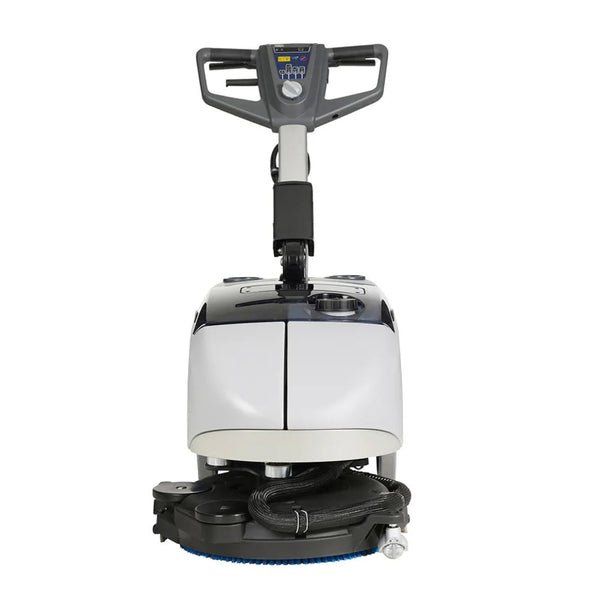
Four litres against forty. Freshway's listing for the Kärcher BR 30/4 C gives it a 4-litre fresh-water tank. The listing for the Nilfisk SC500 gives it 40 litres. Both are walk-behind machines from the same floor scrubbers range, and both are sold for commercial work. That tenfold gap in water says more about which tier a machine belongs to than its brush width does.
For a buyer, the tank decides how often the operator stops, and the stops decide how much floor gets done in a shift. This guide sets out the spec fields that move a machine from entry level to mid range, using figures from Freshway product pages, so a first purchase does not turn into a second one within a year.
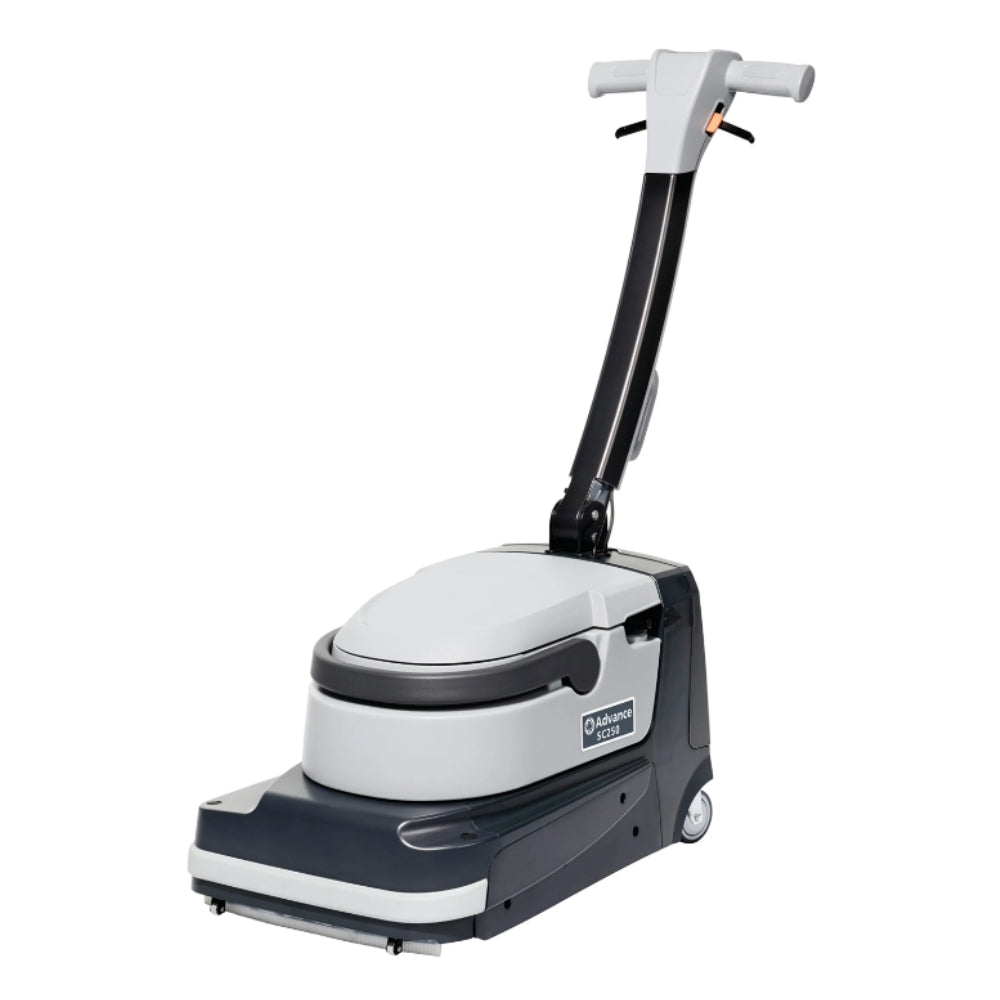
Entry level commercial floor scrubber: the short answer
An entry level commercial floor scrubber suits floors you can finish on one or two tank fills: cafés, washrooms, small retail and classrooms. Move to a mid-range machine when refills, battery runtime or brush width start setting the finish time. Compare tank litres, power source, runtime, path width and local service before price.
In this guide, "entry" means compact machines with solution tanks of about 3 to 12 litres and cleaning paths of 30 to 41 cm. "Mid" means walk-behinds with 30 to 50 litre tanks and paths of 43 to 61 cm. Those bands come from the Freshway listings quoted below, not from an industry standard, and a few machines sit between them. The Hako Scrubmaster B12, for example, is listed with a 38 cm path, a 16-litre solution tank and a 22-litre recovery tank.
If you are new to the category, Freshway's commercial floor scrubber buying guide covers site testing, documentation and quotations. This article stays on one question: which tier to buy first.
Must-have vs nice-to-have
Separate the features you cannot work without from the ones that make a good machine easier to live with. Entry machines usually cover the first list. Mid machines add more of the second.
- Must-have: scrub and dry in one pass. SafeWork NSW lists cleaning products and methods, and spills of liquids such as water, among the common sources of slip risk. A machine that leaves the floor wet behind it creates the hazard you are paying to remove.
- Must-have: a tank that covers the area on one or two fills, so the operator is not walking back to a tap every few minutes.
- Must-have: a power source that suits the building, including where the machine is stored and charged overnight.
- Nice-to-have: onboard detergent dosing. Nilfisk Australia's Ecoflex page describes water-only, ultra-low detergent, standard detergent and burst-of-power modes, with a green, low-flow, detergent-free default at start-up.
- Nice-to-have: a quiet mode. Freshway lists the Nilfisk SC550 at 65 dB(A) normally and 59 to 61 dB(A) in silent mode.
- Nice-to-have: reverse scrubbing. The Nilfisk SC351 listing describes forward and backward scrubbing and drying from a rotating deck.
A common pattern with first purchases is paying for the extras and under-buying the tank.
Tank sizes: the field that sets your stops
Across Freshway's walk-behind listings, solution tanks run from 3 litres on the Nilfisk SC100 to 50 litres on the SC550. In between sit the Kärcher BR 30/4 C at 4 litres each way, the Nilfisk SC250 at 6 and 6, the SC351 at 11.5 and 11.5, the SC401 at 30 and 30 and the SC500 at 40 and 40.
No listing tells you how many square metres one tank covers, because that depends on the flow setting, the soil and the floor. So measure it. On a trial, note the area cleaned before the recovery tank needs emptying, then divide your total floor by that figure. As an illustration only: if a trial covers 150 m² per fill and the site is 900 m², that is 900 ÷ 150 = 6 fills per clean. Six trips to the cleaner's sink on every shift is the clearest sign you are looking at the wrong tier.
Nilfisk Australia's ride-on scrubber page makes the same point for its larger machines: a bigger recovery tank means fewer interruptions.
Drive and traction
Weight climbs quickly between the tiers. Freshway lists the Kärcher BR 30/4 C at 11 kg empty and the Nilfisk SC100 at 12 kg empty. The SC250 is 25 kg including its battery. The SC500 is listed at 75 kg net, and the Hako B12 at 80 kg filled, including the battery.
Water adds to that. A litre weighs about a kilogram, so a full 40-litre solution tank puts roughly another 40 kg on an SC500. Whether that weight is pushed by the operator or driven by the machine matters on ramps, long corridors and lift thresholds. Many listings do not state the drive type, so ask before you order for a site with slopes.
Battery options
The mid machines quoted here are battery powered, and several entry machines are too. The power notes differ in useful ways:
- The SC250 runs on a lithium-ion battery, and the SC351 on a maintenance-free lithium battery with an onboard charger.
- The SC401 has a maintenance-free battery with an onboard charger.
- The SC500 uses a 24 V battery system with a listed runtime of up to 4 hours.
- The Cleanstar MIRA 40 comes with two 36 V lithium-ion batteries of 13 Ah each, which works out at 2 × 36 × 13 = 936 Wh of nominal capacity.
Corded entry machines avoid charging altogether. The Nilfisk SC100 is a 230 V corded machine, and the Kärcher BR 30/4 C has a 12-metre cable. Check the load on bigger corded models: the Kärcher BR 40/10 C is listed at 2,300 W, about 9.6 A at 240 V (2,300 ÷ 240), close to what a standard 10 A outlet supplies.
Chargers and leads used around water also need checking. SafeWork NSW's electrical inspection and testing guidance says plug-in equipment used where moisture or mechanical damage is likely must be regularly inspected and tested by a competent person, with AS/NZS 3760 setting out the methods. For the full battery-versus-cable trade-off, read Freshway's guide to battery vs corded floor scrubbers.
Brand support and parts
Before choosing a brand, ask three things: who stocks squeegee blades, brushes and pads; how long a battery replacement takes; and who repairs the machine locally.
Freshway's Service & Repairs page lists floor scrubbers, polishers and sweepers among the equipment its Sydney workshop handles, including drive faults, battery issues, water recovery problems and control board faults. It names Kärcher, Pacvac, Nilfisk, Numatic, Kerrick, Makita and DeWalt among the brands its technicians work on, gives a quote before work starts and lists a 30-day repair warranty for the same issue. For brands outside that list, confirm parts and service before you order.
Upgrade path
Tennant Australia's guide to choosing a scrubber fleet argues for a mix of machines rather than one, matching machine size and type to each zone. That suits a growing cleaning business:
- Start compact. Buy an entry machine for washrooms, cafés and small retail floors that are done in one or two fills.
- Add a mid walk-behind when corridors, halls or supermarket aisles start needing several refills per clean.
- Keep the compact machine for tight spots once the bigger machine arrives. It does not become redundant.
- Look at ride-on or autonomous machines for large open floors. Freshway's range includes the Nilfisk SC2000 micro ride-on and the Liberty SC50 and SC60 autonomous scrubbers.
The trigger to move up a tier is practical: the operator is stopping more often than the floor needs, or the battery runs out before the area is finished.
Spec-sheet fields to check on a floor scrubber
The figures below come from Freshway product pages. Productivity is the theoretical maximum each listing gives.
| Field | Entry examples | Mid examples | What to ask |
|---|---|---|---|
| Cleaning path | 30 cm (BR 30/4 C), 34 cm (SC250), 37 cm (SC351) | 43 cm (SC401), 51 cm (SC500), 51 or 61 cm (SC550) | Will it fit between desks, stalls and shelving? |
| Solution / recovery tank | 4 / 4 L, 6 / 6 L, 11.5 / 11.5 L | 30 / 30 L, 40 / 40 L, 50 / 50 L | How many fills does your floor need? |
| Power | 12 m cable (BR 30/4 C); lithium-ion (SC250, SC351) | Onboard charger (SC401); 24 V, up to 4 hours (SC500) | Where will it charge, and for how long? |
| Brush deck | Cylindrical (BR 30/4 C, SC250) | Cylindrical CYL 51 or disc D 61 (SC550) | Does the floor have grout or loose debris? |
| Listed noise | 66 dB(A) (SC250), 65 dB(A) (SC351) | 66 dB(A) or less (SC500); 59 to 61 dB(A) silent (SC550) | Will you clean while the site is occupied? |
| Productivity | Up to 1,438 m²/h (SC250), 1,360 m²/h (SC351) | Up to 2,330 m²/h (SC401), 2,550 m²/h (SC550 CYL 51) | How much of that survives turns and refills? |
Read the productivity row with care. On a 1,000 m² floor, the SC250's theoretical rate gives about 42 minutes (1,000 ÷ 1,438 = 0.70 hours) and the SC401's about 26 minutes (1,000 ÷ 2,330 = 0.43 hours). Neither figure allows for turns, obstacles or refills, so use them to compare machines, not to roster staff.
On the brush row, Tennant Australia says cylindrical brushes pick up loose debris as they scrub, so there is no pre-sweep, and they suit grout, natural stone and studded rubber safety floors. Disc brushes need the floor swept first and suit flat surfaces such as vinyl tile, sheet vinyl and polished concrete.

Common mistakes to avoid
- Comparing path widths and ignoring tank size.
- Rostering staff from theoretical m²/h figures.
- Forgetting the charging spot. A battery machine needs an outlet in the store room and time on charge between shifts.
- Buying a disc machine for grouted tiles or studded rubber without a trial on that floor.
- Leaving the edges wet. WorkSafe Victoria says wet and slippery floors are among the most common causes of slips, trips and falls, so keep signage in the kit even with a scrubber dryer.
- Skipping a trial on your own floor, which answers the tank and traction questions faster than any spec sheet.

Frequently asked questions
What is a good first floor scrubber for a cleaning company?
A compact walk-behind with a 30 to 37 cm path and a tank that finishes your typical job in one or two fills. Choose the power source next, then trial the machine on your own floor.
How big should the tank be on a commercial floor scrubber?
Big enough to finish the area in one or two fills. Time a trial fill on your floor, then divide your total area by the square metres cleaned per fill.
Is a battery floor scrubber worth it for a first machine?
Battery machines take the cord off the floor but need a charging spot and charging time. Corded compact machines suit short jobs close to outlets.
Should I choose a disc or cylindrical brush scrubber?
Tennant Australia says cylindrical brushes pick up loose debris and suit grout and studded rubber floors, while disc brushes need pre-sweeping and suit flat vinyl and polished concrete.
Next steps with Freshway
Write down your largest floor area, the floor types, where the machine will be stored and the hours you can clean. Then shortlist one entry and one mid machine from the floor scrubbers collection and ask Freshway's Arncliffe team to confirm drive type, parts and service for both. Check each product page for current pricing. If you buy for a cleaning business, the Freshway B2B and credit account page explains 30-day payment terms for approved accounts.